

Legal teams inside companies face growing pressure to handle more contracts, reduce risk, and speed up workflows. Agentic AI for in-house legal teams offers a new way to meet these demands. It moves beyond simple text generation to actively managing multi-step legal tasks. This technology can help legal departments reduce burnout, improve accuracy, and deliver faster results. Understanding agentic AI’s current capabilities and future potential is critical for legal, operations, and tech leaders aiming to keep their teams competitive.
TL;DR
Autonomous by design, agentic AI undertakes complex legal workflows that extend well beyond mere text generation.
While current generative AI tools facilitate drafting and legal research, they do not exhibit comprehensive reasoning capabilities.
By orchestrating the entire contract lifecycle, agentic AI enhances both operational speed and precision.
Legal teams reduce manual workloads through this technology, allowing greater focus on high-level strategic priorities.
Future developments will likely see this technology deeply embedded within enterprise systems, transforming it into an active partner for legal departments.
The tangible advantages of this technology commonly emerge via contract management software that integrates advanced AI features.
Related Article: What the 2026 State of Contracting Report Reveals About AI
What Is Agentic AI and How Does It Differ from Generative AI?
Artificial intelligence has evolved significantly from rule-based systems to the sophisticated neural networks that underpin current generative technologies. Additionally, generative AI systems create content in response to prompts, handling tasks such as drafting contract clauses or summarizing case law. It excels at producing text but does not plan or execute complex workflows on its own.
Agentic AI takes this a step further. It acts autonomously, pursuing goals across multiple steps without constant human input. Think of it as a virtual legal assistant that can remember context, analyze information, and take action toward completing legal tasks. For example, instead of just generating a contract draft, agentic AI can review the draft, flag risky clauses, suggest alternatives, and route it for approval.
This shift from content generation to autonomous action is crucial for legal teams. It means AI can handle repetitive, multi-step processes like contract lifecycle management (CLM) with minimal supervision. Agentic AI uses domain-specific knowledge embedded in its training data and instructions, enabling it to work within legal frameworks accurately.
Early agentic AI models focused on simple tasks, but today’s versions can manage complex workflows involving multiple documents, stakeholders, and compliance checks. They combine natural language processing, machine learning, and rule-based logic to reason through legal scenarios.
Related articles: How Does AI Limitations Impacting Contract Management?
Why Agentic AI Matters for In-House Legal Teams Today
Legal departments are increasingly burdened by expanding contract volumes alongside complex compliance mandates. Manual contract review and management consume significant time and resources. This often leads to bottlenecks, increased risk, and employee burnout.
Agentic AI automates numerous routine tasks, liberating legal professionals to prioritize more strategic activities. Its capabilities encompass a broad spectrum of functions. For instance, it can extract critical data and metadata embedded within contracts with precision. Additionally, the system identifies clauses that may introduce risk or deviate from the organization's established policies. It also proposes alternative language consistent with the company’s legal playbooks. Beyond clause-level analysis, agentic AI monitors contract milestones, providing alerts to ensure timely compliance with obligations. Furthermore, it streamlines contract approval workflows by automating routing processes and dispatching timely reminders.
By consolidating these varied functionalities, agentic AI significantly improves accuracy while reducing the time required for contract processing cycles. Moreover, it also enforces consistency by applying uniform standards and templates.
For example, a legal team using agentic AI might upload a batch of vendor contracts. The AI extracts payment terms, renewal dates, and compliance risks. It then flags contracts needing further review, suggests fallback clauses, and routes them for approval. The team spends less time on manual review and more on negotiation strategy.
According to a 2025 report on AI adoption in legal departments, nearly 70% of in-house teams already use some form of AI. Most rely on generative AI for drafting or research. Agentic AI adoption is growing as teams realize its potential to handle end-to-end contract processes.
Related articles: Agentic AI in Legal: 5 Effective Ways Lawyers Use Agentic AI
How Agentic AI Works in Contract Lifecycle Management
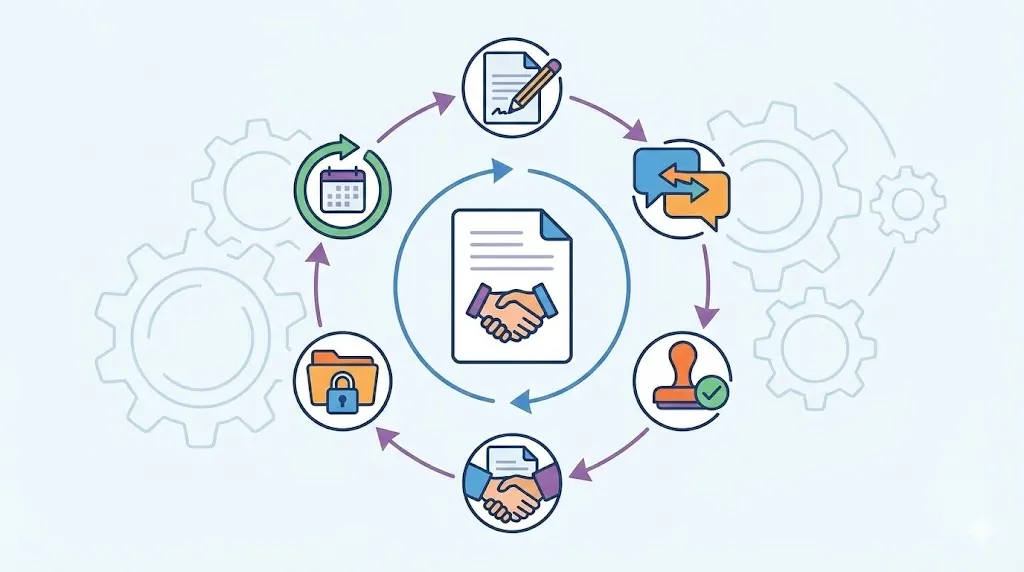
Contract lifecycle management involves multiple stages: contract creation, negotiation, approval, execution, and post-signature management. Additionally, each phase presents distinct challenges and potential risks.
Agentic AI enhances every step by automating complex tasks while delivering actionable insights:
Contract Creation
Generating initial drafts from approved templates and clause libraries, the system ensures contracts adhere to company policies and legal standards. It also customizes clauses according to specific deal terms or jurisdictions.
Contract Review and Negotiation
The AI reviews contracts for risky language, missing clauses, or unusual terms. It highlights these issues and suggests fallback options. During negotiation, agentic AI tracks changes and comments, helping legal teams stay organized and responsive.
Approval Workflow
The contract moves through a structured sequence of multi-level approvals designed to ensure compliance and thorough review. Automated reminders and escalation protocols prevent delays, facilitating smooth progression through workflows.
Execution
Supporting electronic signature integration, the AI confirms that contracts are properly executed and subsequently archives them in a secure repository with full version control.
Obligation Management
Post-signature, agentic AI monitors contract deadlines, renewal dates, and compliance obligations. It sends alerts to responsible parties to prevent missed commitments.
By managing these stages autonomously, agentic AI reduces manual effort and risk. It also provides legal teams with dashboards and analytics to track contract performance and identify bottlenecks.
Related articles: Can AI Replace Lawyers? Exploring the Future of Legal AI
What Legal Teams Should Know About Agentic AI Limitations and Risks
While agentic AI offers many benefits, legal teams must understand its limitations and risks:
Data Quality Matters
Agentic AI depends on high-quality, vetted data for training. Poor or outdated data, on the other hand, increases the risk of generating inaccurate recommendations or overlooking critical risks.
Human Oversight Remains Essential
AI should assist, not replace, legal judgment. Complex or novel legal issues require human review.
Security and Privacy Concerns
Contract data is sensitive, so AI systems need to adhere to data protection regulations while implementing rigorous security measures.
Bias and Compliance Risks
AI models can inherit biases from training data. It is imperative for teams to vigilantly detect any unintended discrimination or deviations from legal compliance standards.
Integration Challenges
Agentic AI works best when integrated with existing contract management, ERP, and CRM systems. Poor integration can limit effectiveness.
Legal leaders must establish comprehensive governance frameworks governing AI deployment. This entails setting clear approval workflows, maintaining detailed audit trails, and ensuring ongoing model performance assessments. Equipping legal staff with thorough training on AI's capabilities and limitations remains indispensable.
Related articles: How to maintain ethically use AI in Legal Operations
What’s Next for Agentic AI in Legal Departments?
The future of agentic AI in legal teams involves deeper integration, smarter automation, and proactive risk management.
Proactive Legal Assistants
Agentic AI will evolve from reactive tools to proactive partners. It could monitor regulatory changes, suggest contract updates, and forecast legal risks before they arise.
Cross-Functional Collaboration
AI will bridge legal, procurement, finance, and sales teams by providing shared contract insights and automating cross-department workflows.
Natural Language Understanding Advances
Improved AI models will better understand complex legal language, enabling more accurate contract analysis and negotiation support.
Customization and No-Code Automation
Organizations can configure AI workflows without coding, tailoring automation to specific business needs.
Ethical and Transparent AI
Adopting AI systems that provide clear audit trails and articulate the rationale behind recommendations will become indispensable within legal operations.
According to Gartner, by 2027, 80% of large enterprises will deploy agentic AI for legal and compliance tasks, up from less than 10% today. This shift will reshape how in-house legal teams operate.
Related articles: Customized AI Powers End-to-End CLM for Legal Departments
5 Ways Agentic AI Reduces Legal Team Burnout
Legal professionals often face heavy workloads and tight deadlines. Agentic AI can ease this pressure in several ways:
Automates Repetitive Tasks: Routine contract review, data extraction, and approval routing become hands-off processes.
Speeds Up Workflows: By accelerating contract turnaround times, AI helps prevent backlog accumulation and mitigates the pressure of last-minute deadlines.
Improves Accuracy: It minimizes human errors that typically lead to rework, thereby reducing stress within legal teams.
Provides Actionable Insights: Through intuitive dashboards that emphasize key priorities, teams can direct their attention to the most critical legal matters.
Enables Strategic Focus: With less time on admin, lawyers can concentrate on negotiation and risk management.
Legal leaders should view agentic AI as a tool to improve employee well-being and retention.
Related articles: AI Contract Review vs. Human Lawyers: Speed, Accuracy & ROI
3 Challenges in Deploying Agentic AI for Legal Teams
Deploying agentic AI is not without hurdles. Teams face these common challenges:
Data Preparation: Cleaning and structuring contract data for AI training requires time and expertise.
Change Management: Legal staff may resist new technology or lack AI skills. Training and clear communication are vital.
System Integration: Connecting AI tools with existing contract repositories and business systems can be complex.
Addressing these challenges early improves adoption and ROI.
Related articles: Maximizing AI ROI in Legal Operations
How Contract Management Software Solves This
CLM platforms provide the foundational infrastructure that supports the effective operation of agentic AI. Additionally, these systems centralize contract data, enforce templates, and automate workflows. When integrated with AI capabilities, CLM solutions enable the following functionalities:
Automatically draft contracts based on pre-approved templates.
Perform contract reviews to detect potential risks and missing elements.
Identify and extract essential metadata, including parties involved, key dates, and contractual obligations.
Monitor contract milestones and generate alerts promptly.
Streamline approval workflows using automated routing and notification systems.
Deliver analytics dashboards that track contract performance and ensure compliance.
Moreover, volody’s lifecycle management platform delivers AI-powered functionalities tailored for in-house legal teams. It facilitates AI-assisted drafting, comprehensive review, metadata extraction, and management of contractual obligations. The system also fosters collaboration, provides version control, and ensures documents are securely stored. Its no-code setup empowers teams to adjust workflows autonomously without relying on IT resources.
See how Volody's CLM Software helps your team move contracts forward with confidence.
FAQ
What exactly does agentic AI do in legal departments?
Agentic AI autonomously manages multi-step legal tasks. It can draft, review, and route contracts, track deadlines, and suggest risk mitigation. Furthermore, it acts like a virtual legal assistant that remembers context and pursues goals without constant human input.
How is agentic AI distinct from generative AI?
Generative AI focuses on producing content from prompts, such as drafting text or summarizing documents, whereas agentic AI integrates these capabilities into orchestrating multi-step workflows and managing complex tasks holistically.
Can agentic AI replace lawyers or legal staff?
No. Agentic AI assists with routine tasks but does not replace human judgment. Complex legal decisions, negotiations, and strategy require experienced lawyers. AI frees legal teams to focus on higher-value work.
Also, what are the risks of using agentic AI in legal work?
Risks include data quality issues, bias in AI models, security concerns, and overreliance without human oversight. Teams must maintain governance, monitor AI outputs, and ensure compliance with legal standards.
In what ways does agentic AI enhance contract lifecycle management?
It automates drafting, review, approval, execution, and obligation tracking. Also, this reduces manual work, speeds up contract turnaround, and improves accuracy and compliance.
Is agentic AI suitable for all types of contracts?
Agentic AI is most effective with standardized contracts and repeatable workflows. Therefore, more complex or unique agreements often necessitate manual intervention. AI capabilities will progressively expand to accommodate greater complexity.
What skills do legal teams need to work with agentic AI?
Teams should understand AI capabilities and limitations. Training in AI tools, data management, and workflow design helps maximize benefits. Collaboration between legal, IT, and operations is essential.
Therefore, how do you integrate agentic AI with existing legal systems?
Integration involves connecting AI tools with contract repositories, ERP, CRM, and e-signature platforms. Consequently, aPIs and middleware often facilitate this. Planning integration early avoids disruptions.
What future developments can we expect in agentic AI for legal?
Expect smarter, more proactive AI that anticipates risks, monitors regulations, and collaborates across departments. No-code customization and explainable AI will become standard features.
How does contract management software support agentic AI?
By centralizing contract data and enforcing policy compliance, CLM systems create a robust environment for AI integration. They further enhance operational workflows and ensure documents remain securely stored. Integrated AI modules contribute to improved drafting, review, and obligation oversight, thereby boosting the overall efficiency of legal operations.
About the Company

Volody AI CLM is an Agentic AI-powered Contract Lifecycle Management platform designed to eliminate manual contracting tasks, automate complex workflows, and deliver actionable insights. As a one-stop shop for all contract activities, it covers drafting, collaboration, negotiation, approvals, e-signature, compliance tracking, and renewals. Built with enterprise-grade security and no-code configuration, it meets the needs of the most complex global organizations. Volody AI CLM also includes AI-driven contract review and risk analysis, helping teams detect issues early and optimize terms. Trusted by Fortune 500 companies, high-growth startups, and government entities, it transforms contracts into strategic, data-driven business assets.





" height="216.72211px" id="FYO0bO80Y" transform="translate(3 6.105)" width="206.073px"/><path d="M 108.174 222 C 88.432 222 70.303 217.239 53.785 207.717 C 37.267 198.196 24.173 185.052 14.504 168.285 C 4.835 151.312 0 132.165 0 110.845 C 0 89.731 4.835 70.792 14.504 54.025 C 24.173 37.052 37.267 23.804 53.785 14.282 C 70.303 4.761 88.432 0 108.174 0 C 128.116 0 146.246 4.761 162.562 14.282 C 179.08 23.804 192.073 37.052 201.541 54.025 C 211.21 70.792 216.044 89.731 216.044 110.845 C 216.044 132.165 211.21 151.312 201.541 168.285 C 192.073 185.052 179.08 198.196 162.562 207.717 C 146.044 217.239 127.915 222 108.174 222 Z M 108.174 183.189 C 120.864 183.189 132.044 180.291 141.713 174.495 C 151.382 168.492 158.936 160.006 164.375 149.035 C 169.814 138.064 172.533 125.334 172.533 110.845 C 172.533 96.355 169.814 83.729 164.375 72.965 C 158.936 61.994 151.382 53.611 141.713 47.815 C 132.044 42.02 120.864 39.122 108.174 39.122 C 95.483 39.122 84.202 42.02 74.332 47.815 C 64.663 53.611 57.109 61.994 51.67 72.965 C 46.231 83.729 43.511 96.355 43.511 110.845 C 43.511 125.334 46.231 138.064 51.67 149.035 C 57.109 160.006 64.663 168.492 74.332 174.495 C 84.202 180.291 95.483 183.189 108.174 183.189 Z" fill="rgba(255, 255, 255, 0.12)" height="222px" id="aa1McFcE9" transform="translate(227.183 3)" width="216.04399999999998px"/><path d="M 42.302 182.257 L 111.799 182.257 L 111.799 216.722 L 0 216.722 L 0 0 L 42.302 0 Z" fill="rgba(255, 255, 255, 0.12)" height="216.72211px" id="yRq4AnrsX" transform="translate(477.721 6.105)" width="111.79899999999998px"/><path d="M 108.174 222 C 88.432 222 70.303 217.239 53.785 207.717 C 37.267 198.196 24.173 185.052 14.504 168.285 C 4.835 151.312 0 132.165 0 110.845 C 0 89.731 4.835 70.792 14.504 54.025 C 24.173 37.052 37.267 23.804 53.785 14.282 C 70.303 4.761 88.432 0 108.174 0 C 128.116 0 146.246 4.761 162.562 14.282 C 179.08 23.804 192.073 37.052 201.541 54.025 C 211.21 70.792 216.045 89.731 216.045 110.845 C 216.045 132.165 211.21 151.312 201.541 168.285 C 192.073 185.052 179.08 198.196 162.562 207.717 C 146.044 217.239 127.915 222 108.174 222 Z M 108.174 183.189 C 120.864 183.189 132.044 180.291 141.713 174.495 C 151.382 168.492 158.936 160.006 164.375 149.035 C 169.814 138.064 172.534 125.334 172.534 110.845 C 172.534 96.355 169.814 83.729 164.375 72.965 C 158.936 61.994 151.382 53.611 141.713 47.815 C 132.044 42.02 120.864 39.122 108.174 39.122 C 95.483 39.122 84.202 42.02 74.332 47.815 C 64.663 53.611 57.108 61.994 51.67 72.965 C 46.231 83.729 43.511 96.355 43.511 110.845 C 43.511 125.334 46.231 138.064 51.67 149.035 C 57.108 160.006 64.663 168.492 74.332 174.495 C 84.202 180.291 95.483 183.189 108.174 183.189 Z" fill="rgba(255, 255, 255, 0.12)" height="222px" id="mo8HQspQ0" transform="translate(609.155 3)" width="216.04500000000007px"/><path d="M 73.727 0 C 95.885 0 115.324 4.45 132.044 13.351 C 148.967 22.252 161.957 34.982 171.027 51.541 C 180.287 67.894 184.917 86.937 184.917 108.671 C 184.917 130.405 180.287 149.449 171.027 165.801 C 161.957 181.947 148.967 194.47 132.044 203.371 C 115.324 212.271 95.885 216.722 73.727 216.722 L 0 216.722 L 0 0 Z M 72.216 179.773 C 94.374 179.773 111.497 173.564 123.583 161.144 C 135.669 148.724 141.713 131.233 141.713 108.671 C 141.713 86.109 135.669 68.515 123.583 55.888 C 111.497 43.055 94.374 36.638 72.216 36.638 L 42.302 36.638 L 42.302 179.773 Z" fill="rgba(255, 255, 255, 0.12)" height="216.72211px" id="I3iXX5Hi_" transform="translate(859.693 6.105)" width="184.91699999999992px"/><path d="M 185.22 0 L 113.91 141.273 L 113.91 216.722 L 71.61 216.722 L 71.61 141.273 L 0 0 L 47.74 0 L 93.06 99.046 L 138.08 0 Z" fill="rgba(255, 255, 255, 0.12)" height="216.72211px" id="nzHyWC0_d" transform="translate(1061.78 6.105)" width="185.22000000000003px"/></svg>)