

Artificial intelligence tools are becoming essential in legal work, yet many organizations lack clear rules on who is responsible when AI makes mistakes. Building your first AI accountability policy helps your team use AI confidently and manage risks effectively. Imagine relying on AI to draft contracts or analyze clauses, but no one knows who checks the AI’s work or handles errors. This gap can lead to costly consequences and damaged trust. This article explains how to create a solid AI accountability policy that fits your legal team’s needs and protects your organization.
TL;DR
While AI integration is prevalent among legal teams, many lack explicit accountability frameworks for errors, thereby amplifying their risk exposure.
Additionally, establishing clear roles and responsibilities is essential for mitigating AI-related risks and enhancing confidence in the generated outputs.
It is critical to calibrate the intensity of review processes in accordance with the potential impact of AI-derived tasks, ensuring alignment with ethical standards and industry best practices.
Developing effective policies requires close cooperation across legal, IT, compliance, and business units to address the multifaceted challenges AI presents.
Such policies demand thorough documentation and must be reinforced through regular audits alongside continuous training programs.
The use of contract management software enhances AI accountability by providing detailed tracking of workflows and approval procedures.
Why Does AI Accountability Matter in Legal Work?
AI tools can speed up contract drafting, review, and analysis, but they are not perfect. Additionally, errors arise from incorrect data, biased training, or misunderstood context. When AI makes a mistake, the consequences can be severe - missed deadlines, overlooked risks, or even legal sanctions.
For example, in early 2026, U.S. courts fined organizations over $145,000 due to AI-generated errors in legal documents. This highlights the stakes involved. Without clear accountability, teams struggle to decide who should catch these errors and who faces the fallout.
Moreover, legal professionals are placing greater trust in AI. A recent survey showed 92% believe AI benefits outweigh risks, up from 59% the year before. Yet, less than half have formal policies defining accountability for AI mistakes. This gap slows AI adoption and exposes organizations to avoidable risks.
An AI accountability policy clarifies who reviews AI outputs, how much review is needed, and who owns the responsibility if something goes wrong. It builds confidence in AI tools and protects your team and organization from liability.
Related articles: AI for Legal Documents: Your Essential Guide
What Challenges Do Teams Face When Defining AI Accountability?
Legal teams face several challenges when trying to assign accountability for AI errors:
Unclear Ownership: Different people believe responsibility lies elsewhere - legal, IT, compliance, or end users. However, agreement on accountability remains elusive.
Varying Risk Levels: AI tasks range from low-risk brainstorming to high-risk contract reviews. The amount of oversight needed varies widely.
Lack of Established Standards: Formal policies or guidelines governing AI integration in legal workflows are scarce across organizations.
Cross-Functional Impact: The deployment of AI solutions frequently spans multiple departments and diverse data categories, necessitating collaboration beyond the legal function.
Rapid AI Adoption: While teams integrate AI tools at an accelerated pace, they often encounter difficulties maintaining current governance frameworks and clear accountability.
These challenges produce an environment where AI deployment outpaces the clarity of responsibility, complicating effective oversight. The consequence is an elevated exposure to risk and a diminished ability to harness AI’s advantages securely.
Related articles: Contract Risk Analysis Strengthened By AI In Legal Ops
How to Decide Who Should Own AI Accountability?
Assigning accountability starts by identifying the right stakeholders. Additionally, AI influences numerous facets of an organization, making it impractical for any single team to govern its use independently. Legal teams usually lead policy creation but need input and support from others.
Key groups to involve include:
Legal: This group holds responsibility for the policy and ensures alignment with legal risk parameters and compliance requirements.
IT and Security: They oversee the technical infrastructure, ensure data privacy protections are in place, and manage the integration of AI tools into existing systems.
Compliance: Their role is to confirm that AI deployment adheres to all relevant industry regulations and standards.
Procurement or Vendor Management: This function handles contractual arrangements with AI vendors and monitors adherence to service-level agreements.
HR: Responsible for managing AI implementations that impact employee data and internal processes.
Executive Leadership: Determines acceptable risk levels and provides final approval for AI governance frameworks.
Initiate the process by assembling a cross-functional working group representing these critical departments. Together, this team outlines the policy’s parameters and designates specific duties and accountability. To facilitate swift consensus, meetings should focus strictly on objectives and actionable outcomes.
Example: A legal team invites IT and compliance leads to a one-hour session. They decide that legal drafts the policy, IT reviews data security, and compliance checks regulatory risks. They assign a policy owner and a separate enforcer to monitor day-to-day adherence.
Related articles: How to maintain ethically use AI in Legal Operations
How Much Review Should AI Outputs Get?
Not all AI tasks require the same level of review. The American Bar Association’s ethics opinion on generative AI offers a useful principle: match review effort to the risk and impact of the task.
Low-risk tasks: When AI generates ideas or initial drafts, a light review may suffice, particularly once the tool's reliability has been established through repeated use.
Moderate-risk tasks: Tasks like creating summaries or conducting routine contract reviews warrant heightened scrutiny, often involving targeted spot checks or sampling methods.
High-risk tasks: Final contract approvals and sensitive legal analyses require exhaustive human oversight and validation to effectively manage potential liabilities.
For example, a lawyer might only need to scan AI-generated drafts of simple nondisclosure agreements for glaring mistakes, whereas more complex outputs demand thorough examination. But if AI summarizes a batch of complex contracts, the team should manually review a sample to confirm accuracy before trusting the tool fully.
This tiered approach balances efficiency with risk management. It prevents overburdening teams with unnecessary checks while protecting against costly mistakes.
Related articles: AI Contract Review vs. Human Lawyers: Speed, Accuracy & ROI
What Should an AI Accountability Policy Include?
A clear AI accountability policy should address these fundamental components:
Scope: Define which AI applications and tasks the policy covers.
Roles and Responsibilities: Clarify ownership, enforcement authority, and the designated reviewers responsible for evaluating AI outputs.
Review Standards: Specify the criteria used to assess how thoroughly each AI task requires review, adjusting this rigor in line with the potential risks involved.
Approval Processes: Detail the necessary procedural steps to secure authorization for AI-generated documents or decisions prior to their implementation.
Training and Awareness: Implement targeted educational programs that ensure users grasp AI’s limitations and adhere strictly to the policy guidelines.
Incident Handling: Develop protocols for reporting, investigating, and remedying AI-related issues.
Policy Updates: Schedule periodic assessments to revise the policy in response to evolving AI capabilities and associated risks.
Document these elements in simple language. Avoid vague statements. Use examples and checklists where possible to guide users.
Example clause: “All AI-generated contract summaries must be spot-checked by a qualified legal reviewer for accuracy before final approval.”
Related articles: How to Simplify Contract Review with AI? Comprehensive Guide
How to Build Your AI Accountability Policy in One Day
If you need to create a baseline policy quickly, follow these steps:
Step 1: Gather Key Stakeholders
Invite representatives from legal, IT, compliance, and any other impacted teams. Additionally, keep the group small and focused. Aim for a one-hour working session.
Step 2: Map AI Use Cases
List the AI tools and tasks your team currently uses or plans to use. Identify the risk level for each task (low, medium, high).
Step 3: Assign Roles
Decide who owns the policy, who enforces it, and who reviews AI outputs. Assign specific people or teams to each role.
Step 4: Define Review Requirements
Set review standards for each AI task based on risk. Use simple categories like “light review,” “sample review,” or “full review.”
Step 5: Draft the Policy
Write a short document covering scope, roles, review standards, approval steps, and incident handling. Moreover, use language that is clear and direct.
Step 6: Share and Get Feedback
Circulate the draft to stakeholders for input. Adjust as needed. Plan for regular updates.
This quick process creates a working policy that your team can improve over time. It establishes clear accountability and builds trust in AI tools.
Related articles: Can AI Replace Lawyers? Exploring the Future of Legal AI
How to Enforce and Maintain Your AI Accountability Policy
A policy is only effective if people follow it. Enforcement demands a sustained commitment and multifaceted approach:
Training: Organize recurring sessions to thoroughly communicate the policy details and the inherent risks associated with AI applications.
Audits: Implement regular, detailed evaluations that assess both the AI-generated outcomes and the operational processes behind them.
Feedback Loops: Develop robust mechanisms that allow users to report AI errors or raise concerns promptly.
Updates: Maintain a proactive stance by revising the policy to keep pace with advancements in AI technologies and shifts in regulatory requirements.
Leadership Support: Ensure executives support enforcement and resource allocation.
For example, schedule quarterly audits where a sample of AI-generated contracts is reviewed for compliance with the policy. Share results with the team and adjust training accordingly.
Related articles: How AI CLM Ensures Contract Compliance and Audit Readiness
What Are the Risks of Not Having an AI Accountability Policy?
Without clear accountability, organizations face multiple risks:
Legal Liability: Errors in contracts or advice can lead to lawsuits or regulatory penalties.
Financial Loss: Missing crucial deadlines or embedding flawed terms may result in substantial monetary damages for the organization.
Reputational Damage: When AI-generated errors occur, they can cause operational disruptions that quickly undermine stakeholder confidence.
Operational Inefficiency: Ambiguities in process guidelines often cause redundant efforts and overlooked critical assessments.
Employee Frustration: Unclear directives create uncertainty that undermines the seamless adoption of AI tools and diminishes user involvement.
Promptly establishing and enforcing AI accountability measures is imperative to mitigate these risks.
Related articles: Aligning Legal Ops with General Counsel to Reduce Cost Risks
Why Contract Management Software Matters for AI Accountability
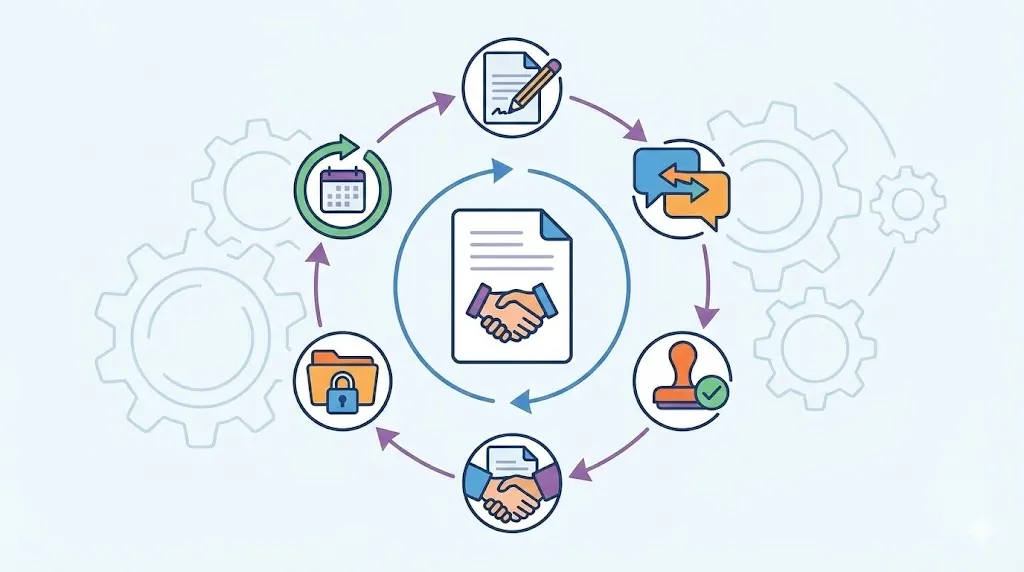
Contract lifecycle management (CLM) systems are essential tools for implementing policies that ensure accountability in AI applications. Additionally, it also centralizes contract, approval, and workflow management to enhance visibility and governance.
Key benefits of CLM software include:
Automated Workflows: Enable seamless routing of contract drafts generated with AI assistance through established approval channels.
Audit Trails: Maintain detailed records of reviewers, editors, and approvers for AI-generated content, including timestamps.
Version Control: Systematically preserve every version and change made to contracts.
Risk Analysis: Utilize AI-powered analytics to detect clauses or omissions that may pose risks.
Collaboration: Promote dynamic review sessions and issue resolution among legal and business stakeholders.
Volody’s contract management platform combines these features with integrated AI capabilities. In addition, it accelerates contract drafting, review, and approval while ensuring adherence to accountability standards.
See how Volody's CLM Software helps your team move contracts forward with confidence.
FAQ
What is an AI accountability policy in legal teams?
An accountability framework for AI specifies who is responsible for monitoring AI outputs, defines the required scrutiny levels, and outlines procedures for addressing errors. Moreover, it ensures legal teams operate AI tools with responsibility and risk mitigation.
Why do legal teams need AI accountability policies now?
AI adoption is growing rapidly, but many teams lack clear rules on responsibility. Without policies, errors can cause legal, financial, and reputational harm. Moreover, these frameworks cultivate trust and facilitate secure AI integration.
Who should be involved in creating an AI accountability policy?
Legal, IT, compliance, procurement, HR, and executive leadership should collaborate. Each group brings expertise on different risks and operational impacts to create a workable policy.
How do you decide how much to review AI outputs?
Match review effort to risk. Furthermore, low-risk tasks need light checks, while high-risk tasks require thorough human review. Furthermore, implement sample audits to verify AI performance over time.
Can AI replace human review in legal work?
No. AI assists but does not replace human judgment. Humans must verify AI outputs, especially for critical legal decisions and contracts.
What happens if an AI error causes a legal issue?
The accountability policy should specify who investigates and manages incidents. Clear roles help respond quickly and prevent similar errors.
Therefore, how often should an AI accountability policy be updated?
Regularly. Update the policy as AI tools evolve, new risks emerge, or regulations change. Review at least annually or after major AI tool changes.
Also, what role does training play in AI accountability?
Training ensures users understand AI limits, policy requirements, and how to spot errors. It promotes consistent, responsible AI use.
How does contract management software support AI accountability?
In practice, CLM platforms manage AI-enhanced contract drafting, enforce structured approval workflows, and provide detailed audit logs. This guarantees transparent oversight throughout AI-augmented processes.
Is it possible to create an AI accountability policy quickly?
Yes. A focused working session with key stakeholders can produce a baseline policy in one day. This policy can then be refined over time.
This comprehensive guide equips legal teams to build their first AI accountability policy with confidence. Clear roles, risk-based review, and cross-team collaboration are essential. Using contract management software enhances enforcement and transparency, helping your organization harness AI safely and effectively.
About the Company

Volody AI CLM is an Agentic AI-powered Contract Lifecycle Management platform designed to eliminate manual contracting tasks, automate complex workflows, and deliver actionable insights. As a one-stop shop for all contract activities, it covers drafting, collaboration, negotiation, approvals, e-signature, compliance tracking, and renewals. Built with enterprise-grade security and no-code configuration, it meets the needs of the most complex global organizations. Volody AI CLM also includes AI-driven contract review and risk analysis, helping teams detect issues early and optimize terms. Trusted by Fortune 500 companies, high-growth startups, and government entities, it transforms contracts into strategic, data-driven business assets.




" height="216.72211px" id="FYO0bO80Y" transform="translate(3 6.105)" width="206.073px"/><path d="M 108.174 222 C 88.432 222 70.303 217.239 53.785 207.717 C 37.267 198.196 24.173 185.052 14.504 168.285 C 4.835 151.312 0 132.165 0 110.845 C 0 89.731 4.835 70.792 14.504 54.025 C 24.173 37.052 37.267 23.804 53.785 14.282 C 70.303 4.761 88.432 0 108.174 0 C 128.116 0 146.246 4.761 162.562 14.282 C 179.08 23.804 192.073 37.052 201.541 54.025 C 211.21 70.792 216.044 89.731 216.044 110.845 C 216.044 132.165 211.21 151.312 201.541 168.285 C 192.073 185.052 179.08 198.196 162.562 207.717 C 146.044 217.239 127.915 222 108.174 222 Z M 108.174 183.189 C 120.864 183.189 132.044 180.291 141.713 174.495 C 151.382 168.492 158.936 160.006 164.375 149.035 C 169.814 138.064 172.533 125.334 172.533 110.845 C 172.533 96.355 169.814 83.729 164.375 72.965 C 158.936 61.994 151.382 53.611 141.713 47.815 C 132.044 42.02 120.864 39.122 108.174 39.122 C 95.483 39.122 84.202 42.02 74.332 47.815 C 64.663 53.611 57.109 61.994 51.67 72.965 C 46.231 83.729 43.511 96.355 43.511 110.845 C 43.511 125.334 46.231 138.064 51.67 149.035 C 57.109 160.006 64.663 168.492 74.332 174.495 C 84.202 180.291 95.483 183.189 108.174 183.189 Z" fill="rgba(255, 255, 255, 0.12)" height="222px" id="aa1McFcE9" transform="translate(227.183 3)" width="216.04399999999998px"/><path d="M 42.302 182.257 L 111.799 182.257 L 111.799 216.722 L 0 216.722 L 0 0 L 42.302 0 Z" fill="rgba(255, 255, 255, 0.12)" height="216.72211px" id="yRq4AnrsX" transform="translate(477.721 6.105)" width="111.79899999999998px"/><path d="M 108.174 222 C 88.432 222 70.303 217.239 53.785 207.717 C 37.267 198.196 24.173 185.052 14.504 168.285 C 4.835 151.312 0 132.165 0 110.845 C 0 89.731 4.835 70.792 14.504 54.025 C 24.173 37.052 37.267 23.804 53.785 14.282 C 70.303 4.761 88.432 0 108.174 0 C 128.116 0 146.246 4.761 162.562 14.282 C 179.08 23.804 192.073 37.052 201.541 54.025 C 211.21 70.792 216.045 89.731 216.045 110.845 C 216.045 132.165 211.21 151.312 201.541 168.285 C 192.073 185.052 179.08 198.196 162.562 207.717 C 146.044 217.239 127.915 222 108.174 222 Z M 108.174 183.189 C 120.864 183.189 132.044 180.291 141.713 174.495 C 151.382 168.492 158.936 160.006 164.375 149.035 C 169.814 138.064 172.534 125.334 172.534 110.845 C 172.534 96.355 169.814 83.729 164.375 72.965 C 158.936 61.994 151.382 53.611 141.713 47.815 C 132.044 42.02 120.864 39.122 108.174 39.122 C 95.483 39.122 84.202 42.02 74.332 47.815 C 64.663 53.611 57.108 61.994 51.67 72.965 C 46.231 83.729 43.511 96.355 43.511 110.845 C 43.511 125.334 46.231 138.064 51.67 149.035 C 57.108 160.006 64.663 168.492 74.332 174.495 C 84.202 180.291 95.483 183.189 108.174 183.189 Z" fill="rgba(255, 255, 255, 0.12)" height="222px" id="mo8HQspQ0" transform="translate(609.155 3)" width="216.04500000000007px"/><path d="M 73.727 0 C 95.885 0 115.324 4.45 132.044 13.351 C 148.967 22.252 161.957 34.982 171.027 51.541 C 180.287 67.894 184.917 86.937 184.917 108.671 C 184.917 130.405 180.287 149.449 171.027 165.801 C 161.957 181.947 148.967 194.47 132.044 203.371 C 115.324 212.271 95.885 216.722 73.727 216.722 L 0 216.722 L 0 0 Z M 72.216 179.773 C 94.374 179.773 111.497 173.564 123.583 161.144 C 135.669 148.724 141.713 131.233 141.713 108.671 C 141.713 86.109 135.669 68.515 123.583 55.888 C 111.497 43.055 94.374 36.638 72.216 36.638 L 42.302 36.638 L 42.302 179.773 Z" fill="rgba(255, 255, 255, 0.12)" height="216.72211px" id="I3iXX5Hi_" transform="translate(859.693 6.105)" width="184.91699999999992px"/><path d="M 185.22 0 L 113.91 141.273 L 113.91 216.722 L 71.61 216.722 L 71.61 141.273 L 0 0 L 47.74 0 L 93.06 99.046 L 138.08 0 Z" fill="rgba(255, 255, 255, 0.12)" height="216.72211px" id="nzHyWC0_d" transform="translate(1061.78 6.105)" width="185.22000000000003px"/></svg>)