

A corporate legal department managing thousands of supplier agreements operates much like an air traffic control center during peak hours. Every contract represents an incoming flight that requires careful radar tracking, clear flight path verification, and immediate clear-to-land sign-offs before operations stall. When general counsel rely entirely on external law firms to handle every routine flight check, legal costs skyrocket while standard commercial approvals grind to a halt. AT&T addressed this exact operational bottleneck by developing an internal technology platform known as LegalEdge to manage core routine tasks. Implementing a clear in-house legal AI strategy allows corporate departments to reclaim control over high-volume document workflows without compromising enterprise safety. This structural shift marks a permanent change in how enterprise legal operations handle contract review, panel management, and internal risk controls.
TL;DR:
The Core Move: AT&T built an internal AI team (LegalEdge) to handle routine legal work in-house, enabling them to shrink their outside law firm panel from 30 down to 18–20 firms and significantly cut external legal spend.
How It Works: Rather than relying on expensive outside associates, AI automates first-draft reviews, vendor NDA redlines, and playbook deviation checks, delivering structured redlines directly to internal counsel in seconds.
Safety & Control: Human-in-the-loop verification controls and audit logs ensure AI handles high-volume tasks without exposing the company to unmanaged risk or hallucinations.
The Key Enabler: Successful legal AI requires centralized contract lifecycle management (CLM) software to provide clean historical data, automated intake workflows, and strict compliance controls.
The Takeaway: Corporate legal teams don't need to build custom tech like AT&T—they can adopt turnkey solutions like Volody CLM to bring routine contract workflows internal, accelerate contract velocity by up to 70%, and cut external billable hours by over 30%.
What Is the AT&T Legal Edge Strategy?
AT&T established its dedicated LegalEdge team to rethink how enterprise legal services are delivered across a global telecommunications footprint. The telecom giant assembled a specialized group of 38 legal, technology, and operations professionals to build custom internal tools powered by advanced large language models. Rather than relying on off-the-shelf software, the team partnered directly with leading technology providers to create an environment tailored to their exact contracting requirements. This focused operational group focuses on converting routine corporate tasks into automated internal processes.
The Shift From Outside Counsel to Legal Edge
For decades, enterprise legal departments routed complex first-draft reviews and standard contract negotiations to outside panel law firms. This reliance created significant budget pressure as hourly billing rates for law firm associates continued to climb each year. The LegalEdge initiative fundamentally changes this distribution by capturing standard legal work before it leaves the enterprise perimeter. Internal teams now process nondisclosure agreements, commercial vendor terms, and initial contract redlines in-house using automated review workflows. By keeping high-volume work internal, corporate teams reduce response times from weeks to hours while retaining firm knowledge inside the organization.
Why Corporate Legal Operations Are Evolving Fast
Corporate legal departments face growing pressure from chief executive officers and chief financial officers to operate as agile business enablers rather than cost centers. Recent industry data shows that over 70 percent of corporate legal departments plan to increase their internal technology investments to control external vendor spend. Rising legal rates force legal operations leaders to examine every line item in outside counsel invoices. Modern legal workflow automation allows internal counsel to manage larger contract volumes without expanding headcount at the same rate. This shift ensures that senior legal talent focuses on strategic corporate transactions while automated systems process repeatable daily tasks.
Strategy Component | Traditional Outside Counsel Model | AT&T LegalEdge In-House Model |
|---|---|---|
Primary Execution | External law firm panel associates | Dedicated internal legal & tech team |
Turnaround Time | 3 to 7 business days per draft | Real-time automated first-draft redlines |
Cost Structure | High hourly billable rates | Predictable internal software & ops spend |
Data Retention | Dispersed across external law firm drives | Centralized within secure enterprise repository |
How Does AI Shift Work In-House Safely?
Transitioning core legal tasks from law firm associates to internal automated platforms requires robust operational safety protocols. Moving routine work in-house cannot mean taking on unmanaged legal exposure or accepting unverified output. Enterprise teams must establish clear boundaries for where automated processing stops and human review begins. How do leading legal operations teams maintain absolute accuracy during this transition? They combine automated contract review algorithms with strict human-in-the-loop verification controls at every key decision gate.
Moving Junior Associate Tasks Internal
Law firm associates traditionally spent thousands of hours reviewing boilerplate clauses, identifying deviation from standard playbooks, and drafting basic agreement summaries. Modern AI contract review tools perform these basic extraction and comparison tasks in seconds. Internal legal teams use automated playbooks to scan incoming vendor contracts against approved company positions, highlighting non-standard indemnity terms, liability caps, or termination clauses instantly. This initial automated pass delivers a structured redline directly to in-house counsel. Internal staff can then focus their effort entirely on resolving highlighted commercial risks rather than manually reading hundreds of pages of standard prose.
Establishing Audit Trails and Human Controls
Security and regulatory compliance require that every automated legal action leaves a clear digital breadcrumb. Advanced contract lifecycle management software captures every edit, prompt response, and clause modification within a permanent audit log. In-house legal departments enforce precise permission levels, ensuring that automated systems never execute binding agreements without explicit sign-off from authorized personnel. Human verification gates ensure that senior attorneys review high-risk modifications before agreements move to execution. This systematic approach gives corporate boards full confidence that internal automated workflows maintain strict legal governance and risk control standards across every department.
Related Article: Top 10 Contract Management Software For Enterprises In 2026
What Are the Pillars of Legal AI Adoption?
Building a scalable internal legal capability requires more than purchasing software licenses or configuring isolated chatbots. Successful enterprise deployment rests on a foundation of clean data organization, structured workflow mapping, and continuous integration. Organizations that attempt to deploy advanced models without proper data architecture often suffer from inaccurate outputs and low adoption rates. What structural components form the bedrock of corporate legal AI adoption? Enterprise teams must combine centralized document repositories with end-to-end contract management automation to achieve predictable operational success.
Centralizing Repositories for AI Model Inputs
Large language models require access to structured, high-quality legal data to produce accurate redlines and summaries. When corporate contracts reside in scattered email folders, desktop drives, or legacy network shares, legal technology tools cannot function effectively. Centralizing historical agreements into a unified contract lifecycle management software repository creates the clean data foundation required for intelligent processing. Modern platforms automatically ingest, categorize, and index historical contracts, metadata, and past negotiation history. This centralized architecture ensures that automated models evaluate new vendor terms against verified historical company standards rather than arbitrary public datasets.
Automating Routine Contract Lifecycle Workflows
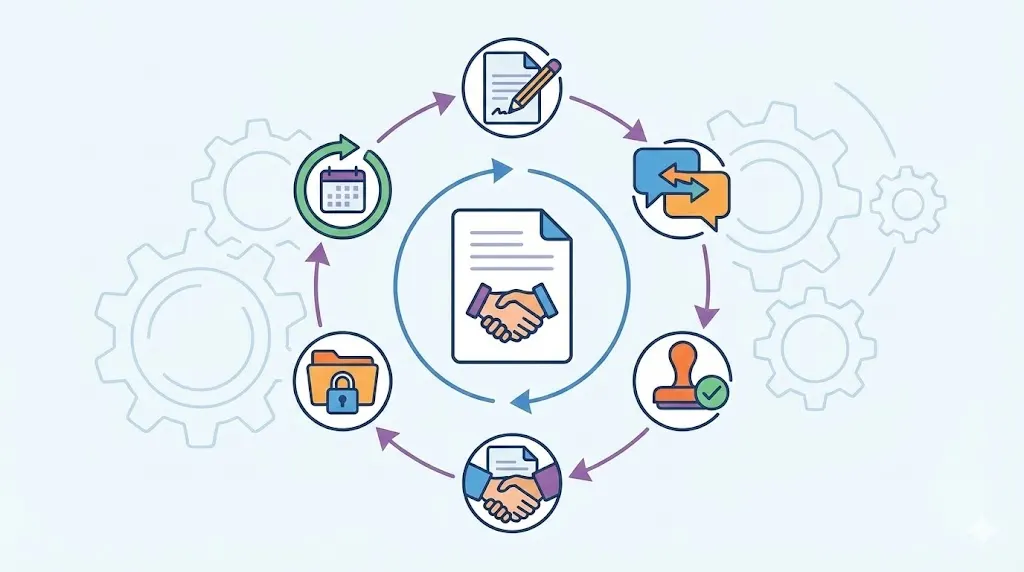
Data centralization enables complete automation of the contract lifecycle from initial request to post-execution tracking. Legal departments set up intake portals where business teams submit contract requests using dynamic forms that collect all required commercial metadata upfront. The system routes incoming requests automatically, applying pre-approved fallback clauses and generating standard first drafts without manual legal intervention. Integrated approval workflows route non-standard language directly to designated subject matter experts based on pre-set financial or risk thresholds. Automating these end-to-end steps eliminates administrative friction and gives general counsel complete real-time visibility over enterprise contract velocity.
How to Manage Outside Counsel Panel Reductions?
Centralizing internal workflows creates the operational leverage required to execute a disciplined outside counsel panel management strategy. As internal teams handle a larger share of routine drafting, general counsel can drastically consolidate their external firm relationships. AT&T demonstrated this approach by targeting a reduction in its law firm panel from 30 preferred firms down to 18 or 20 key partners. Consolidating external spend gives corporate legal departments superior bargaining leverage with remaining firms. This structural shift allows general counsel to demand predictable pricing structures and higher service levels across all remaining external mandates.
Redefining Mandates for External Law Firms
Shrinking external panel sizes requires corporate legal teams to set firm boundaries around which matters travel outside the organization. General counsel explicitly prohibit outside law firms from billing hourly rates for routine first-draft contract generation or basic document discovery. Outside counsel receive assignments exclusively for specialized litigation, major cross-border mergers and acquisitions, or complex regulatory investigations. This division of labor ensures that expensive external law firm partners provide specialized expertise rather than basic administrative capacity. External counsel become targeted advisors for high-stakes enterprise risks rather than default resources for routine operations.
Structuring Fixed-Fee High-Value Engagements
Panel consolidation allows corporate legal departments to replace traditional billable hours with predictable fixed-fee pricing models. General counsel utilize internal historical contract data to establish precise cost benchmarks for specific legal outcomes. External firms competing for panel placement must offer fixed-fee arrangements or capped risk-sharing fee structures to secure long-term enterprise volume. Law firms that embrace internal automation can deliver these fixed-fee services profitably, aligning their financial incentives with client efficiency. This structural pricing shift eliminates invoice surprises and helps legal operations leaders maintain total control over external annual legal budgets.
What Governance Is Needed for Legal AI?
Scaling automated workflows across global enterprise divisions requires establishing enterprise-grade security and compliance frameworks. Introducing legal prompt engineering and LLMs into daily operations introduces serious data security and regulatory exposures if left unmanaged. Legal operations executives must ensure that proprietary commercial terms, intellectual property, and sensitive client data remain completely isolated from public training sets. Establishing comprehensive governance frameworks for in-house generative AI builds the operational confidence necessary for full board and compliance approval.
Protecting Confidentiality and Data Security
Maintaining strict enterprise confidentiality standards requires deploying generative models within isolated tenant architectures. General counsel must verify that legal technology providers enforce zero-data retention policies with underlying model vendors. Proprietary contracts, trade secrets, and internal negotiation playbooks should never feed public model training cycles. Enterprise systems employ end-to-end encryption for data at rest and in transit, ensuring complete compliance with global privacy regulations such as GDPR and CCPA. Protecting core enterprise data assets allows legal departments to process sensitive commercial transactions securely without external exposure.
Enforcing Standard Clauses Across Operations
Managing contract risk across multiple business units demands strict adherence to centralized, pre-approved playbook positions. Automated governance engines ensure that every generated draft or redline strictly complies with company-mandated indemnity, limitation of liability, and jurisdiction terms. When vendor redlines challenge mandatory company terms, automated risk scoring alerts in-house counsel instantly. The system flags the precise policy deviation and suggests pre-approved alternative fallback clauses. Enforcing consistent contract language across all global subsidiaries reduces enterprise litigation exposure and simplifies long-term contract compliance monitoring.
How Can Legal Teams Measure AI Execution ROI?
Justifying enterprise technology investments requires legal operations leaders to present clear financial metrics to executive stakeholders. Demonstrating total return on investment extends far beyond soft claims of improved team morale or modern work tools. General counsel must show clear quantitative evidence of operational speed improvements and external cost reductions. How can in-house legal department efficiency be accurately measured across complex global business operations? Legal operations executives track specific key performance indicators that isolate internal review acceleration and external law firm fee savings.
Tracking Turnaround Times for In-House Drafts
Contract velocity serves as a primary metric for evaluating internal technology effectiveness across enterprise procurement and sales workflows. Advanced contract lifecycle management systems monitor contract lifecycle duration automatically from initial request through electronic signature. Teams measure the exact time saved during first-draft generation, redline reviews, and internal manager sign-offs. Data shows that enterprise legal departments using automated review platforms cut standard commercial contract turnaround times by up to 70 percent. Accelerating contract execution helps sales teams realize revenues faster while eliminating procurement roadblocks across the supply chain.
Quantifying Reductions in External Billable Hours
The most direct financial benchmark for legal technology adoption appears in reduced external legal spend invoices. Legal operations leaders track monthly decreases in outside counsel billable hours allocated to high-volume routine matters. Comparing historical panel invoices against post-deployment spend reveals the precise dollar savings generated by capturing routine work internally. Successful corporate legal AI implementations routinely generate external billable hour reductions exceeding 30 percent in the first year of operation. Reallocating those saved capital reserves allows corporate departments to invest in specialized internal expertise and modern operations infrastructure.
Volody Enterprise CLM: Powering Your Legal AI Strategy
Replicating AT&T’s LegalEdge strategy does not require building custom software platforms from scratch or hiring massive internal software engineering teams. Volody Enterprise CLM provides corporate legal departments with a turnkey, enterprise-grade contract lifecycle management platform powered by built-in artificial intelligence. Volody centralizes contract repositories, automates complex redlining against custom company playbooks, and enforces strict risk governance across every legal workflow. With end-to-end encryption, zero data retention guarantees, and flexible deployment models, Volody empowers general counsel to cut outside counsel reliance immediately while maintaining total compliance. Schedule a demo with Volody today to transform your internal legal operations.
Learn more: AI-powered contract management software
Conclusion
The shift demonstrated by AT&T's LegalEdge initiative proves that the future of corporate legal operations belongs to departments that build strong internal technology capabilities.
By combining clean data repositories, automated contract lifecycle management, and clear human verification controls, general counsel can drastically lower external law firm dependency without compromising enterprise compliance. Corporate legal teams that embrace structured internal legal AI strategies today will lead the industry in agility, cost control, and strategic value.
FAQ
How does an in-house legal AI strategy lower legal spend?
An in-house legal AI strategy automates routine contract drafting, review, and redlining tasks internally. By capturing high-volume, low-complexity legal tasks before they reach external law firm panels, corporate departments significantly reduce billable hourly fees paid to outside counsel.
What legal tasks can generative AI handle internally?
Generative AI tools excel at first-draft redlines, contract summarization, clause extraction, playbook deviation tracking, and risk analysis for standard commercial agreements like NDAs, MSAs, and vendor contracts.
How do legal teams maintain accuracy with AI review?
Legal teams ensure accuracy by pairing automated playbooks with human-in-the-loop review controls. Advanced CLM software routes highlighted policy deviations and non-standard terms directly to internal counsel for final verification before contract execution.
Can small legal departments replicate AT&T's approach?
Yes. Smaller departments do not need to build proprietary models like AT&T. They can adopt purpose-built enterprise platforms like Volody CLM to achieve similar reductions in outside law firm spend without custom engineering overhead.
How does CLM software support legal AI deployment?
CLM software provides the essential data centralization, workflow routing, and audit logging required for AI models to operate securely. It acts as the single source of truth for contract data and enforces company compliance standards automatically.
What are the risks of reducing outside law firm panels?
Reducing panel sizes without proper internal automated tools can overwhelm in-house attorneys. Corporate legal departments must deploy automated contract workflows prior to reducing law firm panel sizes to ensure smooth operational continuity.
About the Company

Volody AI CLM is an Agentic AI-powered Contract Lifecycle Management platform designed to eliminate manual contracting tasks, automate complex workflows, and deliver actionable insights. As a one-stop shop for all contract activities, it covers drafting, collaboration, negotiation, approvals, e-signature, compliance tracking, and renewals. Built with enterprise-grade security and no-code configuration, it meets the needs of the most complex global organizations. Volody AI CLM also includes AI-driven contract review and risk analysis, helping teams detect issues early and optimize terms. Trusted by Fortune 500 companies, high-growth startups, and government entities, it transforms contracts into strategic, data-driven business assets.




" height="216.72211px" id="FYO0bO80Y" transform="translate(3 6.105)" width="206.073px"/><path d="M 108.174 222 C 88.432 222 70.303 217.239 53.785 207.717 C 37.267 198.196 24.173 185.052 14.504 168.285 C 4.835 151.312 0 132.165 0 110.845 C 0 89.731 4.835 70.792 14.504 54.025 C 24.173 37.052 37.267 23.804 53.785 14.282 C 70.303 4.761 88.432 0 108.174 0 C 128.116 0 146.246 4.761 162.562 14.282 C 179.08 23.804 192.073 37.052 201.541 54.025 C 211.21 70.792 216.044 89.731 216.044 110.845 C 216.044 132.165 211.21 151.312 201.541 168.285 C 192.073 185.052 179.08 198.196 162.562 207.717 C 146.044 217.239 127.915 222 108.174 222 Z M 108.174 183.189 C 120.864 183.189 132.044 180.291 141.713 174.495 C 151.382 168.492 158.936 160.006 164.375 149.035 C 169.814 138.064 172.533 125.334 172.533 110.845 C 172.533 96.355 169.814 83.729 164.375 72.965 C 158.936 61.994 151.382 53.611 141.713 47.815 C 132.044 42.02 120.864 39.122 108.174 39.122 C 95.483 39.122 84.202 42.02 74.332 47.815 C 64.663 53.611 57.109 61.994 51.67 72.965 C 46.231 83.729 43.511 96.355 43.511 110.845 C 43.511 125.334 46.231 138.064 51.67 149.035 C 57.109 160.006 64.663 168.492 74.332 174.495 C 84.202 180.291 95.483 183.189 108.174 183.189 Z" fill="rgba(255, 255, 255, 0.12)" height="222px" id="aa1McFcE9" transform="translate(227.183 3)" width="216.04399999999998px"/><path d="M 42.302 182.257 L 111.799 182.257 L 111.799 216.722 L 0 216.722 L 0 0 L 42.302 0 Z" fill="rgba(255, 255, 255, 0.12)" height="216.72211px" id="yRq4AnrsX" transform="translate(477.721 6.105)" width="111.79899999999998px"/><path d="M 108.174 222 C 88.432 222 70.303 217.239 53.785 207.717 C 37.267 198.196 24.173 185.052 14.504 168.285 C 4.835 151.312 0 132.165 0 110.845 C 0 89.731 4.835 70.792 14.504 54.025 C 24.173 37.052 37.267 23.804 53.785 14.282 C 70.303 4.761 88.432 0 108.174 0 C 128.116 0 146.246 4.761 162.562 14.282 C 179.08 23.804 192.073 37.052 201.541 54.025 C 211.21 70.792 216.045 89.731 216.045 110.845 C 216.045 132.165 211.21 151.312 201.541 168.285 C 192.073 185.052 179.08 198.196 162.562 207.717 C 146.044 217.239 127.915 222 108.174 222 Z M 108.174 183.189 C 120.864 183.189 132.044 180.291 141.713 174.495 C 151.382 168.492 158.936 160.006 164.375 149.035 C 169.814 138.064 172.534 125.334 172.534 110.845 C 172.534 96.355 169.814 83.729 164.375 72.965 C 158.936 61.994 151.382 53.611 141.713 47.815 C 132.044 42.02 120.864 39.122 108.174 39.122 C 95.483 39.122 84.202 42.02 74.332 47.815 C 64.663 53.611 57.108 61.994 51.67 72.965 C 46.231 83.729 43.511 96.355 43.511 110.845 C 43.511 125.334 46.231 138.064 51.67 149.035 C 57.108 160.006 64.663 168.492 74.332 174.495 C 84.202 180.291 95.483 183.189 108.174 183.189 Z" fill="rgba(255, 255, 255, 0.12)" height="222px" id="mo8HQspQ0" transform="translate(609.155 3)" width="216.04500000000007px"/><path d="M 73.727 0 C 95.885 0 115.324 4.45 132.044 13.351 C 148.967 22.252 161.957 34.982 171.027 51.541 C 180.287 67.894 184.917 86.937 184.917 108.671 C 184.917 130.405 180.287 149.449 171.027 165.801 C 161.957 181.947 148.967 194.47 132.044 203.371 C 115.324 212.271 95.885 216.722 73.727 216.722 L 0 216.722 L 0 0 Z M 72.216 179.773 C 94.374 179.773 111.497 173.564 123.583 161.144 C 135.669 148.724 141.713 131.233 141.713 108.671 C 141.713 86.109 135.669 68.515 123.583 55.888 C 111.497 43.055 94.374 36.638 72.216 36.638 L 42.302 36.638 L 42.302 179.773 Z" fill="rgba(255, 255, 255, 0.12)" height="216.72211px" id="I3iXX5Hi_" transform="translate(859.693 6.105)" width="184.91699999999992px"/><path d="M 185.22 0 L 113.91 141.273 L 113.91 216.722 L 71.61 216.722 L 71.61 141.273 L 0 0 L 47.74 0 L 93.06 99.046 L 138.08 0 Z" fill="rgba(255, 255, 255, 0.12)" height="216.72211px" id="nzHyWC0_d" transform="translate(1061.78 6.105)" width="185.22000000000003px"/></svg>)