
A signed contract can guide revenue, cost, risk, and customer service. Yet many businesses keep those details buried in folders. Turn Contracts Into Strategic Digital Assets With AI by converting static files into usable business data. Picture a procurement team preparing for renewal season. Instead of searching thousands of files, the team sees key dates, obligations, and risks in one working view.
TL;DR
AI can extract terms, dates, risks, and obligations from contracts stored across scattered systems.
Digital contract data also helps teams protect revenue, reduce risk, and make faster business decisions.
With strong governance in place, AI remains accurate and secure, while its outputs stay explainable and subject to human review.
A central repository brings legacy agreements together with new contracts, workflows, and business systems.
Begin with clearly defined use cases and clean data; set measurable goals, then roll out the system in a controlled way.
Contract management software converts extracted information into the actions, alerts, and reports teams use each day.
Why Legacy Contracts Hold Back Business
Most companies have years of signed agreements. Additionally, many of those files sit in shared drives, email accounts, local folders, and old systems. Some exist as searchable PDFs, while others remain scanned images. Teams may also hold several versions of the same agreement.
This creates a basic business problem. Without reliable information at hand, people cannot act on what the agreements require. Renewal dates may remain hidden in lengthy documents until the deadline has passed. Service credits may be buried in exhibits and go unclaimed. During a merger, teams may overlook a change of control clause.
Moreover, legal teams usually feel this pressure first. They receive questions about terms, rights, and obligations. They then search across repositories and ask business owners for help. Each answer takes time, and each manual step creates room for error.
Operations teams face a different issue. Their work relies on contracts with suppliers, customers, partners, and internal service providers. Often, they cannot determine which agreement governs a particular transaction. Furthermore, dependencies linking the contract to other systems may also escape notice.
Finance teams need accurate commercial data. They track prices, payment terms, rebates, credits, and renewal changes. Manual review makes it hard to compare those terms across business units. It also limits the quality of forecasts and reports.
The risk grows as a company expands. Each region may use different templates, naming rules, and storage practices. Also, acquisitions add another layer of inconsistency. Also, the legal team inherits contracts without knowing their format, quality, or business owner.
The costs appear in several forms:
Missed renewal and notice dates
Unclaimed rebates, credits, or price adjustments
Payments against outdated commercial terms
Unclear ownership for contractual duties
Slow responses to audit and compliance requests
Delayed sales, procurement, and supplier decisions
Poor visibility into exposure from unusual clauses
According to the U.S. Government Accountability Office, federal agencies face challenges with managing data across fragmented systems. Private companies encounter much the same problem with contract information. When data remains fragmented, oversight suffers even if each document contains valuable facts.
AI alone cannot remedy poor contract practices. It can, however, help teams find and organize information at a scale that manual work cannot match. The first step involves treating contracts as data, not only as documents.
Related articles: Contract Risk Analysis Strengthened By AI In Legal Ops
What Makes Contracts Strategic Digital Assets
A digital asset creates value because people can find, use, and connect it. A contract becomes a strategic digital asset when teams can apply its terms to business decisions. That requires more than storing a file in a central folder.
The file still matters. It provides the legal record and protects the agreed language. AI adds a structured layer around that record. This layer can include parties, dates, prices, obligations, notice periods, governing law, and risk terms.
For example, a customer agreement may contain the following information:
Annual subscription value
Automatic renewal date
Required notice period
Service level commitments
Data protection duties
Liability limits
Termination rights
Price increase rules
A business user may need only one of those facts. Without structured data, that person must read the entire agreement or contact legal. With structured data, the user can search for the answer and open the source clause for context.
This changes how teams use contracts. They can compare agreements by region, supplier, product, or risk type. Some contracts contain no privacy language at all. In others, the liability cap may be inadequate. Renewal dates, meanwhile, support contract grouping and owner assignment.
That value increases when systems connect contract data with other business information. A procurement platform may show supplier spend. A contract system may show pricing rights and notice dates. Together, those records help procurement decide which suppliers need attention first.
The same approach is useful to sales teams. Before proposing a new deal, they can review the commitments already made to each customer. For finance, the task is reconciling payment terms with billing records. Security teams, meanwhile, trace data processing obligations. Operations can monitor service levels and delivery commitments using the data.
Contracts also support scenario planning. When a company plans to exit a market, leaders can identify affected contracts, termination rights, notice periods, and required customer communications. Suppose prices rise across a supply chain. Procurement can then identify agreements that contain adjustment clauses or fixed pricing terms.
AI is not a substitute for legal review. It helps users reach the relevant documents and facts more quickly. Legal interpretation, contextual judgment, and approval of the legal position still rest with a lawyer.
The approach is consistent with the National Institute of Standards and Technology AI Risk Management Framework, which calls for clear controls around valid, reliable, safe, secure, explainable, and accountable AI. That emphasis is particularly important in contract work: legal teams need evidence to support every material answer.
A strategic contract asset should therefore have four qualities:
Findable: Search, filters, and metadata let users locate it.
Understandable: Within the system, key terms appear in language users can interpret.
Connected: Its data links to owners, tasks, systems, and business events.
Controlled: The system keeps access, changes, sources, and approvals visible.
Taken together, these qualities convert the archive into an operating resource rather than a passive repository. The organization gains a clearer view of its commercial relationships. That visibility allows it to act before deadlines create pressure.
Related reading: How Does AI Limitations Impacting Contract Management?
How AI Digitizes Contract Portfolios
AI can help convert a mixed collection of files into usable contract information. Additionally, the work begins with intake. Teams gather contracts from shared drives, document systems, email archives, and legacy tools. Before extracting any fields, they build a clear inventory of the collected material.
For each file, the inventory captures basic facts. Include its source, format, business owner, date, and apparent contract type. Flag duplicates and damaged files. Executed agreements should remain distinct from drafts, exhibits, amendments, and notices.
Optical character recognition, or OCR, allows systems to interpret scanned documents. It converts text embedded in images into machine-readable content. Because OCR output is not error-free, teams need quality checks. In practice, clear scans generally produce more reliable results than blurry or handwritten pages.
AI then identifies relevant fields and clauses. It can look for parties, effective dates, renewal terms, payment schedules, governing law, and termination rights. Moreover, it can also detect obligations, data use provisions, insurance requirements, and liability language.
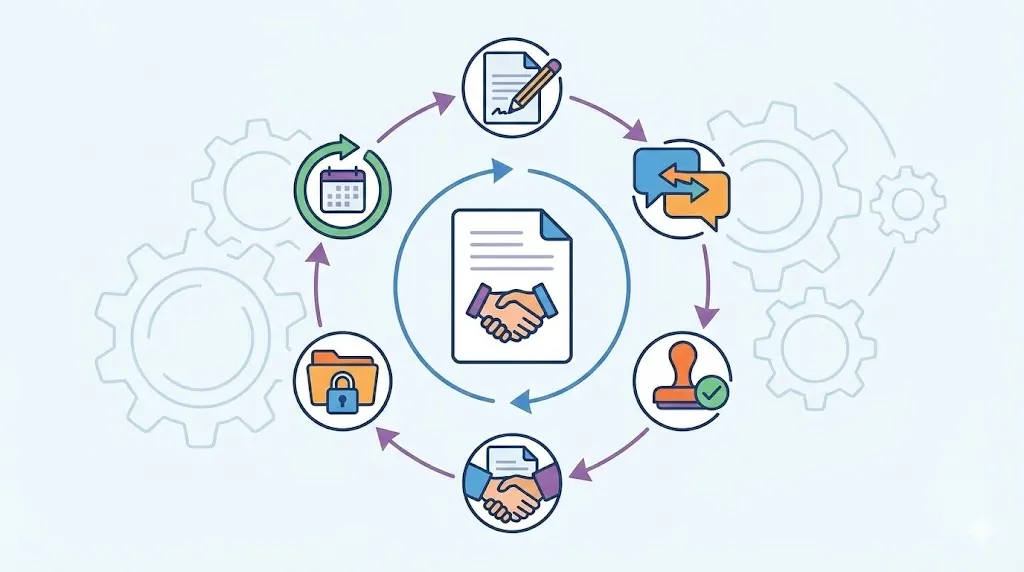
A useful extraction process follows this path:
Collect files from approved sources.
Remove duplicates while grouping related documents together.
Turn scanned pages into searchable text.
Assign each document a type and purpose.
Pull out the agreed fields and key clauses.
Associate amendments, schedules, and exhibits with the underlying agreement.
Display confidence levels alongside the relevant source passages.
Route uncertain results to a human reviewer.
Transfer approved data into the contract repository.
Record corrections so they can inform subsequent quality improvements.
Confidence matters. Furthermore, an AI system should not present every result as certain. It should show when a date appears unclear or when a clause does not match expected language. Reviewers can then focus on exceptions instead of reading every document from scratch.
Therefore, a field also needs context. Consider a renewal date. It could be stated on the first page, in an order form, or in a later amendment. Extracting only the first date a system encounters could introduce a serious error. The date therefore needs to remain tied to both its clause and the applicable document version.
The same issue affects party names. A parent company may sign the agreement, while a subsidiary receives the service. AI should therefore preserve those relationships. The business may need to know which entity owns the right or carries the duty.
AI can also classify clause patterns. Also, these may include unlimited liability, broad audit rights, automatic renewal, assignment restrictions, and unusual termination language. Rather than applying an assumed universal rule, the tool should evaluate those terms against a legal playbook.
The International Organization for Standardization explains that information security controls help organizations manage confidentiality, integrity, and availability. Contract digitization must follow the same basic discipline. As a result, sensitive agreements need controlled access, secure storage, and clear retention rules.
A limited data set provides a sensible starting point. For the initial scope, select one contract type or business unit. Measure extraction quality against a sample reviewed by humans. Monitor false positives, missed fields, and time saved. Refine the process before expanding it across the enterprise.
This approach supports trust. Legal and operations teams can see how the system works. They can challenge results and correct errors. Over time, the organization builds a cleaner contract data foundation.
Related articles: How Contract AI Archives Transform Legal Workflows
How Teams Use Contract Intelligence
Digitized contracts create value only when teams use them in daily work. Additionally, a repository by itself does not prevent missed obligations. People need tasks, alerts, owners, and workflows connected to the extracted data.
Renewal management offers a clear example. The system can organize agreements for review according to renewal date and notice period. Months before action becomes urgent, it can alert the owner. The owner then has time to assess performance, pricing, and business needs.
The same process can also support termination rights. A business may seek to end a supplier agreement after poor service. It can then display the required notice, approved delivery method, and deadline. Legal can verify the position before the business sends notice.
Another practical application is obligation tracking. Supplier contracts may call for quarterly reports. Customers, in turn, may need to maintain insurance. The company may be responsible for meeting service levels or completing security reviews.
Each obligation needs a clear owner. The record should include its due date, status, supporting evidence, and escalation path. AI identifies the duty; workflow tools then help people fulfill it.
Contract intelligence is particularly useful for assessing risk during major business events. Also, consider a planned acquisition. The legal team may need to find:
Change of control clauses
Consent requirements
Termination rights
Exclusivity commitments
Data transfer restrictions
Key customer and supplier dependencies
Unusual indemnity or liability terms
A searchable contract portfolio can produce an initial list quickly. Lawyers can therefore concentrate on interpretation and negotiation. The result is faster work without displacing professional judgment.
Procurement teams can also use contract data to compare supplier terms. Moreover, the comparison may bring to light different payment periods for similar services. It may likewise expose agreements with inconsistent price adjustment rights. Teams can apply that information to guide sourcing and renewal discussions.
Finance teams can assess revenue and cost impacts. They can reconcile agreed prices with invoices. Volume discounts and unused credits are easier to identify through this analysis. Variable-cost contracts can also be monitored.
Before closing a new deal, sales operations can review customer obligations. An earlier agreement may place limits on territory, customer use, or product changes. With that visibility, teams are less likely to make promises that conflict with existing terms.
According to the Association for Contract Management and World Commerce & Contracting, contract performance depends on what happens after signature, not only during negotiation. That principle should guide system design. A useful platform must support execution, monitoring, and improvement.
As a result, teams should measure business results, not only system activity. Useful measures include:
Time required to answer contract questions
Percentage of contracts with assigned owners
Renewal notices sent before the deadline
Obligations completed on time
Revenue recovered through contract rights
Reduction in manual review hours
Number of high-risk clauses identified
Search time for audit and compliance requests
These measures help leaders decide whether the program works. They also show where teams need better templates, policies, or training.
The best results come from shared ownership. Legal sets standards and explains risk. Performance oversight sits with Operations. Finance validates the commercial data. IT is responsible for access and integrations. Business owners are responsible for completing obligations and making decisions.
Related articles: How to Simplify Contract Review with AI? Comprehensive Guide
How to Build a Safe AI Contract Program
A strong program needs more than an AI feature. Additionally, the program also needs clear goals, reliable data, controlled access, and human oversight. Leaders should treat the work as a business change program, not a document upload project.
Begin with a specific problem. Do not start with a broad goal such as “use AI across all contracts.” Choose a measurable use case. You might target renewal tracking, legacy contract migration, or review of privacy clauses.
Define the business owner before selecting technology. The owner should approve the scope, measure progress, and resolve process questions. Moreover, legal, operations, and IT should be part of the design group as well.
Establish a contract data model before configuring the system. Identify the fields that matter for each contract type. The fields required for a supplier agreement will differ from those needed for a customer agreement. Keep the first version focused. Too many fields can slow adoption and create poor data quality.
Create a legal playbook for review. Furthermore, it should describe approved language, fallback positions, escalation rules, and prohibited terms. The playbook gives AI a controlled basis for identifying deviations. It also creates consistency across reviewers.
Set rules for human review. Reviewers should verify the material fields and give particular attention to high-risk clauses. Preserve the source text alongside every extracted result. The record should show whether the data was approved or changed, and by whom.
Also, protect confidential information through role-based access. Also, users should see only the contracts and fields needed for their work. Separate permissions may apply by business unit, region, entity, or contract type.
Control the use of external AI services. Do not send confidential contract text to a tool without approved security terms. Review data retention, training use, encryption, access controls, and deletion processes. Involve security and privacy teams before production use.
Test the system with representative documents. Therefore, include a mix of clean PDFs, scans, amendments, exhibits, foreign language files, and unusual clauses. Assess accuracy separately for each field and contract type. An aggregate accuracy score can conceal weaknesses in areas that materially affect the program.
Do not proceed to a broad rollout until the system has completed a pilot. A practical pilot can proceed as follows:
Select a single contract family for the pilot.
Assemble a sample that has already undergone human review.
Configure the fields and the rules governing review.
Consequently, run the configured system against that sample to extract the data.
Compare those outputs against the approved answers.
Use the comparison to revise the rules and prompts.
Test the workflows users will follow.
Measure processing time, accuracy, and adoption throughout the pilot.
Document exceptions.
Expand only after the owner approves.
As a result, training also matters. As a result, business users need instruction in searching, verifying, assigning, and completing tasks. Make explicit which tasks AI can handle and where human judgment remains necessary. Clear guidance helps prevent both unwarranted trust and unnecessary apprehension.
Governance should continue after launch. Governance reviews should cover model results, user corrections, access logs, and missed deadlines. Playbooks need updating when laws, policies, or business terms change. Retire fields that no longer support a decision.
The U.S. National Archives provides guidance on managing records through their lifecycle. Contract programs should apply a similar discipline. Define retention, disposition, legal holds, and audit requirements before migration.
A safe program creates an evidence trail. It shows the original document, extracted value, reviewer action, and later change. That trail helps legal teams defend decisions and helps technology teams improve the system.
Related articles: Contract Data Extraction: Unlocking Value from PDF Contracts
How Contract Management Software Solves This
Generic contract management software can centralize files, extract metadata, automate reminders, and connect obligations with owners. Additionally, it can also support search, version control, approval workflows, access rules, audit trails, and reporting. Volody adds AI drafting, review, clause suggestions, summaries, metadata extraction, bulk import, OCR, obligation tracking, and configurable workflows in one environment.
With these capabilities in place, teams can replace scattered documents with controlled contract operations. Users can locate terms more quickly, apply a more consistent approach to risk review, and continue monitoring commitments after signing. Integrations with common business systems and familiar tools, including Microsoft Word, are supported as well.
Looking for a better way to manage contracts? Discover Volody's CLM Software.
FAQ
Can AI read scanned contracts?
Yes. Additionally, OCR can convert scanned pages into searchable text. AI can then extract fields and clauses, but reviewers should check unclear scans and low-confidence results.
Does AI replace contract lawyers?
No. AI handles repeatable search, extraction, comparison, and summarization tasks. Lawyers still interpret legal meaning, assess business context, and approve important decisions.
What contract data should companies extract first?
Moreover, start with parties, dates, renewal terms, payment terms, obligations, governing law, and risk clauses. Choose fields that support clear business decisions.
How accurate is AI contract extraction?
Accuracy depends on document quality, contract type, language, and system configuration. Test the system against reviewed samples and send uncertain results to people.
How can companies protect confidential contracts?
Furthermore, use approved systems with strong access controls, encryption, audit logs, retention rules, and secure integrations. Review how each AI provider stores and processes contract data.
What is the best first AI contract use case?
Renewal tracking, legacy contract search, and metadata extraction can deliver clear, measurable value. Choose a use case tied to a visible pain point and defined results.
Can contract data connect with other systems?
Yes. Also, contract platforms can connect with finance, procurement, CRM, HR, enterprise resource planning, and electronic signature systems. Also, these connections help teams act on contract data.
How should a company measure success?
Track search time, review time, missed deadlines, obligation completion, data accuracy, adoption, and financial recovery. Combine operational measures with user feedback.
What happens after contracts become digital assets?
Teams can monitor performance, compare terms, assign obligations, and plan renewals. Leaders gain better evidence for risk, revenue, cost, and supplier decisions.
About the Company

Volody AI CLM is an Agentic AI-powered Contract Lifecycle Management platform designed to eliminate manual contracting tasks, automate complex workflows, and deliver actionable insights. As a one-stop shop for all contract activities, it covers drafting, collaboration, negotiation, approvals, e-signature, compliance tracking, and renewals. Built with enterprise-grade security and no-code configuration, it meets the needs of the most complex global organizations. Volody AI CLM also includes AI-driven contract review and risk analysis, helping teams detect issues early and optimize terms. Trusted by Fortune 500 companies, high-growth startups, and government entities, it transforms contracts into strategic, data-driven business assets.





" height="216.72211px" id="FYO0bO80Y" transform="translate(3 6.105)" width="206.073px"/><path d="M 108.174 222 C 88.432 222 70.303 217.239 53.785 207.717 C 37.267 198.196 24.173 185.052 14.504 168.285 C 4.835 151.312 0 132.165 0 110.845 C 0 89.731 4.835 70.792 14.504 54.025 C 24.173 37.052 37.267 23.804 53.785 14.282 C 70.303 4.761 88.432 0 108.174 0 C 128.116 0 146.246 4.761 162.562 14.282 C 179.08 23.804 192.073 37.052 201.541 54.025 C 211.21 70.792 216.044 89.731 216.044 110.845 C 216.044 132.165 211.21 151.312 201.541 168.285 C 192.073 185.052 179.08 198.196 162.562 207.717 C 146.044 217.239 127.915 222 108.174 222 Z M 108.174 183.189 C 120.864 183.189 132.044 180.291 141.713 174.495 C 151.382 168.492 158.936 160.006 164.375 149.035 C 169.814 138.064 172.533 125.334 172.533 110.845 C 172.533 96.355 169.814 83.729 164.375 72.965 C 158.936 61.994 151.382 53.611 141.713 47.815 C 132.044 42.02 120.864 39.122 108.174 39.122 C 95.483 39.122 84.202 42.02 74.332 47.815 C 64.663 53.611 57.109 61.994 51.67 72.965 C 46.231 83.729 43.511 96.355 43.511 110.845 C 43.511 125.334 46.231 138.064 51.67 149.035 C 57.109 160.006 64.663 168.492 74.332 174.495 C 84.202 180.291 95.483 183.189 108.174 183.189 Z" fill="rgba(255, 255, 255, 0.12)" height="222px" id="aa1McFcE9" transform="translate(227.183 3)" width="216.04399999999998px"/><path d="M 42.302 182.257 L 111.799 182.257 L 111.799 216.722 L 0 216.722 L 0 0 L 42.302 0 Z" fill="rgba(255, 255, 255, 0.12)" height="216.72211px" id="yRq4AnrsX" transform="translate(477.721 6.105)" width="111.79899999999998px"/><path d="M 108.174 222 C 88.432 222 70.303 217.239 53.785 207.717 C 37.267 198.196 24.173 185.052 14.504 168.285 C 4.835 151.312 0 132.165 0 110.845 C 0 89.731 4.835 70.792 14.504 54.025 C 24.173 37.052 37.267 23.804 53.785 14.282 C 70.303 4.761 88.432 0 108.174 0 C 128.116 0 146.246 4.761 162.562 14.282 C 179.08 23.804 192.073 37.052 201.541 54.025 C 211.21 70.792 216.045 89.731 216.045 110.845 C 216.045 132.165 211.21 151.312 201.541 168.285 C 192.073 185.052 179.08 198.196 162.562 207.717 C 146.044 217.239 127.915 222 108.174 222 Z M 108.174 183.189 C 120.864 183.189 132.044 180.291 141.713 174.495 C 151.382 168.492 158.936 160.006 164.375 149.035 C 169.814 138.064 172.534 125.334 172.534 110.845 C 172.534 96.355 169.814 83.729 164.375 72.965 C 158.936 61.994 151.382 53.611 141.713 47.815 C 132.044 42.02 120.864 39.122 108.174 39.122 C 95.483 39.122 84.202 42.02 74.332 47.815 C 64.663 53.611 57.108 61.994 51.67 72.965 C 46.231 83.729 43.511 96.355 43.511 110.845 C 43.511 125.334 46.231 138.064 51.67 149.035 C 57.108 160.006 64.663 168.492 74.332 174.495 C 84.202 180.291 95.483 183.189 108.174 183.189 Z" fill="rgba(255, 255, 255, 0.12)" height="222px" id="mo8HQspQ0" transform="translate(609.155 3)" width="216.04500000000007px"/><path d="M 73.727 0 C 95.885 0 115.324 4.45 132.044 13.351 C 148.967 22.252 161.957 34.982 171.027 51.541 C 180.287 67.894 184.917 86.937 184.917 108.671 C 184.917 130.405 180.287 149.449 171.027 165.801 C 161.957 181.947 148.967 194.47 132.044 203.371 C 115.324 212.271 95.885 216.722 73.727 216.722 L 0 216.722 L 0 0 Z M 72.216 179.773 C 94.374 179.773 111.497 173.564 123.583 161.144 C 135.669 148.724 141.713 131.233 141.713 108.671 C 141.713 86.109 135.669 68.515 123.583 55.888 C 111.497 43.055 94.374 36.638 72.216 36.638 L 42.302 36.638 L 42.302 179.773 Z" fill="rgba(255, 255, 255, 0.12)" height="216.72211px" id="I3iXX5Hi_" transform="translate(859.693 6.105)" width="184.91699999999992px"/><path d="M 185.22 0 L 113.91 141.273 L 113.91 216.722 L 71.61 216.722 L 71.61 141.273 L 0 0 L 47.74 0 L 93.06 99.046 L 138.08 0 Z" fill="rgba(255, 255, 255, 0.12)" height="216.72211px" id="nzHyWC0_d" transform="translate(1061.78 6.105)" width="185.22000000000003px"/></svg>)