

Hyderabad’s expanding FinTech ecosystem requires contract operations that combine speed, governance, and accountability. Legal, compliance, finance, and business teams must manage lending, payments, banking, and vendor agreements while maintaining reliable records for audits, renewals, and operational reviews. This guide evaluates five tools from the supplied research against the capabilities and controls that matter most to growing Hyderabad FinTech companies. It offers a structured comparison rather than a definitive local ranking.
TL;DR
CLM for FinTech Hyderabad needs strong controls, audit trails, and clear approval ownership.
Conga, Pramata, Evisort, LinkSquares, and JAGGAER serve different contract needs.
AI extraction, drafting, redlining, search, and analytics support faster contract work.
Major risks include scattered files, missed duties, weak access controls, and poor adoption.
Buyers should test security, DPDP Act alignment, integrations, pricing, support, and maturity.
A phased rollout helps teams gain CLM automation benefits without disrupting daily work.
CLM Requirements for Hyderabad FinTech Teams
Regulatory accountability and audit readiness
FinTech contracts often contain sensitive business and customer information. Teams need strong controls around access, storage, review, and retention. A contract tool should show who opened, changed, approved, or signed each agreement. These records create useful evidence during internal checks and reviews.
Encryption protects contract data during storage and transfer. Role-based access limits files to approved users and teams. Retention rules help companies keep records for the right period. Teams should also review data handling under India’s DPDP Act.
The Digital Personal Data Protection Act sets rules for personal data use. A CLM platform does not replace legal advice about those rules. It can still support better records, access controls, and review steps. Buyers should ask where data is stored and how it moves.
India’s CLM market may reach USD 1,011.78 million by 2033. Market research cited in the supplied results gives that projection. It also cites a 14.51% CAGR from 2025 to 2033. These figures show rising interest, not proof of local product fit.
Speed across high-volume agreement workflows
FinTech teams handle many agreement types across several business units. Lending firms may manage borrower, partner, servicing, and vendor contracts. Payments firms may handle merchants, banks, processors, and technology providers. Insurance technology firms face similar needs across partners and suppliers.
Customizable CLM workflows can remove many manual follow-ups. They can route requests to legal, finance, security, or compliance teams. They can also send reminders when reviews or signatures remain pending.
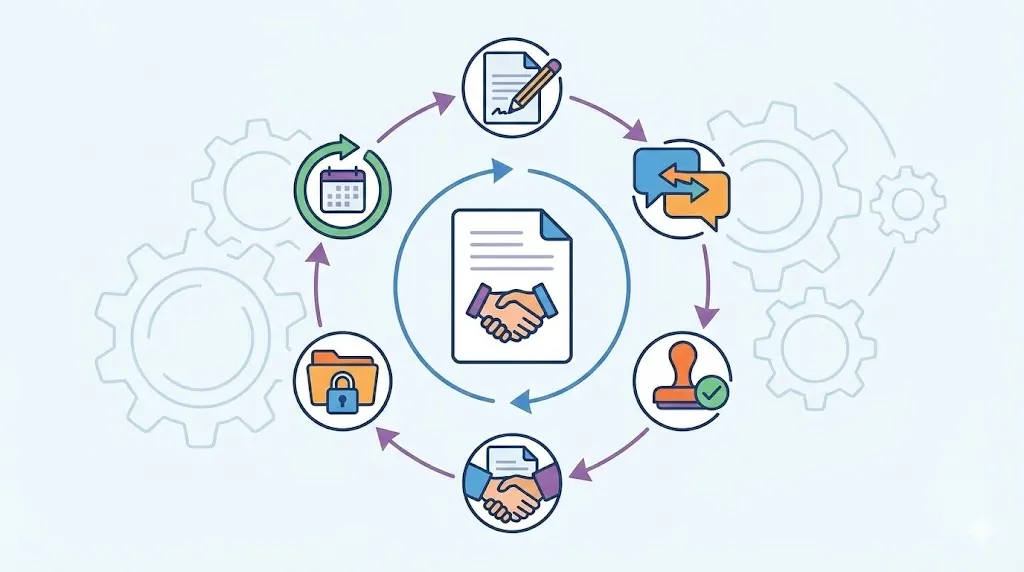
A useful lifecycle map should cover these stages:
Request: Capture the business need, parties, value, and risk.
Drafting: Use approved templates, clauses, and required intake fields.
Negotiation: Track redlines, comments, exceptions, and legal decisions.
Signature: Route the final version through approved signers and tools.
Tracking: Monitor duties, renewals, notices, payments, and key dates.
Review: Compare outcomes against approved terms and risk rules.
This map helps teams spot ownership gaps early. It also supports clearer reports across legal and business groups.
Related Article: Top Contract Management Software for Hyderabad
The Five Tools in Scope
The research identifies five tools for this comparison. They are Conga, Pramata, Evisort, LinkSquares, and JAGGAER. The available evidence does not support a Hyderabad-specific ranking. Buyers should confirm current features, prices, integrations, and local support.
Workflow and procurement coverage
Conga is positioned as a broad contract lifecycle platform. It may suit companies seeking wider workflow coverage across contract stages. Its fit depends on the buyer’s process design and integration needs.
JAGGAER brings contract work closer to procurement operations. Its focus includes source-to-pay visibility and a unified workspace. It also provides an AI contract assistant for contract-related insights. This may suit teams managing supplier and purchasing agreements.
AI analysis and contract search
Pramata supports contract AI analysis, according to the research. It also supports auto-redlining through a Microsoft Word add-in. Its self-service template generation can help business users start agreements. Legal teams should still review every suggested change.
Evisort focuses on AI extraction, analysis, and powerful search. These features can help teams find terms across older agreements. They may also support faster reviews during audits or renewals.
Drafting, analytics, and redline support
LinkSquares offers agreement analytics, AI drafting, and redline suggestions. These features may help legal teams review and create agreements faster. The right fit depends on workflow depth and business integration needs.
Capabilities can change as vendors update their products. Pricing and support can also differ by company size and scope. The research does not verify local deployments in Hyderabad. Each buyer should request a current product demonstration and proposal.
Tool | Primary use case | AI extraction | Drafting | Redlining | Search | Analytics | Procurement visibility | Workspace design | Integration options | Governance controls | Implementation support | Pricing transparency |
|---|---|---|---|---|---|---|---|---|---|---|---|---|
Conga | Broad contract lifecycle workflows | Vendor validation needed | Vendor validation needed | Vendor validation needed | Vendor validation needed | Vendor validation needed | Broader business workflows | Lifecycle platform | Confirm required systems | Confirm access and audit features | Confirm service model | Request current pricing |
Pramata | AI contract analysis and business self-service | Contract AI analysis | Self-service templates | Auto-redlining in Word | Confirm in demo | Contract analysis | Limited evidence in supplied research | Contract workflow focus | Confirm Word and core systems | Confirm controls and logs | Confirm migration support | Request current pricing |
Evisort | Contract extraction, analysis, and search | AI extraction | Vendor validation needed | Vendor validation needed | Powerful search | AI analysis | Limited evidence in supplied research | Search-led contract workspace | Confirm required systems | Confirm security evidence | Confirm service model | Request current pricing |
LinkSquares | Agreement analytics and drafting | Vendor validation needed | AI drafting | Redline suggestions | Vendor validation needed | Agreement analytics | Limited evidence in supplied research | Agreement management workspace | Confirm required systems | Confirm controls and logs | Confirm rollout support | Request current pricing |
JAGGAER | Procurement and source-to-pay contracts | Vendor validation needed | Vendor validation needed | Vendor validation needed | Vendor validation needed | AI assistant insights | Source-to-pay visibility | Unified workspace | Confirm procurement stack | Confirm governance features | Confirm implementation scope | Request current pricing |
This matrix supports a structured contract lifecycle management platforms comparison. It does not replace product testing or legal review. A Hyderabad buyer should score each tool against real contracts and workflows.
Related Article: Best Contract Management Software: Top 10 CLM Tools
AI and Automation Capabilities That Matter
Contract data extraction and classification
AI extraction can identify key details within large agreement collections. These details may include parties, dates, payment terms, and renewal dates. It may also find liability language, governing law, and compliance clauses. This reduces the need to read every document from the first page.
Teams should check extraction accuracy before trusting reports. Poor scans, unusual formats, and missing pages can cause errors. Human reviewers should confirm important fields before business decisions.
Classification adds another useful layer to contract work. It can group agreements by type, owner, supplier, risk, or status. That makes targeted reviews easier for legal and compliance teams.
Automated drafting and template generation
Automated drafting starts with approved templates and clause libraries. Guided intake forms collect facts before a draft begins. The system can then use those facts to create a first draft. This gives business users a safer path to self-service contracting.
Dynamic template generation can support different agreement types. A payment partner may need different clauses from a software vendor. Approval routing can also change based on value, risk, or data access.
Legal teams should control the source templates and fallback clauses. They should review updates before business users can apply them. This keeps speed from weakening contract quality.
Redlining and negotiation support
Auto-redlining can compare proposed language with approved positions. A Microsoft Word add-in can support review inside a familiar tool. Suggested changes may flag unusual language or missing protections. They may also recommend fallback clauses for common negotiation points.
AI suggestions need human legal review before acceptance. A tool may miss context within a complex commercial deal. It may also treat a rare clause as risky without enough background. Legal owners should record why exceptions were approved.
Post-signature analytics and obligation visibility
Contract work continues after signature. Teams must track deliverables, notices, renewals, payments, and service duties. AI-driven contract analytics can help surface missed or upcoming actions. It can also compare signed terms with approved commercial terms.
For example, a payment company receives a partner contract request. The system captures intake details and creates a draft. It extracts renewal, pricing, security, and data duties from the draft. It suggests redlines when language falls outside the playbook. High-risk terms move to compliance and legal for approval. After signature, reminders track notices and partner obligations.
This workflow shows the value of connected automation. It also shows why people must review high-risk decisions.
Related Article: Atlanta Contract Management: Top AI CLM Solutions
Evaluating Contract Lifecycle Management Platforms
Security, governance, and compliance controls
Security should lead every CLM evaluation for a FinTech business. Ask how the platform handles encryption, access, backups, and data transfer. Review role-based permissions and segregation of duties. The latter means separating actions that should not share one owner.
Audit logs should capture key user and workflow actions. Retention settings should support company policy and legal needs. Buyers should also ask about data residency and deletion controls. These questions support DPDP Act reviews and internal governance work.
Request evidence instead of accepting broad security statements. Useful evidence may include security documents, test reports, and process records. The buyer should understand each control’s scope and limits.
Integration, usability, and scalability
A CLM tool must fit the daily work of several teams. Legal users need strong drafting and review support. Procurement users need supplier and purchase visibility. Business users need simple intake and status updates.
Common integration needs include Microsoft Word and e-signature tools. Other needs may include CRM, ERP, procurement, finance, and identity systems. Collaboration and ticketing links can also reduce duplicate data entry.
Usability affects adoption more than feature count alone. A complex form may push users back to email. A clear workflow can improve intake quality and approval speed. Buyers should test common tasks with real users.
Use this weighted scorecard during product reviews:
Security: Check encryption, permissions, logs, retention, and data controls.
Usability: Test intake, search, drafting, approvals, and reporting.
Automation: Review extraction, reminders, routing, and obligation tracking.
Integrations: Test required links with business and identity systems.
Customization: Check fields, rules, templates, clauses, and workflows.
Analytics: Review reports for risk, renewals, cycle time, and obligations.
Implementation support: Confirm migration, training, testing, and service ownership.
Scalability: Test volume, users, teams, regions, and future contract types.
Reliability: Review references, product history, support, and issue handling.
Pricing transparency: Request clear fees for users, modules, services, and growth.
Score the tools with the same evidence standard. This creates a fairer view of the best contract management software Hyderabad teams can adopt.
Related Article: Best Contract Management Software in 2026: Top 20 CLM Tools
5 Key Challenges in Managing FinTech Contracts
1. Fragmented contract repositories
Agreements often sit across email, shared drives, and local folders. Some may also remain inside procurement, sales, or finance systems. This makes search slow and renewal reports unreliable. It also makes it hard to confirm the latest signed version.
Legal teams may miss older contracts during risk reviews. Business owners may not know where their duties are recorded. A central repository can create one controlled place for contract records.
2. Inconsistent approval and negotiation practices
Different teams often use different templates and clauses. Some deals may bypass legal review when deadlines feel urgent. Exceptions may remain in email without clear approval records. This creates delays and weakens negotiation control.
Ownership can also become unclear between legal, sales, procurement, and finance. A clear workflow should show who acts next. It should also define when compliance or security teams must review.
3. Hidden obligations and renewal exposure
A signed contract may include many duties beyond payment. These can cover service levels, notice periods, data protection, and reporting. Automatic renewals can create cost and planning problems. Missed termination rights can limit future choices.
Obligation tracking should assign each duty to a named owner. The system should send reminders before important dates. Reports should show open, overdue, and completed commitments.
4. Access, privacy, and audit risks
Excessive permissions expose sensitive contracts to the wrong users. Weak document rules can create duplicate or outdated copies. Missing logs make later reviews harder to complete. FinTech teams also handle sensitive vendor and operational information.
Access should match each person’s role and need. Reviews should remove access when roles change. Audit records should preserve key activity without hiding changes.
5. Integration and adoption barriers
Implementation can disrupt teams when plans lack clear stages. Data migration may expose duplicates, gaps, and poor metadata. Users may resist tools that add fields without removing effort. Support quality may also vary by vendor and service model.
Challenge | Operational impact | Affected stakeholder | Early warning sign | Mitigation priority |
|---|---|---|---|---|
Fragmented repositories | Slow search and missed renewals | Legal and business owners | Many file locations | High |
Inconsistent approvals | Delays and uncontrolled exceptions | Legal, sales, procurement | Email-based approvals | High |
Hidden obligations | Missed duties and unexpected costs | Finance and operations | No owner or reminder | High |
Access and audit risks | Data exposure and weak evidence | Compliance and security | Shared accounts or missing logs | High |
Integration barriers | Duplicate entry and low adoption | All contract users | Manual copying between systems | Medium to high |
This risk register helps leaders set the right order. It also connects contract problems with measurable business effects.
Remedies and Best Practices for Safer CLM Operations
Standardize intake, templates, and clause playbooks
Start with clear intake forms for each agreement type. Ask for value, parties, data access, term, and business owner. Use approved templates for common lending, vendor, and partnership deals. Clause playbooks should show preferred, fallback, and prohibited language.
Assign contract ownership by agreement type and business unit. This reduces confusion when reviews or renewals approach. It also helps teams measure work across the contract portfolio.
Build controls into customizable workflows
Approval rules should reflect value, risk, and data access. Separate drafting, approval, and signature duties where needed. Role-based access should limit sensitive records to approved users. Automated reminders should support reviews, notices, and renewals.
Exception routing should send unusual terms to the right experts. Audit-ready histories should record decisions and approval times. These controls support safer FinTech contract compliance tools.
Govern AI use with human review
AI can support contract work, but it should not replace judgment. Teams should validate extracted fields before relying on reports. Reviewers should check suggested clauses against current playbooks. They should also record material decisions and approved exceptions.
Managers should watch for false positives and missed terms. Sensitive matters may need restricted automation rules. Regular testing can show whether the tool remains accurate.
Use this practical controls checklist during rollout:
Repository cleanup: Remove duplicates and preserve signed originals.
Metadata standards: Define required fields for owners, dates, and risks.
Clause governance: Approve templates, fallbacks, and prohibited language.
Permissions: Review roles, access changes, and sensitive records.
Renewal alerts: Assign owners and set notice reminders.
Review ownership: Name legal, business, finance, and compliance owners.
AI validation: Check extracted fields and suggested language.
Audit testing: Review logs, approvals, exceptions, and retention rules.
Implementation, Integration, and Vendor Due Diligence
Prepare data and define contract ownership
Begin with an inventory of current agreements. Remove duplicates and identify missing signed versions. Standardize metadata for parties, dates, owners, value, and risk. Prioritize high-risk and high-volume contract groups first.
Every agreement should have a business owner. That owner should confirm duties, renewals, and required reviews. Legal should define the rules for unclear or disputed records.
Connect CLM with the wider FinTech stack
Contract management integration Hyderabad teams need will vary. CRM links may connect deals with contract requests. ERP and finance links may support payment and value checks. E-signature links can return completed documents to the repository.
Procurement links may support supplier and source-to-pay processes. Identity links can manage user access and role changes. Ticketing and compliance links can route tasks and evidence.
Ask vendors to show real integration flows. Do not rely only on a list of supported systems. Test the data direction, fields, errors, and ownership.
Validate commercial and vendor claims
Confirm local pricing, deployment choices, and service coverage. Ask about implementation timelines for your contract volume. Review security documents and integration depth before signing. Request evidence of product maturity and customer support.
The supplied research does not verify local pricing. It also does not confirm Hyderabad deployments for these five tools. Buyers should ask vendors for referenceable evidence where possible.
Measure adoption and business outcomes
Set measures before the rollout begins. Track cycle time from request through signature. Track repository completeness, approval delays, and renewal visibility. Also review obligation closure and self-service usage.
Exception rates can show whether playbooks work well. Audit preparation effort can show governance gains. User feedback can reveal forms, steps, or reports needing change.
Use a phased rollout sequence:
Discovery: Map agreement types, owners, risks, and current systems.
Pilot design: Choose one workflow with clear success measures.
Migration: Clean, classify, and load priority agreements.
Integration testing: Check data flows, permissions, alerts, and errors.
User training: Teach intake, review, approval, search, and reporting.
Controlled launch: Start with selected teams and monitored support.
Quarterly optimization: Improve rules, templates, fields, and reports.
A measured rollout reduces disruption. It also creates evidence for later investment decisions.
Related Article: Leading Contract Management Software for Enterprises
Why Contract Management Software Matters
Contract management software acts as an operating control. It connects requests, drafts, approvals, signatures, and obligations. That connection gives teams clearer ownership across each agreement.
Central repositories reduce time spent searching for documents. Structured workflows show where each request stands. Automated reminders reduce missed renewals and open duties. These controls directly address many managing FinTech contracts risks.
AI can support legal and business users during routine work. Extraction can find dates, parties, clauses, and payment terms. Search can surface older agreements during reviews. Drafting and redline tools can support faster negotiation.
Human oversight remains essential for sensitive FinTech decisions. Reviewers must confirm key fields and suggested contract language. They must also approve exceptions and record important judgments.
Volody’s CLM Software can support customizable CLM workflows for growing teams. It includes AI Contract Review, AI Contract Summaries, and Obligation Management. These features can flag risky terms, highlight key duties, and track renewals. Teams can use the platform to create stronger governance and clearer ownership.
For example, a lending firm can review partner terms centrally. It can flag unusual clauses, summarize renewal duties, and assign reminders. Legal staff can then approve the final position with an activity record.
A buyer still needs to test fit against its own controls. That includes security, integrations, data needs, and approval rules. The five tools above offer useful comparison points for that process.
> Explore Volody's CLM Software to streamline legal workflows, strengthen contract governance, and give your teams clearer control from intake through obligation management.
FAQ
What should Hyderabad FinTech companies evaluate before choosing a CLM platform?
Start with security, access controls, audit logs, and DPDP Act considerations. Then test workflow customization, integrations, search, reporting, and scalability. Review usability with legal, procurement, compliance, finance, and business users. Also confirm implementation support, pricing transparency, vendor maturity, and local service coverage.
Can CLM software help FinTech companies manage DPDP Act and audit requirements?
Yes, CLM software can support these needs through strong governance controls. Useful features include encryption, access rules, retention settings, audit logs, and approval histories. Searchable records can make internal reviews easier and faster. However, software does not replace legal advice or a complete compliance program.
How does AI contract analysis reduce risks in FinTech agreements?
AI contract analysis can find key terms, duties, dates, and unusual clauses. It can compare language against approved playbooks and highlight possible gaps. It can also support renewal monitoring and post-signature contract analysis. Human reviewers must validate important findings before making legal or business decisions.
What integrations are important for contract management in Hyderabad?
Common integrations include CRM, ERP, procurement, e-signature, and identity systems. Finance, collaboration, ticketing, and compliance tools may also matter. The right choices depend on each company’s contract process and system landscape. Ask vendors to demonstrate real data flows, permissions, errors, and support duties.
How long does it take to implement a contract lifecycle management platform?
The timeline depends on repository size, data quality, and workflow complexity. Integration needs, migration scope, training, and vendor support also affect timing. A phased rollout often reduces disruption and improves user feedback. Start with a focused pilot before moving into wider contract categories.
Are the five tools discussed ranked for Hyderabad FinTech companies?
No, the research identifies five tools within the article’s scope. It does not provide enough evidence for a definitive Hyderabad ranking. It also does not verify local pricing, integrations, or customer deployments. Buyers should validate current capabilities through demonstrations, documents, and reference checks.
About the Company

Volody AI CLM is an Agentic AI-powered Contract Lifecycle Management platform designed to eliminate manual contracting tasks, automate complex workflows, and deliver actionable insights. As a one-stop shop for all contract activities, it covers drafting, collaboration, negotiation, approvals, e-signature, compliance tracking, and renewals. Built with enterprise-grade security and no-code configuration, it meets the needs of the most complex global organizations. Volody AI CLM also includes AI-driven contract review and risk analysis, helping teams detect issues early and optimize terms. Trusted by Fortune 500 companies, high-growth startups, and government entities, it transforms contracts into strategic, data-driven business assets.





" height="216.72211px" id="FYO0bO80Y" transform="translate(3 6.105)" width="206.073px"/><path d="M 108.174 222 C 88.432 222 70.303 217.239 53.785 207.717 C 37.267 198.196 24.173 185.052 14.504 168.285 C 4.835 151.312 0 132.165 0 110.845 C 0 89.731 4.835 70.792 14.504 54.025 C 24.173 37.052 37.267 23.804 53.785 14.282 C 70.303 4.761 88.432 0 108.174 0 C 128.116 0 146.246 4.761 162.562 14.282 C 179.08 23.804 192.073 37.052 201.541 54.025 C 211.21 70.792 216.044 89.731 216.044 110.845 C 216.044 132.165 211.21 151.312 201.541 168.285 C 192.073 185.052 179.08 198.196 162.562 207.717 C 146.044 217.239 127.915 222 108.174 222 Z M 108.174 183.189 C 120.864 183.189 132.044 180.291 141.713 174.495 C 151.382 168.492 158.936 160.006 164.375 149.035 C 169.814 138.064 172.533 125.334 172.533 110.845 C 172.533 96.355 169.814 83.729 164.375 72.965 C 158.936 61.994 151.382 53.611 141.713 47.815 C 132.044 42.02 120.864 39.122 108.174 39.122 C 95.483 39.122 84.202 42.02 74.332 47.815 C 64.663 53.611 57.109 61.994 51.67 72.965 C 46.231 83.729 43.511 96.355 43.511 110.845 C 43.511 125.334 46.231 138.064 51.67 149.035 C 57.109 160.006 64.663 168.492 74.332 174.495 C 84.202 180.291 95.483 183.189 108.174 183.189 Z" fill="rgba(255, 255, 255, 0.12)" height="222px" id="aa1McFcE9" transform="translate(227.183 3)" width="216.04399999999998px"/><path d="M 42.302 182.257 L 111.799 182.257 L 111.799 216.722 L 0 216.722 L 0 0 L 42.302 0 Z" fill="rgba(255, 255, 255, 0.12)" height="216.72211px" id="yRq4AnrsX" transform="translate(477.721 6.105)" width="111.79899999999998px"/><path d="M 108.174 222 C 88.432 222 70.303 217.239 53.785 207.717 C 37.267 198.196 24.173 185.052 14.504 168.285 C 4.835 151.312 0 132.165 0 110.845 C 0 89.731 4.835 70.792 14.504 54.025 C 24.173 37.052 37.267 23.804 53.785 14.282 C 70.303 4.761 88.432 0 108.174 0 C 128.116 0 146.246 4.761 162.562 14.282 C 179.08 23.804 192.073 37.052 201.541 54.025 C 211.21 70.792 216.045 89.731 216.045 110.845 C 216.045 132.165 211.21 151.312 201.541 168.285 C 192.073 185.052 179.08 198.196 162.562 207.717 C 146.044 217.239 127.915 222 108.174 222 Z M 108.174 183.189 C 120.864 183.189 132.044 180.291 141.713 174.495 C 151.382 168.492 158.936 160.006 164.375 149.035 C 169.814 138.064 172.534 125.334 172.534 110.845 C 172.534 96.355 169.814 83.729 164.375 72.965 C 158.936 61.994 151.382 53.611 141.713 47.815 C 132.044 42.02 120.864 39.122 108.174 39.122 C 95.483 39.122 84.202 42.02 74.332 47.815 C 64.663 53.611 57.108 61.994 51.67 72.965 C 46.231 83.729 43.511 96.355 43.511 110.845 C 43.511 125.334 46.231 138.064 51.67 149.035 C 57.108 160.006 64.663 168.492 74.332 174.495 C 84.202 180.291 95.483 183.189 108.174 183.189 Z" fill="rgba(255, 255, 255, 0.12)" height="222px" id="mo8HQspQ0" transform="translate(609.155 3)" width="216.04500000000007px"/><path d="M 73.727 0 C 95.885 0 115.324 4.45 132.044 13.351 C 148.967 22.252 161.957 34.982 171.027 51.541 C 180.287 67.894 184.917 86.937 184.917 108.671 C 184.917 130.405 180.287 149.449 171.027 165.801 C 161.957 181.947 148.967 194.47 132.044 203.371 C 115.324 212.271 95.885 216.722 73.727 216.722 L 0 216.722 L 0 0 Z M 72.216 179.773 C 94.374 179.773 111.497 173.564 123.583 161.144 C 135.669 148.724 141.713 131.233 141.713 108.671 C 141.713 86.109 135.669 68.515 123.583 55.888 C 111.497 43.055 94.374 36.638 72.216 36.638 L 42.302 36.638 L 42.302 179.773 Z" fill="rgba(255, 255, 255, 0.12)" height="216.72211px" id="I3iXX5Hi_" transform="translate(859.693 6.105)" width="184.91699999999992px"/><path d="M 185.22 0 L 113.91 141.273 L 113.91 216.722 L 71.61 216.722 L 71.61 141.273 L 0 0 L 47.74 0 L 93.06 99.046 L 138.08 0 Z" fill="rgba(255, 255, 255, 0.12)" height="216.72211px" id="nzHyWC0_d" transform="translate(1061.78 6.105)" width="185.22000000000003px"/></svg>)