

License agreements protect your intellectual property while allowing others to use it. But many agreements fail because they miss key clauses that handle real-world problems. Imagine handing over rights to your software or patent, only to face disputes because the contract didn’t clearly say what happens if the licensee misuses your IP or misses payments. This article breaks down the key clauses you need to build bulletproof license agreements that stand up to challenges and protect your business interests.
TL;DR
Clearly specifying the rights granted—including permitted uses, formats, and any restrictions—helps prevent legal disputes.
Selecting the appropriate license type—whether exclusive, non-exclusive, or sole—determines the degree of control over usage.
It is critical to define territorial scope and distribution channels, particularly for digital products that can be accessed globally.
Contractual provisions addressing duration, renewal options, and termination clauses are essential for mitigating lifecycle risks.
Explicitly detailing royalties, fees, payment schedules, and audit rights safeguards against potential revenue discrepancies.
Employing contract management software to monitor obligations and deadlines minimizes the risk of overlooked renewals or breaches.
Related Article: Key Clauses Every License Agreement Should Include
What Exactly Is a License Agreement?
An agreement that permits the use of intellectual property (IP) by another party under defined terms is known as a license agreement. The owner, referred to as the licensor, retains ownership while granting the licensee rights to utilize the IP. Instead of transferring ownership outright, it functions more like a lease of intellectual property rights. Such contracts frequently arise in industries involving software, patents, trademarks, and creative works.
Instead of constituting a single, isolated transaction, this contract creates an ongoing relationship. The licensor does not simply deliver a product and disengage. It specifies the authorized uses of the intellectual property, the timeframe of the license, and the ramifications of any contractual violations. Maintaining this ongoing regulatory authority is crucial for safeguarding intellectual property rights and associated revenue streams.
The U.S. licensing market is huge, valued at nearly $70 billion in 2026 according to industry reports. Yet many companies lose money because they don’t manage license agreements well. Research shows organizations lose about 11% of contract value after signing due to missed renewals, underreported royalties, and poor enforcement.
Every enforceable license agreement needs these core elements:
Identified IP: The specific intellectual property being licensed, like a patent or software.
Licensor and Licensee: The parties involved, detailing ownership of the IP and the recipient of usage rights.
Grant of Rights: Defines the extent and nature of permissions granted for exploiting the intellectual property.
Consideration: The compensation provided to the licensor, typically in the form of royalties or fees.
Restrictions: Specifies the constraints imposed on the licensee’s utilization of the licensed material.
Clearly articulating these elements is essential to avoid misunderstandings and legal disputes down the line.
Related articles: What is Software License Agreement? Know the Basics
What Are the Main Types of License Agreements?
The type of license you grant shapes the entire agreement. Additionally, it also defines the operational boundaries for both parties and the mechanisms for safeguarding your IP. There are three main categories:
Exclusive License
An exclusive license grants one licensee the right to use the IP within a defined scope. The licensor is excluded from using the IP in that territory. This is the most restrictive and usually the most expensive type. You hand over sole commercial rights.
Clauses about territory, sublicensing, and performance minimums are critical here. You want to make sure the licensee uses the IP actively and doesn’t let it sit idle.
Non-Exclusive License
A non-exclusive license lets the licensor grant the same rights to multiple licensees simultaneously. This is common in software, music, and content licensing. Since many licensees may operate in overlapping areas, territory and channel restrictions become more important.
Sole License
A sole license grants rights to one licensee while allowing the licensor to retain their own usage privileges. This type is less common but useful in joint development or consulting where both parties need ongoing access.
License Type | Number of Licensees | Licensor Usage Rights | Typical Pricing | Common Use Cases |
|---|---|---|---|---|
Exclusive | One | No | Highest | Pharma patents, franchises |
Non-Exclusive | Multiple | Yes | Lowest | Software, stock content |
Sole | One | Yes | Moderate | Co-development, consulting |
Choosing the right license type upfront shapes how you write other clauses.
Related articles: Dispute Resolution Clause: How to Draft a Strong One
What Are the Key Clauses Every License Agreement Needs?
Certain provisions commonly appear in most license agreements. Additionally, these clauses serve to assign particular risks or duties that are intrinsic to licensing relationships. Omitting any of these critical components can lead to complications, both legally and operationally, down the line.
Related Articles: Essential Clauses for Rock-Solid License Agreements
Grant of Rights and Scope of Use
This clause specifies the exact permissions granted to the licensee regarding your intellectual property. It covers:
Types of use (manufacture, distribute, display, modify)
Formats allowed (digital, print, physical products)
Field-of-use restrictions (specific industries or applications)
The more specific you are, the fewer disputes you face. Vague language leads to disagreements about what’s allowed.
Example: A software license might state, “Licensee may utilize the software solely for internal business operations and is prohibited from sublicensing or distributing it to third parties.”
Related Article: What is Consideration Clause in Your Contracts? A 2026 Guide
Exclusivity and Sublicensing
This clause clarifies whether the license is exclusive, non-exclusive, or sole. Moreover, it also controls sublicensing rights.
Sublicensing permits the licensee to extend rights to other entities. Without appropriate constraints, sublicensing can diminish the value of your IP. Most agreements either prohibit sublicensing entirely or require your prior written approval.
Example: “Licensee shall not grant sublicenses of the IP without Licensor’s prior written consent.”
Territory and Distribution Channels
This clause sets geographic boundaries and sales channels where the licensee can operate. For physical goods, this is straightforward. Furthermore, digital products complicate this because online access is global by default.
You must explicitly state where online sales or access are permitted. For instance, “Licensee may distribute the software only within the United States and Canada and may not offer access outside these territories.”
Term, Renewal, and Termination
This clause governs how long the license lasts, renewal conditions, and how either party can end it early.
Define the initial term (e.g., 3 years) and renewal process (automatic or by agreement).
Clarify termination for cause (breach, insolvency) and termination for convenience (notice period).
Irrevocable licenses, where the licensor cannot end the agreement at will, require very careful wording.
Example: “The duration of this agreement is 5 years, with automatic renewal for successive one-year periods unless either party provides 90 days’ written notice.”
Royalties, Fees, and Payment Terms
This clause details the financial terms:
Royalty rates or fixed fees
Minimum guarantees or advance payments
Payment schedules and methods
Audit rights to verify royalty reports
Audit rights are critical to ensure accurate royalty reporting. Also, without them, licensees might underreport payments.
Example: “Licensee will pay a royalty of 5% of net sales quarterly. Licensor may audit Licensee’s records once per year with 30 days’ notice.”
Quality Control (for Trademark Licenses)
If you license a trademark, you must include quality control provisions. Failure to monitor quality standards can cause “naked licensing,” which risks losing trademark protection.
Example: “Licensee agrees to maintain product quality standards set forth in Exhibit A and permits Licensor to inspect products upon reasonable notice.”
Confidentiality and Data Protection
Include clauses to protect confidential information shared during the license relationship. Also, address data protection if personal data is involved.
Example: “Both parties shall keep confidential all proprietary information disclosed during the term of this agreement.”
Indemnification and Liability
Specify who bears responsibility if third parties claim damages related to the licensed IP or its use, and limit liability where feasible.
Example: “Licensee agrees to indemnify Licensor against claims resulting from Licensee’s misuse of the IP.”
Governing Law and Dispute Resolution
Identify the applicable jurisdiction’s laws and outline the dispute resolution mechanisms (mediation, arbitration, court).
Example: “This agreement is governed by the laws of the State of New York. Any disputes will be resolved through binding arbitration.”
Related articles: 20 Key Contract Clauses Every Business Should Know in 2026
How Do License Agreement Clauses Vary by IP Type?
Different types of intellectual property require tailored clauses. Additionally, while the fundamental framework remains consistent, the specific provisions adapt to the nuances of each IP category.
Patent Licenses
Patent licenses frequently encompass:
Detailed field-of-use restrictions to protect patent scope
Performance milestones or minimum royalties to ensure active use
Clear definitions of improvements or derivatives
Example: In the context of a medical device, the patent agreement might limit application to specific countries and mandate minimum annual sales.
Trademark Licenses
Trademark licenses focus heavily on quality control to prevent loss of rights. They also specify how the mark can be used visually and in marketing.
Example: For a clothing brand, the trademark agreement establishes criteria for fabric quality, labeling, and promotional materials.
Copyright Licenses
Copyright licenses cover creative works like software, music, or publications. They often specify permitted reproduction, modification, and distribution rights.
Example: A software license might allow internal use but prohibit reverse engineering or resale.
Software Licenses
Software licenses have unique challenges:
Define user types (single user, enterprise, concurrent users)
Address updates, maintenance, and support obligations
Include license key or activation controls
Manage online access and cloud usage
Example: A SaaS license may limit access to a certain number of users and require payment based on usage.
Related articles: 5 Best CLM & Contract Management Software in CA
How to Draft a License Agreement Step by Step
Drafting a license agreement requires careful planning and precision. Follow these steps:
Identify the IP and Parties: Clearly describe the asset being licensed and name the licensor and licensee.
Choose License Type: Decide if the license is exclusive, non-exclusive, or sole.
Define Grant of Rights: Clearly delineate permissible uses, detailing authorized use types, permissible formats, and any applicable limitations related to the licensed material.
Set Territory and Channels: Specify the geographic scope and distribution channels authorized for its exploitation.
Determine Term and Renewal: Establish the duration, renewal terms, and termination rights.
Agree on Consideration: Set royalties, fees, payment schedules, and audit rights.
Include Quality and Compliance Clauses: For trademarks or regulated IP, add quality control and compliance terms.
Add Confidentiality and Indemnity: Incorporate provisions to safeguard proprietary information and delineate responsibility for liabilities.
Specify Governing Law and Dispute Resolution: Identify the applicable legal jurisdiction and outline the mechanisms for resolving disputes.
Review and Negotiate: Provide both parties the opportunity to examine the document, propose amendments, and reach a final consensus.
Employ precise and unambiguous terminology throughout the agreement. It is crucial to tailor clauses to the unique aspects of your transaction rather than relying on generic templates.
Related articles: Explore techniques for generating comprehensive renewal and termination summaries to enhance contract management.
How to Manage License Agreement Clauses After Signing
Signing the agreement is just the start. Additionally, effective management of license agreements is essential to avoid revenue leakage and mitigate legal exposure.
Centralize Contracts: All license agreements should be stored in a secure repository designed for easy navigation and controlled access.
Track Key Dates: It is crucial to monitor renewal deadlines, termination windows, and payment schedules meticulously.
Automate Alerts: Deploy automated systems capable of issuing proactive notifications before critical contractual events occur.
Monitor Obligations: Ensure ongoing compliance by both parties with respect to quality standards, reporting commitments, and payment obligations.
Conduct Audits: Perform periodic reviews to confirm the accuracy of royalty statements and adherence to contract provisions.
Update Agreements: Revise licenses to reflect evolving business requirements or regulatory changes.
According to the 2026 Contracting Benchmark Report, poor contract management causes 40% of contract leakage. Systems that automate tracking and alerts reduce this risk significantly.
Related articles: Legal Playbook: Reasons Why Your Business Needs One
Why Contract Management Software Matters
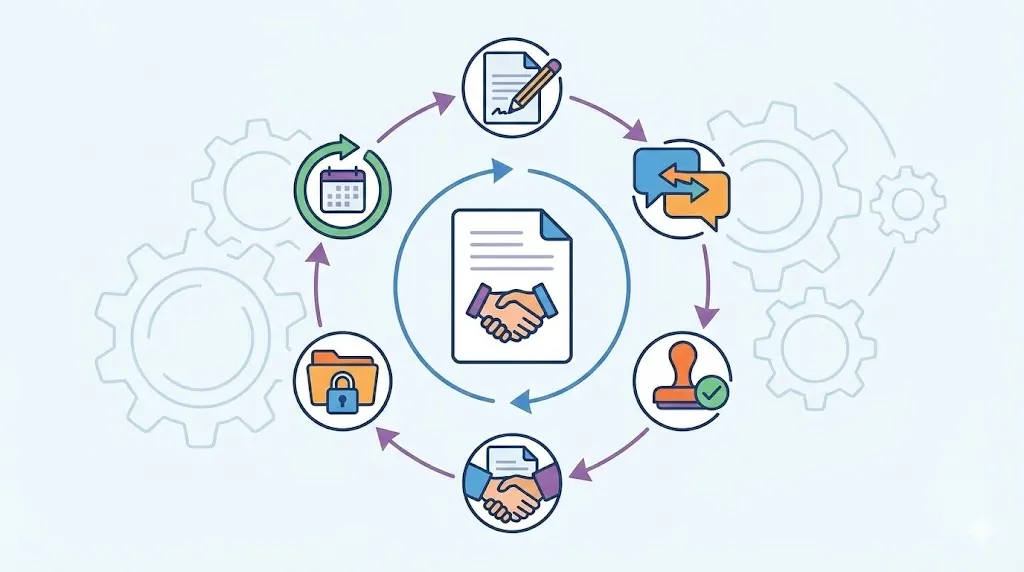
Managing complex license agreements manually creates risks. Additionally, contract lifecycle management (CLM) software streamlines the organization, oversight, and enforcement of license clauses.
CLM tools consolidate your contracts into a single platform while capturing essential details such as renewal dates, royalty terms, and usage restrictions.
Automated notifications alert you well in advance of key deadlines, helping to guarantee timely renewals and payments.
By incorporating AI functionalities, CLM solutions examine contracts to detect missing or potentially problematic provisions.
The system monitors adherence to contractual commitments and enforces audit rights to ensure consistent compliance.
Volody’s contract management solution integrates AI-driven drafting, review, and obligation monitoring capabilities within a unified platform.
Its centralized repository includes version control combined with sophisticated search functions.
Moreover, streamlined approval workflows accelerate processing times, while built-in electronic signature capabilities minimize execution delays.
Explore how Volody's CLM Software empowers your team to manage contracts confidently.
FAQ
What happens if a license agreement lacks clear grant of rights language?
Without explicit grant language, disputes frequently arise regarding the licensee’s authorized activities. Ambiguities in permitted uses, formats, or fields often lead to unauthorized exploitation or costly litigation to delineate rights.
How do exclusive and non-exclusive licenses differ in risk?
An exclusive license grants sole rights within a defined scope, barring the licensor from licensing others for those same rights.
Exclusive licenses concentrate operational risk if the licensee underperforms, whereas non-exclusive arrangements spread that risk across multiple licensees, potentially compromising exclusivity value.
Furthermore, each licensing strategy presents distinct trade-offs that should align with your overall business goals.
Why are quality control clauses critical in trademark licenses?
Trademark owners must actively supervise licensee use to preserve trademark validity. Failure to enforce quality standards may result in courts deeming “naked licensing,” which jeopardizes trademark rights. Such clauses define consistent quality benchmarks that safeguard brand integrity.
Can I terminate a license agreement at any time?
Termination rights are defined by the specific provisions within the contract.
Also, most agreements permit termination for cause, such as breach, and sometimes for convenience upon notice. Furthermore, some licenses are irrevocable, limiting termination possibilities. It is essential to scrutinize termination provisions prior to execution.
How do audit rights protect licensors?
Audit rights enable licensors to verify that licensees accurately report royalties and fulfill their contractual duties. They provide a mechanism for early detection of underreporting or misuse. Without these rights, licensors rely solely on licensee transparency, which risks revenue loss.
What should I consider when licensing software?
Software licenses require clearly defined user categories, precise usage parameters, and explicit policies on updates.
Therefore, considerations also include cloud access provisions, support commitments, and prohibitions on reverse engineering.
Licensing digital products demands meticulous terms to prevent unauthorized distribution.
How can contract management software reduce license agreement risks?
Contract management systems centralize your agreements, monitor critical deadlines, and issue proactive reminders.
These capabilities help prevent missed renewals, late royalty payments, and compliance failures.
AI-enhanced features identify high-risk clauses and extract key information, enhancing oversight and control.
What is a sole license and when is it useful?
Consequently, a sole license confers exclusive rights to a specified licensee while allowing the licensor to retain usage privileges.
This arrangement suits joint ventures or consulting relationships where shared access is necessary.
It balances exclusivity with operational flexibility for the licensor.
How do territorial restrictions apply to digital products?
Because digital products can be accessed worldwide, defining territorial limitations requires careful drafting.
You need to delineate authorized regions for online sales or access explicitly.
Techniques such as IP address filtering or geo-restriction of logins help enforce these territorial boundaries.
What are common mistakes to avoid when drafting license agreements?
Common errors include vague grant language, missing audit rights, unclear termination terms, and lack of quality control for trademarks. Also, failing to track obligations post-signature leads to revenue loss. Draft with precision and plan for ongoing management.
This comprehensive guide equips legal and operations leaders with the knowledge to draft and manage license agreements that protect intellectual property and revenue. Clear clauses, tailored to your IP type and business model, combined with diligent contract management, create agreements that hold strong under pressure.
About the Company

Volody AI CLM is an Agentic AI-powered Contract Lifecycle Management platform designed to eliminate manual contracting tasks, automate complex workflows, and deliver actionable insights. As a one-stop shop for all contract activities, it covers drafting, collaboration, negotiation, approvals, e-signature, compliance tracking, and renewals. Built with enterprise-grade security and no-code configuration, it meets the needs of the most complex global organizations. Volody AI CLM also includes AI-driven contract review and risk analysis, helping teams detect issues early and optimize terms. Trusted by Fortune 500 companies, high-growth startups, and government entities, it transforms contracts into strategic, data-driven business assets.




" height="216.72211px" id="FYO0bO80Y" transform="translate(3 6.105)" width="206.073px"/><path d="M 108.174 222 C 88.432 222 70.303 217.239 53.785 207.717 C 37.267 198.196 24.173 185.052 14.504 168.285 C 4.835 151.312 0 132.165 0 110.845 C 0 89.731 4.835 70.792 14.504 54.025 C 24.173 37.052 37.267 23.804 53.785 14.282 C 70.303 4.761 88.432 0 108.174 0 C 128.116 0 146.246 4.761 162.562 14.282 C 179.08 23.804 192.073 37.052 201.541 54.025 C 211.21 70.792 216.044 89.731 216.044 110.845 C 216.044 132.165 211.21 151.312 201.541 168.285 C 192.073 185.052 179.08 198.196 162.562 207.717 C 146.044 217.239 127.915 222 108.174 222 Z M 108.174 183.189 C 120.864 183.189 132.044 180.291 141.713 174.495 C 151.382 168.492 158.936 160.006 164.375 149.035 C 169.814 138.064 172.533 125.334 172.533 110.845 C 172.533 96.355 169.814 83.729 164.375 72.965 C 158.936 61.994 151.382 53.611 141.713 47.815 C 132.044 42.02 120.864 39.122 108.174 39.122 C 95.483 39.122 84.202 42.02 74.332 47.815 C 64.663 53.611 57.109 61.994 51.67 72.965 C 46.231 83.729 43.511 96.355 43.511 110.845 C 43.511 125.334 46.231 138.064 51.67 149.035 C 57.109 160.006 64.663 168.492 74.332 174.495 C 84.202 180.291 95.483 183.189 108.174 183.189 Z" fill="rgba(255, 255, 255, 0.12)" height="222px" id="aa1McFcE9" transform="translate(227.183 3)" width="216.04399999999998px"/><path d="M 42.302 182.257 L 111.799 182.257 L 111.799 216.722 L 0 216.722 L 0 0 L 42.302 0 Z" fill="rgba(255, 255, 255, 0.12)" height="216.72211px" id="yRq4AnrsX" transform="translate(477.721 6.105)" width="111.79899999999998px"/><path d="M 108.174 222 C 88.432 222 70.303 217.239 53.785 207.717 C 37.267 198.196 24.173 185.052 14.504 168.285 C 4.835 151.312 0 132.165 0 110.845 C 0 89.731 4.835 70.792 14.504 54.025 C 24.173 37.052 37.267 23.804 53.785 14.282 C 70.303 4.761 88.432 0 108.174 0 C 128.116 0 146.246 4.761 162.562 14.282 C 179.08 23.804 192.073 37.052 201.541 54.025 C 211.21 70.792 216.045 89.731 216.045 110.845 C 216.045 132.165 211.21 151.312 201.541 168.285 C 192.073 185.052 179.08 198.196 162.562 207.717 C 146.044 217.239 127.915 222 108.174 222 Z M 108.174 183.189 C 120.864 183.189 132.044 180.291 141.713 174.495 C 151.382 168.492 158.936 160.006 164.375 149.035 C 169.814 138.064 172.534 125.334 172.534 110.845 C 172.534 96.355 169.814 83.729 164.375 72.965 C 158.936 61.994 151.382 53.611 141.713 47.815 C 132.044 42.02 120.864 39.122 108.174 39.122 C 95.483 39.122 84.202 42.02 74.332 47.815 C 64.663 53.611 57.108 61.994 51.67 72.965 C 46.231 83.729 43.511 96.355 43.511 110.845 C 43.511 125.334 46.231 138.064 51.67 149.035 C 57.108 160.006 64.663 168.492 74.332 174.495 C 84.202 180.291 95.483 183.189 108.174 183.189 Z" fill="rgba(255, 255, 255, 0.12)" height="222px" id="mo8HQspQ0" transform="translate(609.155 3)" width="216.04500000000007px"/><path d="M 73.727 0 C 95.885 0 115.324 4.45 132.044 13.351 C 148.967 22.252 161.957 34.982 171.027 51.541 C 180.287 67.894 184.917 86.937 184.917 108.671 C 184.917 130.405 180.287 149.449 171.027 165.801 C 161.957 181.947 148.967 194.47 132.044 203.371 C 115.324 212.271 95.885 216.722 73.727 216.722 L 0 216.722 L 0 0 Z M 72.216 179.773 C 94.374 179.773 111.497 173.564 123.583 161.144 C 135.669 148.724 141.713 131.233 141.713 108.671 C 141.713 86.109 135.669 68.515 123.583 55.888 C 111.497 43.055 94.374 36.638 72.216 36.638 L 42.302 36.638 L 42.302 179.773 Z" fill="rgba(255, 255, 255, 0.12)" height="216.72211px" id="I3iXX5Hi_" transform="translate(859.693 6.105)" width="184.91699999999992px"/><path d="M 185.22 0 L 113.91 141.273 L 113.91 216.722 L 71.61 216.722 L 71.61 141.273 L 0 0 L 47.74 0 L 93.06 99.046 L 138.08 0 Z" fill="rgba(255, 255, 255, 0.12)" height="216.72211px" id="nzHyWC0_d" transform="translate(1061.78 6.105)" width="185.22000000000003px"/></svg>)