

Enterprise contract management is a critical business discipline for controlling risk, strengthening accountability, and turning contractual commitments into measurable performance. A missed renewal can damage trust, trigger disputes, and expose weak controls—especially when a global organization manages thousands of supplier agreements across email, shared drives, and disconnected systems.
TL;DR
Strong contract controls translate written promises into defined actions, assigned owners, deadlines, and supporting evidence.
Enterprise teams also need a trusted record that brings together agreements, risks, approvals, and business commitments.
AI can identify key terms, but people remain responsible for governing how it is used, validating its accuracy, controlling access, and overseeing resulting decisions.
Supplier contracts can advance ethical sourcing while supporting privacy, security, and broader compliance objectives.
The right technology links legal work to finance, procurement, sales, security, and operations rather than leaving it in a silo.
Begin by establishing clear ownership and useful data, then build simple workflows around measurable business outcomes.
Why Contracts Build Trust and Compliance
Contracts shape an organization’s dealings with customers, suppliers, employees, and partners. Additionally, they set out prices, delivery duties, service levels, data rules, payment dates, and remedies. Each clause imposes a promise that someone must understand and fulfill.
That promise can affect several teams at once. A data processing clause can span legal, security, and information technology. Rebates often draw in sales, finance, and procurement. Before a review, operations may have to assemble evidence under a supplier audit right.
Many businesses still regard execution of the agreement as the finish line. Moreover, in practice, however, signature marks the start of performance. Once the agreement is signed, the business must perform the terms, document proof, and act before key dates pass.
How contract obligations affect business performance
An obligation directs a party to take an action, refrain from one, or satisfy a condition. The required action might involve a monthly report, a service credit, a security review, or notice before renewal. Some duties arise only once; others continue for years.
Lengthy contract paragraphs often conceal these duties. Different agreements may describe the same concept in different language. A supplier might promise to “maintain safeguards,” while another agreement requires “reasonable security controls.”
This variation creates practical problems:
Teams may miss duties buried in schedules or attachments.
Furthermore, it may be unclear to owners which actions belong to them.
Business targets are sometimes mistaken for binding commitments.
A renewal may proceed without any review of poor performance.
Locating proof of compliance may be difficult for auditors.
The risk grows with scale. Contracts may span countries, legal entities, currencies, and languages within a single organization. Each group may store files in a different place. Also, teams may also use separate tools for requests, approvals, signatures, and reporting.
The U.S. Department of Justice asks companies to assess whether their compliance programs work in practice. That question applies to contract controls as well. A policy has little value if employees cannot find the relevant agreement or act on its requirements.
A strong contract process connects each obligation to five basic facts:
What must someone do?
Who is accountable for carrying it out?
By what date must it be completed?
Therefore, what record demonstrates completion?
What happens if the party misses the duty?
This structure makes compliance visible. It gives managers a fair basis for measuring performance. They can see open tasks, late actions, upcoming renewals, and repeated supplier failures.
Why trust depends on reliable contract data
Trust grows when a company keeps its promises. As a result, customers expect accurate invoices, reliable services, and proper data handling. For suppliers, fair payment, clear standards, and consistent decisions matter. Consequently, regulators, in turn, expect records that support the company’s claims.
All three relationships depend on contract data. It shows what the company agreed to do and what the other party agreed to provide. It gives leaders a shared record during a dispute.
Poor records weaken that trust. A business may consequently retain several versions of one agreement. The latest amendment may be difficult to identify. As a result, proof that an authorized person approved a change may be missing.
A central contract record reduces these problems. It should include the executed agreement, related amendments, key dates, parties, owners, and business terms. It should record actions taken during review, approval, negotiation, and performance as well.
That record must support more than legal review. Finance may need payment terms. Procurement may need supplier commitments. Security teams should be able to review audit rights. Executives may need exposure reports across entities and regions.
How contracts support responsible business goals
Organizations often make public promises about privacy, fair labor, security, environmental care, and responsible sourcing. Those promises need operational support. Contracts can convert broad goals into specific supplier and customer requirements.
For example, a company may require suppliers to:
Follow a code of conduct.
Raise concerns involving forced labor.
Safeguard personal information.
Subsequently, keep business continuity plans in place.
Allow compliance reviews.
Notify the company when security incidents occur.
Furnish evidence of required certifications.
Contract language by itself cannot establish performance. The company must assign owners, set review dates, and collect evidence. It should define escalation steps for late reports or failed reviews as well.
The OECD Guidelines for Multinational Enterprises describe responsible business conduct across areas such as human rights, labor, environment, and disclosure. Enterprises can reflect those expectations in supplier terms and review processes.
A contract program should also avoid unrealistic promises. If a company cannot monitor a requirement, it should question whether the clause works. Measurable, clearly assigned terms generally produce better outcomes than broad language with no owner.
Related articles: What is Contract Risk ; How to manage it?
What Makes Enterprise Contract Management Difficult
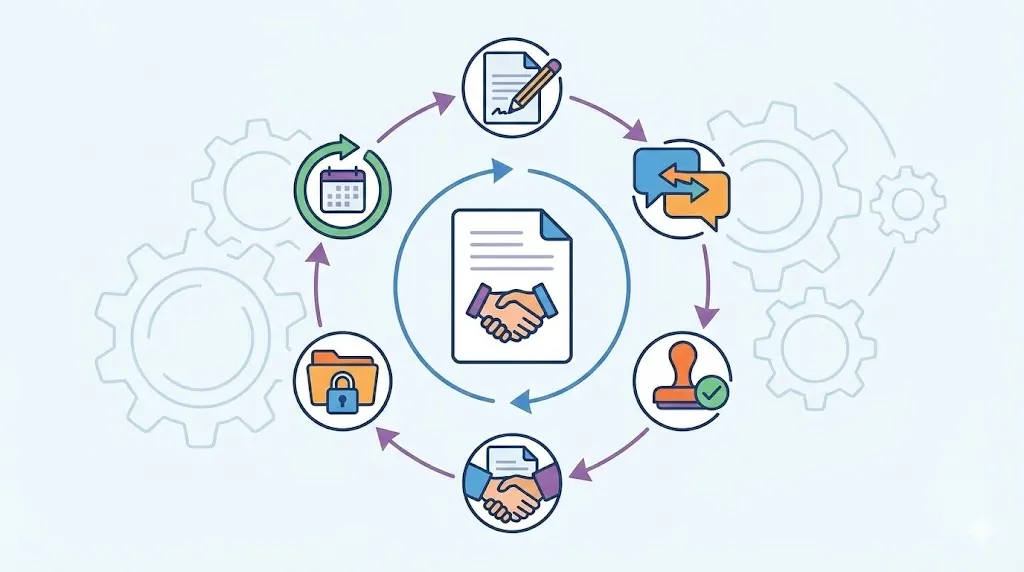
Enterprise contract management spans the full contract lifecycle, from initial request through renewal or termination. Additionally, it encompasses drafting, review, negotiation, approval, signature, storage, performance, and reporting. When teams rely on disconnected methods, any of these stages can introduce delays or risk.
Legal teams often feel the pressure first. They receive incomplete requests, unclear business goals, and urgent reviews. They must also answer questions about old contracts while negotiating new ones.
Business teams face a different problem. They need prompt access to answers about pricing, contract term, service levels, rights, and responsibilities. Many are not sure which legal provisions require approval. When the formal process moves too slowly, they may turn to workarounds.
Where manual processes break down
In complex contract work, email makes for a poor record. A single request may produce dozens of messages, several attachments, and conflicting instructions. A new employee may struggle to understand the final decision.
Shared drives create another problem. Moreover, they store documents, but they rarely manage the work around those documents. A folder cannot remind an owner about a notice date or route a high-risk clause for review.
Spreadsheets can track dates for small portfolios. They become fragile when teams manage thousands of agreements. Users may enter inconsistent values, overwrite formulas, or stop updating the file.
Manual work also creates uneven decisions. One lawyer may accept a clause that another lawyer would reject. One business unit may use an approved template, while another copies an old agreement with outdated terms.
These failures often appear as separate issues:
Slow contract turnaround.
Renewals and notice windows receive no follow-up.
Clarity around approval authority.
Obligation tracking remains incomplete.
Audit evidence may be weak.
Furthermore, little visibility into supplier or customer risk.
The root cause usually involves disconnected data and unclear ownership. Technology can help, but it cannot fix a process that lacks basic rules.
Why contract data quality matters
A contract repository only helps if its records remain accurate. Teams need consistent values for contract type, region, entity, owner, risk level, renewal date, and counterparty. They also need a method for handling missing or uncertain data.
Poor data can mislead leaders. A dashboard may show fewer upcoming renewals because dates were not entered. A risk report may miss a supplier because the company used two names for that supplier. A search may fail because scanned contracts contain no text layer.
Data quality work should begin before system configuration. Create a short data dictionary. Define each field in plain language. Then decide which fields require validation and which fields can remain optional.
A useful data review follows this path:
Inventory the current contract sources.
Eliminate obvious duplicate records.
Locate missing documents and amendments.
Bring names, dates, entities, and categories into a consistent format.
Have contract owners review records whose details remain uncertain.
Establish rules governing future data entry.
The National Institute of Standards and Technology offers a useful model for identifying, protecting, detecting, responding to, and recovering from risk. Contract systems can support these ideas by linking security duties to owners, deadlines, and evidence.
How governance controls reduce risk
Governance defines who can request, approve, sign, change, and access a contract. It also specifies which terms warrant special review. Absent governance, a system may only accelerate poor decisions.
Approval rules should reflect the level of business risk involved. For low-value purchases, the approval path is often straightforward. Therefore, a global data agreement may need legal, security, privacy, and executive review. Therefore, the system should route work based on clear conditions.
Access controls also matter. Users should see the contracts needed for their roles. Sensitive agreements may require access by entity, department, region, or matter. Administrators should review permissions as roles change.
Keep an audit trail for major actions. Record who changed a clause, approved a request, rejected a term, or completed an obligation. This history helps during audits, disputes, and internal investigations.
The National Archives and Records Administration provides guidance on reliable records and proper retention. Organizations should apply similar discipline to contract records, while also following their own legal and regulatory requirements.
How to measure contract management performance
Leaders need measures that show business value. Count the work, but do not stop there. High contract volume can indicate growth, poor intake, or duplicate work.
Useful measures include the following:
Elapsed time from request to first draft.
Average time from draft to approval.
Contracts that use approved templates, as a percentage of the total.
Obligations assigned to named owners, expressed as a percentage.
Missed notice dates during the measurement period.
Value associated with unresolved obligations.
Contracts with complete metadata, as a percentage of the total.
Contracts located through self-service search.
Time required to review high-risk clauses.
Supplier compliance rates, broken down by category.
Interpret each measure in relation to a business question. For example, a shorter review time may matter less than fewer pricing errors. A high template rate may look strong, yet fail to address poor renewal control.
Review measures by business unit and contract type. A global services agreement may require more review than a standard purchase order. Fair comparisons need similar work groups.
Related articles: Contract Management for Small Business: A Complete Guide
How Technology Improves Contract Control
Contract technology is most valuable when it connects documents with the decisions, duties, and outcomes they produce. Additionally, it should make work faster without hiding the judgment behind those decisions. A well-designed platform supports self-service activity while leaving room for rigorous legal review.
Begin with the process rather than the product. Trace the current path from the initial request through renewal, noting each handoff, delay, duplicate entry, and approval. Define the future-state process in terms the business can apply.
Build one reliable contract record
A central repository gives teams a dependable place to locate agreements. It should contain signed documents, amendments, exhibits, order forms, and related records. After optical character recognition, full-text search should extend to scanned files.
Search should support criteria such as:
The counterparty's name.
Moreover, the contract owner and responsible business unit.
The legal entity involved in the agreement.
The contract type.
The governing law.
The renewal date.
The payment term.
The risk category.
Keywords and related concepts.
Metadata should serve reporting, routing, and reminders without becoming an administrative burden. Furthermore, capture only the fields needed to support those functions. Do not accumulate dozens of fields that no one uses.
Version control protects the negotiation record. Users should be able to review the current draft alongside earlier versions, comments, and approvals. The signed version must also be clearly identified as the controlling document.
Use AI for discovery and review
AI can process large contract sets more quickly than a human review team. Also, it can identify parties, dates, payment terms, renewal rules, liability caps, governing law, and duties. It can produce a plain-language summary for the business owner responsible for the contract.
AI review can flag unusual wording or missing provisions. It may compare a draft against an approved playbook. Also, it may also suggest fallback language for a negotiation.
These functions help lawyers focus on judgment. They do not remove the need for judgment. A model may misread a sentence, miss a definition, or apply the wrong context.
Set clear controls for AI use:
Define which contract types the tool can review.
Use approved playbooks and clause standards as the basis for review.
Show the source text on which each finding relies.
Require human review before any final action.
Document user decisions and corrections.
Therefore, evaluate results across languages and document formats.
Protect confidential information with appropriate access controls.
AI output should carry a confidence signal or review status. Users therefore need to distinguish between a clear clause identified by the system and an interpretation that remains uncertain.
Automate intake, approval, and signature
A request portal can replace scattered email requests. Business users answer guided questions about the deal, counterparty, value, geography, and required timing. The system can then select a suitable template and approval path.
Templates and clause libraries support consistent drafting. Dynamic fields reduce manual copying. Consequently, approved fallback clauses help lawyers negotiate within defined boundaries.
Workflow automation can route work based on risk. As a result, a contract with personal data may go to privacy review. A deal above a value threshold may require finance approval. A change to liability language may require senior legal approval.
Electronic signatures shorten the final step. Store the signed file and signature record with the contract. The platform should also distinguish clearly between a draft and an executed agreement.
Track obligations and key dates
Obligation management turns contract language into assigned work. Create a task for each important duty. Next, add an owner, due date, frequency, evidence type, and escalation rule.
For a software services agreement, the system might track:
Monthly uptime reports.
Yearly security testing and certification.
Agreed support response targets.
Requirements for renewing insurance certificates.
Data deletion obligations after termination.
Notice requirements before price changes.
Automated reminders should reach the right owner. Subsequently, escalations should reach a manager if the owner misses a deadline. Legal should receive visibility without becoming the owner of every business task.
Renewal control needs special care. Next, many agreements renew automatically unless someone gives notice within a short window. Set reminders well before the notice date. Use that time to review price, performance, risk, and business need.
Connect contract work with enterprise systems
Contract management should not create another isolated system. Connect it with tools that already hold business data. Possible connections include customer relationship management, enterprise resource planning, procurement, finance, human resources, security, and electronic signature systems.
Integration can reduce duplicate entry. It can improve reporting as well. For example, finance can compare contracted payment terms with invoice behavior. Procurement can compare supplier commitments with purchase activity.
Subsequently, assign clear ownership to each data source. Signed terms may be authoritative in the contract system. Payment records may instead belong to the finance system. A connected design should present both sources without permitting conflicting edits.
The U.S. Securities and Exchange Commission has issued rules and guidance that increase attention on cybersecurity disclosures. Contract teams can support related governance by tracking security commitments, incident notice terms, and vendor review duties.
Protect confidential contract information
Contracts contain pricing, trade secrets, personal data, and negotiation strategy. Security must address storage, access, transmission, backups, and deletion. Then, that protection must extend to users, administrators, integrations, and service providers.
Use role-based access control. Limit sensitive records to authorized groups. For example, review access after transfers, departures, mergers, and reorganizations.
Keep audit logs for viewing, editing, downloading, sharing, and approval actions. Use encryption and strong authentication. Set retention rules that reflect legal holds, business needs, and applicable law.
Technology leaders should ask vendors direct questions:
Where does the system store data?
How does it protect data during use and transfer?
Can the customer set retention controls?
Is customer content used to train public models?
What is the vendor's incident response process?
Which certifications and audit reports are available?
What support does the platform provide for regional access rules?
These questions establish trust before deployment. They also help teams align procurement, security, privacy, and legal review.
Related articles: 7 Contract Management Principles Every Legal Team Needs
How to Start an Enterprise Contract Management Program
A successful program needs a defined scope and a clearly accountable owner. Additionally, start with a manageable set of agreements instead of trying to digitize the entire portfolio at once. Choose a contract group where the operational pain is clear and the potential value is material.
Supplier agreements, sales contracts, software licenses, and data processing agreements are often good candidates. Choose a group substantial enough to produce demonstrable results. If the pilot is too narrow, it may fail to show value at the enterprise level.
Define the business case
Tie the program to outcomes that organizational leaders recognize as important. For legal, the priority may be faster review. Procurement may prioritize greater supplier control. Finance may be focused on payment accuracy. Moreover, security may require stronger evidence that vendors are meeting their duties.
State the current problem in measurable terms. For example, the company may lack reliable renewal dates across 40 percent of supplier contracts. It may also spend days answering basic questions about liability or service levels.
Define the desired outcomes before selecting the technology intended to support them. Keep the targets practical:
Make signed contracts readily accessible to users.
Reduce the volume of metadata entered manually.
Give specific individuals responsibility for key obligations.
Shorten turnaround times for standard contracts.
Drive greater use of approved templates.
Furthermore, prevent notice dates from being missed.
Speed up audit responses.
Put an executive sponsor and a process owner in place. The sponsor removes barriers. The process owner manages requirements, adoption, and improvement.
Design roles and decision rights
Clarify ownership at every stage of the process. Legal may own templates and playbooks. Procurement may be responsible for supplier intake. Finance may control payment terms. Also, business teams may be accountable for performance duties.
Create a simple responsibility model for each contract type. Identify who can approve commercial terms, legal exceptions, security provisions, and data processing terms. Set escalation rules for exceptions.
Include regional and business unit leaders early. Enterprise processes often fail because local teams regard them as rules imposed from above. Determine where local law, language, or market practice requires variation.
Establish a governance group that includes representatives from:
Legal operations.
An information technology representative.
Therefore, an information security representative.
Privacy.
A sales or operations representative.
Someone from records management.
Hold regular meetings during rollout. Review adoption, exceptions, data quality, and user feedback. Keep decisions documented.
Prepare legacy contracts
Legacy contracts often hold the most important risk. They may contain old pricing, expired insurance terms, weak security language, or unclear renewal rights. Yet they may exist as scans, email attachments, or paper files.
Apply OCR so scanned documents can be searched. Pull key metadata and obligations from the resulting text. Consequently, send uncertain results to human reviewers. Do not treat an automated extraction as a final legal interpretation.
As a result, prioritize the portfolio by business impact. Start with contracts that involve high spend, sensitive data, critical suppliers, automatic renewal, or regulatory exposure. Then move to lower-risk groups.
Create a migration checklist:
Confirm the source file is complete.
Connect amendments and related documents to the appropriate agreement.
Establish which signed version governs.
Record the key terms and dates.
Assign the business and legal owners.
Assess high-risk clauses.
As a result, add reminders and obligations as the next step.
Record missing information.
Create a workable adoption plan
Systems gain traction when they reduce users’ effort. Keep intake forms short. Present labels and examples in plain language. Give business users access to status updates without requiring legal knowledge.
Offer different views for different roles. A lawyer may need clause history and risk findings. A procurement manager may need supplier duties and renewal dates. Next, an executive may need exposure, volume, and performance trends.
Train users around real work. Show how to request a contract, find a signed agreement, approve a term, and complete an obligation. Avoid training that focuses only on system buttons.
Use feedback after launch. Track abandoned requests, repeat questions, search failures, and manual workarounds. Address the sources of greatest friction first.
Set a review cycle
Contract management requires ongoing maintenance. Templates need periodic revision, as do legal requirements. Subsequently, business models also shift. A clause that worked last year may no longer meet security, privacy, or commercial needs.
Review the playbooks on a regular schedule. Compare approved clauses with negotiated outcomes. Look closely at exceptions and disputes. Finally, update workflows when approval rules change.
Review contract data as well. Find missing owners, duplicate records, expired agreements, and dates that fall outside expected ranges. Good records support good decisions.
A mature program helps leaders ask better questions:
Which suppliers carry the greatest operational risk?
Which agreements are being renewed without a performance review?
In which areas do teams accept exceptions most frequently?
Which obligations remain open after their due dates?
Which terms affect revenue, margin, or customer service?
Which agreements should be renegotiated before renewal?
Related articles: Contract Management Software for Sales Teams | CLM Guide
How CLM Software Solves This
Contract lifecycle management software brings intake, drafting, review, approval, signature, storage, and obligation tracking into one controlled process. Additionally, it can also reduce manual work, improve search, and give each team a shared view of commitments. The right system also supports permissions, audit trails, integrations, and reports.
Volody helps teams draft from approved templates, review risky clauses, extract key metadata, summarize agreements, and track obligations. Its workflows can route approvals, manage redlines, send alerts, and connect contract records with common enterprise tools. Users can also search legacy files after bulk import and OCR.
Looking for a better way to manage contracts? Discover Volody's CLM Software.
FAQ
What does managing contracts across an enterprise involve?
Additionally, at the enterprise level, this discipline encompasses the entire lifecycle of a business agreement. That lifecycle runs from the initial request through drafting, negotiation, approval, signature, storage, performance, renewal, and, ultimately, termination. It gives teams a shared record of the parties’ rights and duties, the associated risks, and the dates that govern them.
Why do contracts matter for compliance?
A contract translates policies and business promises into duties that parties can measure. Among other things, those duties may cover security controls, reports, audits, payments, notices, and ethical conduct. To verify that commitments are met, teams need owners, reminders, evidence, and escalation.
How does AI support contract management?
AI can extract terms, summarize agreements, flag unusual language, and suggest approved alternatives. It helps teams review large contract volumes faster. Moreover, people should validate important findings before approval, signature, or enforcement.
How does obligation management work?
The team identifies each important duty in a contract. It assigns an owner, due date, frequency, evidence requirement, and escalation path. The system then sends reminders and records completion or exception details.
What should a contract repository contain?
The repository should include signed agreements, amendments, exhibits, order forms, and related records. Alongside the documents, capture metadata such as parties, owners, entities, dates, contract type, governing law, and risk level. Users should be able to locate the controlling record quickly through search and version history.
How can companies manage supplier compliance through contracts?
Furthermore, supplier agreements should spell out duties covering security, labor, privacy, continuity, and reporting. Internal owners can then review evidence and track supplier actions. Those provisions are most effective when paired with audits, performance reviews, and defined remedies.
What security controls should contract software include?
Also, look for encryption, strong authentication, role-based access, backups, audit trails, and controlled integrations. Ask how the provider handles retention, incidents, data residency, and customer content. Review independent assurance reports and contractual security commitments.
How should a company begin a CLM project?
Start with a contract group that has clear pain points, substantial volume, and measurable outcomes. From there, map the current process, clean core data, define roles, and set approval rules. Provide practical training at launch, then expand after reviewing adoption and results.
Can contract management software replace legal judgment?
No. Effective contract management depends on more than software: it requires accountable owners, reliable data, governed workflows, and informed decisions. Establish the right controls and technology foundation to reduce risk, improve execution, and make every contractual commitment easier to manage.
About the Company

Volody AI CLM is an Agentic AI-powered Contract Lifecycle Management platform designed to eliminate manual contracting tasks, automate complex workflows, and deliver actionable insights. As a one-stop shop for all contract activities, it covers drafting, collaboration, negotiation, approvals, e-signature, compliance tracking, and renewals. Built with enterprise-grade security and no-code configuration, it meets the needs of the most complex global organizations. Volody AI CLM also includes AI-driven contract review and risk analysis, helping teams detect issues early and optimize terms. Trusted by Fortune 500 companies, high-growth startups, and government entities, it transforms contracts into strategic, data-driven business assets.





" height="216.72211px" id="FYO0bO80Y" transform="translate(3 6.105)" width="206.073px"/><path d="M 108.174 222 C 88.432 222 70.303 217.239 53.785 207.717 C 37.267 198.196 24.173 185.052 14.504 168.285 C 4.835 151.312 0 132.165 0 110.845 C 0 89.731 4.835 70.792 14.504 54.025 C 24.173 37.052 37.267 23.804 53.785 14.282 C 70.303 4.761 88.432 0 108.174 0 C 128.116 0 146.246 4.761 162.562 14.282 C 179.08 23.804 192.073 37.052 201.541 54.025 C 211.21 70.792 216.044 89.731 216.044 110.845 C 216.044 132.165 211.21 151.312 201.541 168.285 C 192.073 185.052 179.08 198.196 162.562 207.717 C 146.044 217.239 127.915 222 108.174 222 Z M 108.174 183.189 C 120.864 183.189 132.044 180.291 141.713 174.495 C 151.382 168.492 158.936 160.006 164.375 149.035 C 169.814 138.064 172.533 125.334 172.533 110.845 C 172.533 96.355 169.814 83.729 164.375 72.965 C 158.936 61.994 151.382 53.611 141.713 47.815 C 132.044 42.02 120.864 39.122 108.174 39.122 C 95.483 39.122 84.202 42.02 74.332 47.815 C 64.663 53.611 57.109 61.994 51.67 72.965 C 46.231 83.729 43.511 96.355 43.511 110.845 C 43.511 125.334 46.231 138.064 51.67 149.035 C 57.109 160.006 64.663 168.492 74.332 174.495 C 84.202 180.291 95.483 183.189 108.174 183.189 Z" fill="rgba(255, 255, 255, 0.12)" height="222px" id="aa1McFcE9" transform="translate(227.183 3)" width="216.04399999999998px"/><path d="M 42.302 182.257 L 111.799 182.257 L 111.799 216.722 L 0 216.722 L 0 0 L 42.302 0 Z" fill="rgba(255, 255, 255, 0.12)" height="216.72211px" id="yRq4AnrsX" transform="translate(477.721 6.105)" width="111.79899999999998px"/><path d="M 108.174 222 C 88.432 222 70.303 217.239 53.785 207.717 C 37.267 198.196 24.173 185.052 14.504 168.285 C 4.835 151.312 0 132.165 0 110.845 C 0 89.731 4.835 70.792 14.504 54.025 C 24.173 37.052 37.267 23.804 53.785 14.282 C 70.303 4.761 88.432 0 108.174 0 C 128.116 0 146.246 4.761 162.562 14.282 C 179.08 23.804 192.073 37.052 201.541 54.025 C 211.21 70.792 216.045 89.731 216.045 110.845 C 216.045 132.165 211.21 151.312 201.541 168.285 C 192.073 185.052 179.08 198.196 162.562 207.717 C 146.044 217.239 127.915 222 108.174 222 Z M 108.174 183.189 C 120.864 183.189 132.044 180.291 141.713 174.495 C 151.382 168.492 158.936 160.006 164.375 149.035 C 169.814 138.064 172.534 125.334 172.534 110.845 C 172.534 96.355 169.814 83.729 164.375 72.965 C 158.936 61.994 151.382 53.611 141.713 47.815 C 132.044 42.02 120.864 39.122 108.174 39.122 C 95.483 39.122 84.202 42.02 74.332 47.815 C 64.663 53.611 57.108 61.994 51.67 72.965 C 46.231 83.729 43.511 96.355 43.511 110.845 C 43.511 125.334 46.231 138.064 51.67 149.035 C 57.108 160.006 64.663 168.492 74.332 174.495 C 84.202 180.291 95.483 183.189 108.174 183.189 Z" fill="rgba(255, 255, 255, 0.12)" height="222px" id="mo8HQspQ0" transform="translate(609.155 3)" width="216.04500000000007px"/><path d="M 73.727 0 C 95.885 0 115.324 4.45 132.044 13.351 C 148.967 22.252 161.957 34.982 171.027 51.541 C 180.287 67.894 184.917 86.937 184.917 108.671 C 184.917 130.405 180.287 149.449 171.027 165.801 C 161.957 181.947 148.967 194.47 132.044 203.371 C 115.324 212.271 95.885 216.722 73.727 216.722 L 0 216.722 L 0 0 Z M 72.216 179.773 C 94.374 179.773 111.497 173.564 123.583 161.144 C 135.669 148.724 141.713 131.233 141.713 108.671 C 141.713 86.109 135.669 68.515 123.583 55.888 C 111.497 43.055 94.374 36.638 72.216 36.638 L 42.302 36.638 L 42.302 179.773 Z" fill="rgba(255, 255, 255, 0.12)" height="216.72211px" id="I3iXX5Hi_" transform="translate(859.693 6.105)" width="184.91699999999992px"/><path d="M 185.22 0 L 113.91 141.273 L 113.91 216.722 L 71.61 216.722 L 71.61 141.273 L 0 0 L 47.74 0 L 93.06 99.046 L 138.08 0 Z" fill="rgba(255, 255, 255, 0.12)" height="216.72211px" id="nzHyWC0_d" transform="translate(1061.78 6.105)" width="185.22000000000003px"/></svg>)