

A non-disclosure agreement (NDA) is a critical legal tool for any business. It acts as a shield, allowing you to share confidential business information safely with employees, partners, or investors. Understanding the different types of NDAs is the first step toward securing your confidential data and ensuring your valuable insights remain protected from unauthorised disclosure.
Understanding Non-Disclosure Agreements (NDAs)

At its core, an NDA agreement is a legal contract that establishes a confidential relationship between two or more parties. The primary purpose is to protect confidential information that is shared for business reasons. This legal document ensures that anyone receiving sensitive data is obligated to keep it secret.
These agreements are fundamental to many business operations, from hiring new employees to negotiating mergers. They provide a legal framework that prevents the misuse of private information. Below, we'll explore what an NDA is, its key purposes, and how it safeguards your company's secrets.
What Is an NDA and Why Is It Important?
A non-disclosure agreement, also known as a confidentiality agreement, is a legally binding contract. It outlines what confidential information or material parties wish to share for business purposes while restricting access to it.
Its importance cannot be overstated. When you share proprietary business information, an NDA provides legal recourse if the receiving party breaches their promise of secrecy. This protection allows you to engage in discussions and collaborations with confidence.
Without this legal contract, your company’s trade secrets, customer lists, and financial data could be exposed, putting you at a significant competitive disadvantage.
How NDAs Protect Confidential Information
NDAs provide legal protection by creating a formal agreement that binds the receiving party to secrecy. This means they cannot use or share the disclosed information without permission. The agreement clearly defines what material is considered confidential.
This legal framework is crucial for protecting your most valuable assets, from trade secrets to business strategies. The best type of NDA depends on your specific situation and who is sharing the information.
NDAs offer protection by:
Legally obligating parties to maintain confidentiality.
Defining the specific uses and restrictions for the shared information.
Providing a basis for legal action and monetary damages in case of a breach.
Main Types of NDAs

Non-disclosure agreements are generally categorised into three main types based on the flow of information and the number of parties involved. This legal contract can be unilateral, mutual (or bilateral), or multilateral, each with distinct confidentiality obligations designed for different scenarios.
Understanding these types of NDAs helps you select the right level of protection. A unilateral NDA is for one-way disclosure, while a mutual NDA handles a two-way exchange of information. We will now look at each of these in more detail.
Unilateral (One-Way) NDAs
A unilateral NDA is the most common type of confidentiality agreement. In this setup, only one party—the disclosing party—shares confidential information with another party.
The second party, known as the receiving party, agrees not to disclose this information. This one-way flow of protection is straightforward and highly effective when information sharing is not reciprocal.
Common examples include employment contracts, where an employer shares sensitive company data with a new hire, or when an inventor shows a new product to a potential evaluator.
Mutual (Two-Way) NDAs
Mutual NDAs, also known as bilateral NDAs, are used when two parties are sharing confidential information with each other. In this arrangement, both parties act as both a disclosing and a receiving party.
This agreement creates reciprocal obligations, meaning each side promises to protect the other's sensitive data. It ensures a balanced and fair framework for collaboration.
These are common in partnerships, joint ventures, and merger negotiations where both organisations need to exchange proprietary business plans or financial details to evaluate a potential deal.
Multilateral (Three or More Party) NDAs
A multilateral NDA involves three or more parties, where at least one party discloses confidential information to the others. This type of agreement is ideal for complex business relationships involving multiple stakeholders.
The main advantage is efficiency. Instead of signing multiple separate bilateral NDAs between each pair of parties, a single multilateral NDA covers everyone. This streamlines the process and ensures all parties are bound by the same terms.
You should use a multilateral NDA for situations like consortium deals, multi-partner research projects, or any complex transaction where a third party (or more) needs access to shared secrets.
Unilateral NDAs

The unilateral NDA is a foundational tool for protecting confidential business information. It is designed for scenarios where only one disclosing party needs protection. Because of its simple, one-way structure, it is often the easiest to implement and is a staple of effective contract management.
This type of agreement clearly defines the roles and responsibilities of each party. The following sections will explore the typical structure, common use cases, and the benefits and drawbacks of using unilateral NDAs.
Structure and Typical Clauses in Unilateral Agreements
A unilateral NDA has a clear and focused structure. This legal contract identifies the disclosing and receiving parties and specifies what constitutes confidential information. Using a standard NDA contract template can streamline the contract management process.
The agreement outlines the receiving party's duty to protect the information and not use it for any unauthorised purpose. The clauses are designed to give the disclosing party maximum legal protection.
Here are some typical clauses found in a unilateral NDA:
Clause Name | Purpose |
Definition of Confidential Information | Clearly specifies what data and materials are protected. |
Obligations of Receiving Party | Outlines the duties to keep the information secret. |
Permitted Use | Defines the limited and specific purpose for which the information can be used. |
Duration of Agreement | Sets the time frame for which the confidentiality obligations apply. |
Common Use Cases: Employment, IP Protection, Vendor Engagements
Unilateral NDAs are versatile and used across many business operations where information flows in one direction. They are fundamental for protecting confidential information shared with individuals or external entities that do not provide sensitive data in return.
These agreements are crucial for safeguarding intellectual property, customer data, and internal processes.
Common use cases include:
Employment Contracts: Employees receive access to trade secrets and other proprietary data.
Inventor-Evaluator Agreements: An inventor protects their intellectual property while it is being reviewed.
Vendor Agreements: A company shares operational details with a contractor or supplier.
Benefits and Limitations of Unilateral NDAs
Choosing a unilateral NDA offers several distinct advantages, especially its simplicity and clarity. It provides a strong legal framework that helps a company maintain its competitive advantage when sharing confidential information.
However, its one-sided nature can also be a limitation. In business relationships where the other party may also need to share sensitive data, a unilateral agreement is insufficient and could be resisted.
Benefits: They are simple to draft, clearly define obligations, and offer strong protection for the disclosing party.
Limitations: They offer no protection for the receiving party and may not be suitable for collaborative partnerships.
Mutual NDAs

Mutual NDAs, or bilateral agreements, are essential when collaboration requires a two-way exchange of confidential data. These agreements ensure that shared information is protected on both sides, with each party bound by the same confidentiality rules. This creates a level playing field for negotiations and partnerships.
Unlike a unilateral NDA where protection is one-sided, a mutual NDA establishes reciprocal duties. Let's examine the essential components, common applications, and the pros and cons of these balanced agreements.
Essential Components of Mutual NDAs
The core of mutual NDAs lies in their reciprocal confidentiality obligations. The agreement must clearly state that both parties will be sharing sensitive data and that both are equally responsible for protecting it.
Key components include defining what constitutes confidential information for each party, which could range from financial information to technical data. This establishes a clear and balanced confidential relationship.
The contract should also outline the permitted uses of the information, the duration of the confidentiality, and the remedies for a breach. These clauses ensure that all business dealings are conducted with trust and security.
Where Are Mutual NDAs Used: Partnerships, Joint Ventures
Mutual NDAs are the go-to legal tool for collaborative business operations where both parties have skin in the game. They are designed for situations where a free flow of sensitive data is necessary to explore or execute a shared goal.
These partnership agreements are foundational for building trust and ensuring that shared business plans and other proprietary details are not misused.
Common scenarios for mutual NDAs include:
Joint Ventures: Two companies collaborate on a new project and must share strategies.
Mergers and Acquisitions: Both parties exchange extensive financial and operational data during due diligence.
Strategic Partnerships: Organisations explore a potential partnership and share customer lists or market research.
Pros and Cons of Choosing a Mutual NDA
Choosing mutual NDAs can foster a spirit of collaboration and trust, as both parties are equally protected. This balanced legal contract ensures that the business interests of everyone involved are safeguarded, encouraging more open sharing of confidential information.
On the other hand, these agreements can be more complex to negotiate than unilateral ones. Defining each party's confidential information clearly is critical to avoid disputes and potential legal action down the line.
Pros: Builds trust, provides balanced protection, and facilitates open discussion.
Cons: Can be more complex to draft and may require more negotiation time.
Multilateral NDAs

When business relationships extend beyond two parties, a multilateral NDA becomes an invaluable tool. It is designed to create a confidential relationship among three or more participants, including any third party that needs to be involved in the information exchange.
This type of agreement simplifies complex negotiations by binding all parties under a single contract. The following sections explore how multilateral NDAs function, their ideal use cases, and the challenges associated with drafting them.
How Multilateral NDAs Work: Key Features and Clauses
A multilateral NDA works by establishing a single legal contract that governs the sharing of business information among multiple parties. A key feature is its efficiency, as it eliminates the need to manage numerous separate agreements.
The agreement defines the role of each party—whether they are primarily a discloser, a recipient, or both. It sets out clear confidentiality obligations for everyone involved, including any third party.
Essential clauses specify which information is confidential, who can access it, and the duration of the obligations. This structure ensures every participant understands their responsibilities.
When to Use Multilateral NDAs: M&A, Consortium Deals
Multilateral NDAs are best suited for complex business relationships where multiple entities need to collaborate and share sensitive data. They are particularly useful during the due diligence phases of large-scale transactions.
Using a single agreement for all parties streamlines communication and ensures consistent protection across the board. This is crucial when dealing with high-stakes projects like mergers and acquisitions.
Common applications include:
Consortium Deals: Multiple companies work together on a large project or bid.
Multi-Party Research: Several organisations collaborate on research and development.
Complex M&A: A transaction involves a seller, a buyer, and multiple potential investors or financing partners.
Drafting Challenges and Practical Tips
Drafting a multilateral NDA presents unique challenges due to the number of parties involved. Defining each party's specific roles and access rights to disclosed information can be complex and requires careful attention to protect all business interests.
For robust legal protection, it is often wise to seek legal advice. Additionally, using contract lifecycle management software can help track obligations and manage the agreement efficiently.
Practical tips for drafting include:
Clearly define the roles and responsibilities of each party.
Establish a straightforward process for notifying all parties of a breach.
Specify how a party can exit the agreement and their ongoing obligations.
Industry-Specific and Specialised NDA Types
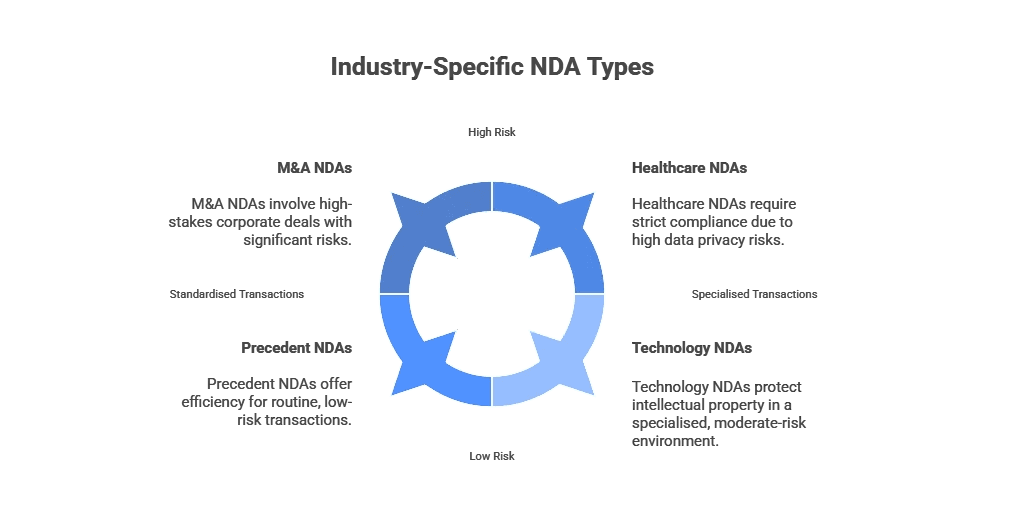
Beyond the three main categories, it is common to find an NDA type tailored for specific industries and use cases. These specialised agreements ensure that the unique nature of confidential business information in a particular sector is adequately protected according to its rules and regulations.
These industry-specific NDAs often include clauses that address sector-specific risks. The next sections will cover some of these specialised types, such as precedent NDAs, M&A NDAs, and those used in technology and health.
Precedent NDAs: For Standardised and Repetitive Transactions
A precedent NDA refers to using a standardised template for repetitive transactions. This approach creates consistency and efficiency in your contract management process, especially when dealing with a high volume of similar agreements.
By using a pre-approved template for standardised transactions, you establish a reliable legal framework that reduces drafting time and minimises legal review. This is particularly useful for routine engagements like hiring new contractors or onboarding vendors.
This practice ensures that your legal protection remains consistent across all repetitive transactions, making compliance easier to manage. CLM software can help store and manage these templates effectively.
M&A NDAs: Due Diligence, Corporate Transactions
In the world of mergers and acquisitions, NDAs are non-negotiable. They are a critical component of the due diligence process, allowing parties to share highly confidential information required for evaluating corporate transactions.
These agreements are typically mutual or multilateral and are drafted to protect the sensitive business interests of all parties involved. They cover everything from financial records to customer data.
Key protections in M&A NDAs include:
Safeguarding detailed financial statements and projections.
Protecting customer lists and supplier relationships.
Ensuring that the existence of the negotiations itself remains confidential.
NDAs in Technology, Health, and Creative Sectors
Different industries handle different types of sensitive information, requiring specialised NDAs. For example, technology NDAs are designed to protect source code and algorithms, which are highly valuable information for tech companies.
Similarly, healthcare NDAs must comply with strict privacy laws like HIPAA when dealing with patient data. In creative industries, NDAs protect unreleased scripts, designs, or music from being leaked before their official debut.
Technology NDAs: Focus on protecting intellectual property like source code and patents.
Healthcare NDAs: Address patient data confidentiality and research protocols.
Creative Industries: Safeguard original works and concepts before public release.
Conclusion
In summary, understanding the various types of Non-Disclosure Agreements (NDAs) is essential for anyone involved in confidential business dealings. By categorising NDAs into unilateral, mutual, and multilateral agreements, you can effectively choose the right framework for your situation. Additionally, context-specific variations like precedent NDAs and M&A NDAs serve particular needs within different industries.
Selecting the appropriate NDA not only protects your confidential information but also fosters trust and collaboration in your professional relationships. Should you require further assistance or wish to explore your options in greater detail, feel free to contact us for a free consultation tailored to your specific needs.
Frequently Asked Questions
What are the main differences between a unilateral and mutual NDA?
The main difference is the flow of confidential information. A unilateral NDA is a one-way street where only one party shares secrets. In mutual NDAs, both parties are sharing confidential information, so this legal contract protects everyone involved in the exchange.
How do I decide which NDA type is proper for my situation?
To choose the right NDA type, consider who is sharing confidential information. If it is only you, a unilateral NDA works. If both sides are sharing, use a mutual NDA. For complex use cases with multiple parties, a multilateral agreement or legal advice is best.
Can you share examples of agreements that use each NDA type?
Certainly. Employee NDAs are classic unilateral business contracts. Partnership agreements frequently use mutual NDAs for two-way protection. For large consortium deals involving several companies, a multilateral NDA agreement is the most efficient choice to ensure all parties are covered under one document.
About the Company

Volody AI CLM is an Agentic AI-powered Contract Lifecycle Management platform designed to eliminate manual contracting tasks, automate complex workflows, and deliver actionable insights. As a one-stop shop for all contract activities, it covers drafting, collaboration, negotiation, approvals, e-signature, compliance tracking, and renewals. Built with enterprise-grade security and no-code configuration, it meets the needs of the most complex global organizations. Volody AI CLM also includes AI-driven contract review and risk analysis, helping teams detect issues early and optimize terms. Trusted by Fortune 500 companies, high-growth startups, and government entities, it transforms contracts into strategic, data-driven business assets.





" height="216.72211px" id="FYO0bO80Y" transform="translate(3 6.105)" width="206.073px"/><path d="M 108.174 222 C 88.432 222 70.303 217.239 53.785 207.717 C 37.267 198.196 24.173 185.052 14.504 168.285 C 4.835 151.312 0 132.165 0 110.845 C 0 89.731 4.835 70.792 14.504 54.025 C 24.173 37.052 37.267 23.804 53.785 14.282 C 70.303 4.761 88.432 0 108.174 0 C 128.116 0 146.246 4.761 162.562 14.282 C 179.08 23.804 192.073 37.052 201.541 54.025 C 211.21 70.792 216.044 89.731 216.044 110.845 C 216.044 132.165 211.21 151.312 201.541 168.285 C 192.073 185.052 179.08 198.196 162.562 207.717 C 146.044 217.239 127.915 222 108.174 222 Z M 108.174 183.189 C 120.864 183.189 132.044 180.291 141.713 174.495 C 151.382 168.492 158.936 160.006 164.375 149.035 C 169.814 138.064 172.533 125.334 172.533 110.845 C 172.533 96.355 169.814 83.729 164.375 72.965 C 158.936 61.994 151.382 53.611 141.713 47.815 C 132.044 42.02 120.864 39.122 108.174 39.122 C 95.483 39.122 84.202 42.02 74.332 47.815 C 64.663 53.611 57.109 61.994 51.67 72.965 C 46.231 83.729 43.511 96.355 43.511 110.845 C 43.511 125.334 46.231 138.064 51.67 149.035 C 57.109 160.006 64.663 168.492 74.332 174.495 C 84.202 180.291 95.483 183.189 108.174 183.189 Z" fill="rgba(255, 255, 255, 0.12)" height="222px" id="aa1McFcE9" transform="translate(227.183 3)" width="216.04399999999998px"/><path d="M 42.302 182.257 L 111.799 182.257 L 111.799 216.722 L 0 216.722 L 0 0 L 42.302 0 Z" fill="rgba(255, 255, 255, 0.12)" height="216.72211px" id="yRq4AnrsX" transform="translate(477.721 6.105)" width="111.79899999999998px"/><path d="M 108.174 222 C 88.432 222 70.303 217.239 53.785 207.717 C 37.267 198.196 24.173 185.052 14.504 168.285 C 4.835 151.312 0 132.165 0 110.845 C 0 89.731 4.835 70.792 14.504 54.025 C 24.173 37.052 37.267 23.804 53.785 14.282 C 70.303 4.761 88.432 0 108.174 0 C 128.116 0 146.246 4.761 162.562 14.282 C 179.08 23.804 192.073 37.052 201.541 54.025 C 211.21 70.792 216.045 89.731 216.045 110.845 C 216.045 132.165 211.21 151.312 201.541 168.285 C 192.073 185.052 179.08 198.196 162.562 207.717 C 146.044 217.239 127.915 222 108.174 222 Z M 108.174 183.189 C 120.864 183.189 132.044 180.291 141.713 174.495 C 151.382 168.492 158.936 160.006 164.375 149.035 C 169.814 138.064 172.534 125.334 172.534 110.845 C 172.534 96.355 169.814 83.729 164.375 72.965 C 158.936 61.994 151.382 53.611 141.713 47.815 C 132.044 42.02 120.864 39.122 108.174 39.122 C 95.483 39.122 84.202 42.02 74.332 47.815 C 64.663 53.611 57.108 61.994 51.67 72.965 C 46.231 83.729 43.511 96.355 43.511 110.845 C 43.511 125.334 46.231 138.064 51.67 149.035 C 57.108 160.006 64.663 168.492 74.332 174.495 C 84.202 180.291 95.483 183.189 108.174 183.189 Z" fill="rgba(255, 255, 255, 0.12)" height="222px" id="mo8HQspQ0" transform="translate(609.155 3)" width="216.04500000000007px"/><path d="M 73.727 0 C 95.885 0 115.324 4.45 132.044 13.351 C 148.967 22.252 161.957 34.982 171.027 51.541 C 180.287 67.894 184.917 86.937 184.917 108.671 C 184.917 130.405 180.287 149.449 171.027 165.801 C 161.957 181.947 148.967 194.47 132.044 203.371 C 115.324 212.271 95.885 216.722 73.727 216.722 L 0 216.722 L 0 0 Z M 72.216 179.773 C 94.374 179.773 111.497 173.564 123.583 161.144 C 135.669 148.724 141.713 131.233 141.713 108.671 C 141.713 86.109 135.669 68.515 123.583 55.888 C 111.497 43.055 94.374 36.638 72.216 36.638 L 42.302 36.638 L 42.302 179.773 Z" fill="rgba(255, 255, 255, 0.12)" height="216.72211px" id="I3iXX5Hi_" transform="translate(859.693 6.105)" width="184.91699999999992px"/><path d="M 185.22 0 L 113.91 141.273 L 113.91 216.722 L 71.61 216.722 L 71.61 141.273 L 0 0 L 47.74 0 L 93.06 99.046 L 138.08 0 Z" fill="rgba(255, 255, 255, 0.12)" height="216.72211px" id="nzHyWC0_d" transform="translate(1061.78 6.105)" width="185.22000000000003px"/></svg>)