

Key Highlights
A unilateral NDA is a one-way legal contract where one party shares confidential information.
The contract creates a legal relationship between a disclosing party and a receiving party.
Its primary purpose is to provide legal protection for sensitive business information.
The receiving party is legally bound not to misuse or share the disclosed information.
Unlike a mutual NDA, the confidentiality obligation flows in only one direction.
These agreements are essential when engaging employees, consultants, or potential investors.
When you need to share valuable company secrets, how do you ensure they remain protected? A unilateral NDA is a crucial legal contract designed for this exact purpose. It allows you to disclose sensitive business information to another party while legally restricting its use and distribution. For example, if a company is presenting a new product idea to a potential investor, the company (as the discloser) can use a unilateral NDA to ensure the investor does not share or misuse that confidential information. A simple example of a unilateral NDA would be a start-up requiring a freelance developer to sign an agreement stating that any proprietary code or business strategies shared with them must be kept confidential and cannot be used or disclosed elsewhere. This guide will walk you through how to draft and manage an effective unilateral NDA to safeguard your most important assets.
Understanding Unilateral NDAs

A unilateral non-disclosure agreement, or one-way NDA, is a foundational tool for business security. It is used when only one party, the disclosing party, is sharing confidential information with another, the receiving party.
This legal contract ensures that the person or company receiving your secrets is bound by a duty of confidentiality. However, using a unilateral NDA presents legal risks such as potentially limited enforceability if the agreement is too broad or vague, possibility of overlooking your own obligations, and challenges if the other party claims the information was already known or independently developed. We will now explore the specific definition, mechanics, and key differences of this essential agreement.
Definition and Core Concept of a Unilateral NDA
A unilateral NDA is a legally binding contract where confidentiality obligations flow in just one direction. The disclosing party is the owner of the sensitive information, while the receiving party agrees not to share this information with any unauthorised third parties.
The central concept is to create a secure channel for sharing secrets. It allows a business to provide proprietary data, such as trade secrets or business plans, to an external party like a contractor or potential investor.
This legal contract establishes a clear confidential relationship, giving the disclosing party legal recourse if the agreement is breached. It is a fundamental document for protecting intellectual property and maintaining a competitive advantage.
How a Unilateral NDA Works in Practice
In practice, a unilateral NDA begins with drafting the legal agreement, which is then signed by authorised representatives of both the disclosing party and the receiving party. Once signed, the disclosing party can share the confidential information.
The information should be clearly designated as confidential. If shared orally, it is best practice to follow up with a written memorandum confirming its confidential nature.
The receiving party is then legally obligated to use the disclosed information only for the purposes outlined in the agreement. They must also ensure that access is restricted within their own organisation to only authorised individuals.
One-Way vs Mutual NDA: Key Differences
Understanding the different types of NDA is key to choosing the right one. A unilateral NDA creates a one-way street for confidentiality, protecting a single party that is sharing business information.
In contrast, a mutual non-disclosure agreement, also known as a bilateral NDA, is a two-way agreement. Both parties are disclosing and receiving confidential information, so both are bound by confidentiality. This is common in joint ventures or mergers where information exchange is reciprocal.
The key differences are:
Information Flow: A unilateral NDA is one-way, while a mutual NDA is two-way.
Obligation: In a unilateral NDA, only the receiving party has confidentiality duties. In a mutual NDA, both parties do.
Use Case: Unilateral NDAs are for hiring or pitching, while mutual non-disclosure agreements suit partnerships.
Related Article: Types of Contracts Every Business Needs
Typical Scenarios for Using Unilateral NDAs

Deciding when to use a unilateral NDA depends on the flow of information. If you are the only one disclosing sensitive information, this is the right legal tool for the job. It offers targeted legal protection for your valuable business information.
There are many common business interactions where this one-way protection is essential. The following sections will detail scenarios like fundraising, hiring external experts, and navigating corporate transactions.
Protecting Sensitive Information During Fundraising
When a startup seeks funding, it must share sensitive information with potential investors. A unilateral NDA is critical in this situation to prevent ideas from being stolen or misused. Without it, proving theft of an idea in court would be extremely difficult.
The receiving party, in this case the investor, signs the agreement and is legally bound to keep the shared details confidential. This allows the startup to openly discuss its vision and financials with a reduced risk of competitive harm.
Information protected during fundraising often includes:
Proprietary data and business models
Financial information and revenue projections
Unpatented inventions or trade secrets
Hiring Consultants and Service Providers
Engaging a consultant, freelancer, or service provider often requires granting them access to your internal operations. To perform their duties, they may need to see confidential information that gives your business its competitive edge.
A unilateral NDA ensures these third parties understand their obligation to protect your data. The agreement restricts them from using your information for any purpose other than the work you hired them for, preventing any unauthorised disclosure of information.
Examples of when to use an NDA include:
A marketing agency accessing customer data and strategies.
A software developer working with your proprietary source code.
An HR consultant reviewing internal employee information.
Mergers, Acquisitions, and Due Diligence Cases
While mutual NDAs are common in mergers and acquisitions, a unilateral non-disclosure agreement can be vital in the early stages. During due diligence, one company may need to disclose a significant amount of sensitive business information for evaluation.
This one-way agreement protects the disclosing company’s proprietary information while the other party assesses the potential deal. It safeguards everything from financial records to strategic plans, ensuring this data is not exploited if the transaction does not proceed.
Key information protected includes:
Detailed financial statements and customer lists.
Operational processes and proprietary technology.
Intellectual property portfolios and strategic business plans.
Related Article: Types of NDA Explained: Choose the Right One for You
Identifying Parties in a Unilateral NDA

Every unilateral NDA clearly identifies two main participants: the disclosing party and the receiving party. This legal contract establishes a confidential relationship between them, with each having distinct roles and responsibilities.
Understanding these roles is fundamental to drafting an effective agreement. The following sections explain the interests of the party sharing information and the duties of the party receiving it.
The Disclosing Party’s Role and Interests
The disclosing party is the owner of the sensitive information. This entity or individual holds the trade secrets, business plans, or proprietary business information that needs protection. Their primary interest is to share this data for a specific purpose without risking its public exposure or misuse.
This legal contract acts as a shield. It gives the disclosing party the power to control how their information is handled and provides a legal basis for action if the terms are violated.
Ultimately, the disclosing party uses the unilateral NDA to safeguard its competitive advantage and intellectual property. It is a proactive measure to prevent financial loss or reputational damage resulting from a leak of confidential data.
The Receiving Party’s Duties
The receiving party is the person or company that gains access to the confidential business information. Under the unilateral NDA, they have strict confidentiality obligations that they must legally uphold.
Their main duty is to keep the information secret and use it only for the specific purpose outlined in the agreement. This means they cannot disclose the information to any unauthorised third party or use it for their own benefit. They are also responsible for implementing reasonable security measures to protect the data.
This legal protection ensures the receiving party is accountable. If they breach their duties, the disclosing party can seek legal remedies for any damages caused.
Related Article: Mastering Business Agreements: Essential Guide
Key Elements to Include in an Effective Unilateral NDA Template
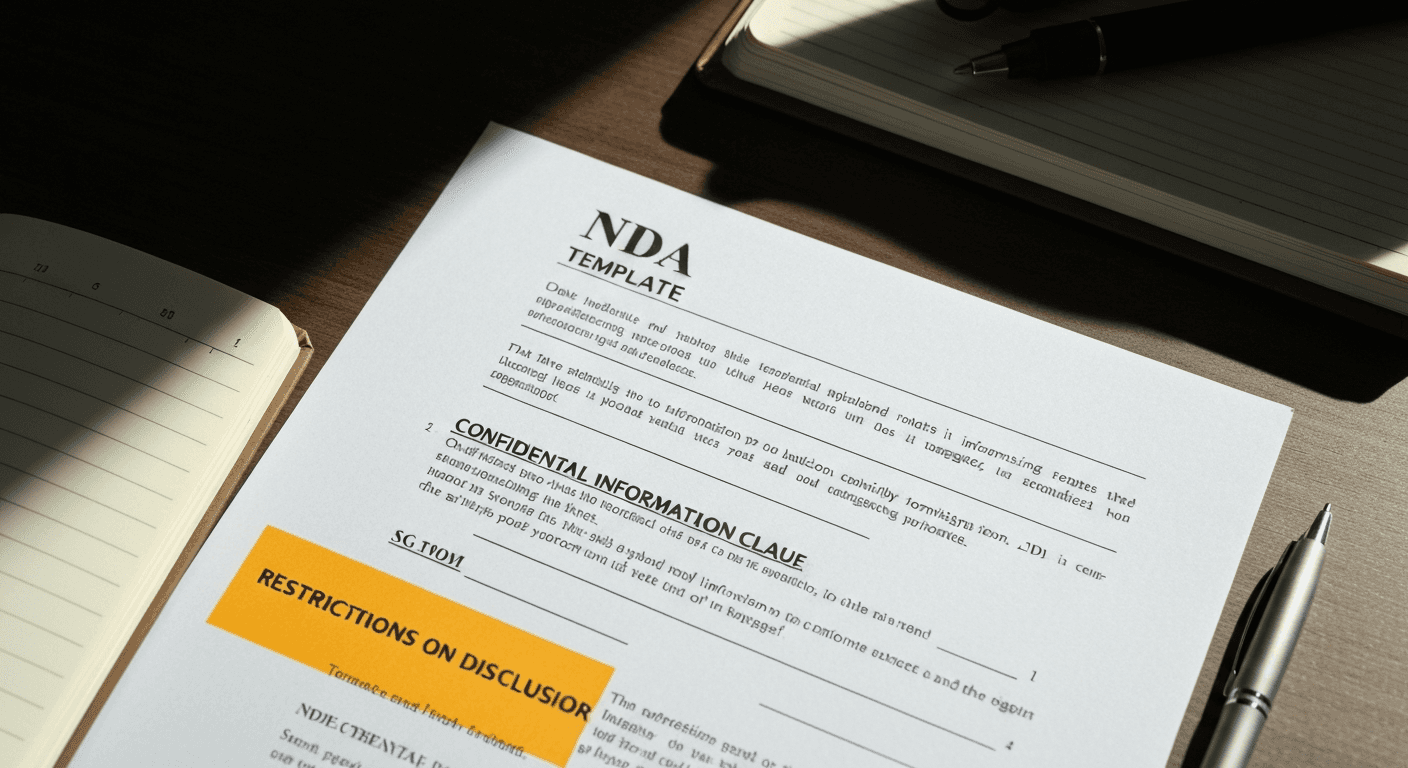
A well-drafted unilateral NDA template is specific, clear, and comprehensive. Including certain key elements is essential to ensure the agreement offers robust legal protection for your business information and is enforceable in court.
To build a strong shield around your secrets, your NDA must clearly define the scope of the agreement, the obligations of the parties, and the consequences of a breach. Let's look at the must-have clauses for any effective template.
Detailed Definition of Confidential Information
This is arguably the most crucial section of the NDA. You must explicitly define what constitutes "confidential information." A vague or overly broad definition can render the agreement unenforceable.
Be comprehensive and list the types of information covered. This includes technical data, financial details, customer lists, marketing strategies, source code, prototypes, and business plans. It is wise to state that information is confidential if marked as such or identified as confidential upon disclosure.
A specific and thorough definition leaves no room for ambiguity. It ensures the receiving party knows exactly what proprietary data they are obligated to protect.
Exclusions: Information Not Protected
To be fair and enforceable, a legal contract like an non-disclosure agreement must include exclusions. This section clarifies what is not considered confidential information, preventing the agreement from being unreasonably restrictive.
These carve-outs protect the receiving party from being penalised for using information that is already public or that they developed independently. Clearly defining these exclusions strengthens the overall enforceability of the non-disclosure agreement.
Common exclusions include information that:
Is or becomes part of the public domain through no fault of the recipient.
Was already rightfully known to the receiving party before disclosure.
Is independently developed without reference to the confidential information.
Obligations of the Receiving Party
This clause outlines the specific confidentiality obligations imposed on the receiving party. It details exactly how they must treat the business information they receive to prevent any breaches.
Key duties typically include keeping the information strictly confidential and using it only for the agreed-upon purpose. The agreement should also require the receiving party to restrict access to the information within their organisation, limiting it to employees who have a "need to know."
Furthermore, this section establishes the disclosing party’s right to legal recourse. It makes it clear that failure to uphold these obligations constitutes a breach of contract, allowing for legal action.
Duration and Termination of the Agreement
The duration of confidentiality, or "term," specifies how long the receiving party must keep the information secret. This is a critical component of any non-disclosure agreement template, as perpetual obligations are often seen as unreasonable by courts.
The length of this period depends on the nature of the information. A typical term is 3-5 years, but for highly sensitive trade secrets, the obligation might last indefinitely or as long as the information legally remains a trade secret. The agreement should also specify what happens upon termination.
Important points to include are:
A fixed time period for confidentiality.
A clause requiring the return or destruction of all confidential materials.
Conditions under which the agreement can be terminated.
Drafting Tips for a Strong Unilateral NDA
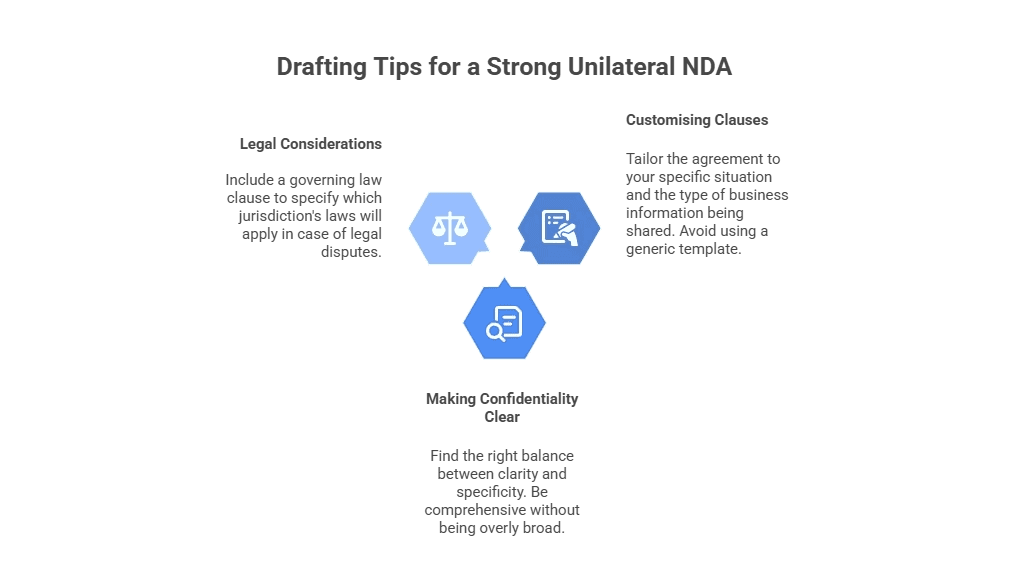
Simply having a unilateral NDA is not enough; it needs to be a strong NDA that will hold up in court. Drafting an effective agreement requires careful attention to detail to ensure your proprietary information and business strategies are fully protected.
While seeking legal counsel is always recommended, there are practical tips you can follow to strengthen your agreement. The following sections will provide guidance on customising clauses and being clear yet specific.
Customising Clauses for Your Business Needs
Avoid using a generic, one-size-fits-all template for your own non-disclosure agreement. To gain a true competitive advantage, you must tailor the agreement to your specific situation and the type of business information being shared.
Customising clauses means being specific about the purpose of the disclosure and the definition of what is confidential. A generic agreement may not adequately cover the unique aspects of your technology or business model, leaving you vulnerable. Efficiently managing versions with contract management software can help maintain a library of approved clauses.
Examples of customising clauses include:
Specifying the exact project the information can be used for.
Listing unique categories of data, such as "customer engagement metrics."
Adjusting the confidentiality term based on the information's shelf life.
Making Confidentiality Clear Yet Specific
The strength of your confidentiality agreement rests on finding the right balance between clarity and specificity. If the definition of confidential information is too vague, it may be unenforceable. If it is too narrow, you might accidentally leave sensitive data unprotected.
Your goal is to be comprehensive without being overly broad. For instance, instead of just saying "business information," specify categories like "financial business models," "proprietary technology," and "customer acquisition strategies."
This approach ensures that the receiving party understands its obligations and that the agreement provides robust legal protection. A well-defined contract scope is your best defence in case of a dispute.
Legal Considerations for Unilateral NDAs in Different Countries
When a unilateral NDA involves an international party, legal protection can vary significantly between countries. It is crucial to include a governing law clause to specify which jurisdiction's laws will apply in case of legal disputes.
Understanding these differences is key to ensuring your agreement is enforceable. Here is a brief comparison of legal considerations in different regions.
Jurisdiction | Key Legal Considerations |
|---|---|
USA | Enforceability relies on reasonable scope and duration; protected by state (UTSA) and federal (DTSA) trade secret laws. |
Europe | Must comply with regulations like eIDAS for e-signatures; agreements cannot be anti-competitive. |
India | Enforceability depends on reasonableness; courts focus on preventing undue restraint of trade. |
Asia | Legal frameworks vary widely; a clear governing law clause is essential for predictability in disputes. |
South Africa | Governed by contract law principles; must have a legitimate interest to protect and be reasonable. |
Conclusion
In summary, drafting an effective Unilateral NDA is essential for safeguarding sensitive business information while engaging with external parties. By understanding the key elements, typical scenarios, and legal considerations, you can tailor the agreement to suit your specific needs. Whether you're raising funds, hiring consultants, or conducting due diligence during mergers and acquisitions, a well-structured Unilateral NDA can streamline the process and protect your proprietary data.
Don’t leave your confidential information to chance; take the necessary steps to ensure its security. If you're ready to strengthen your agreements and need expert assistance, don't hesitate to reach out for a free consultation.
Frequently Asked Questions
Is a one-way NDA the same as a unilateral NDA?
Yes, a one-way NDA is the same as a unilateral NDA. Both terms refer to a legal contract where only one party is disclosing confidential information, and the receiving party is legally obligated to protect it.
What types of information can be protected under a unilateral NDA?
A unilateral NDA can protect a wide range of sensitive information, including proprietary information, business plans, financial data, customer lists, trade secrets, and any other non-public business information that gives you a competitive edge.
Can a unilateral NDA template be found online and used freely?
While you can find a free NDA template online, using it without review is risky. For proper legal protection of your proprietary data, it is best to have any template customised and reviewed by legal counsel or use a trusted clm software.
Who signs the unilateral NDA?
Both parties must sign the unilateral NDA to make it a binding legal contract. This includes an authorised representative from both the disclosing party (who owns the information) and the receiving party (who agrees to protect it).
What are the three types of NDA?
The three main types of non-disclosure agreements (NDAs) are the unilateral NDA (one-way), the mutual NDA (two-way), and the multilateral NDA (involving three or more parties). Each type of agreement offers legal protection tailored to the number of parties disclosing information.
About the Company

Volody AI CLM is an Agentic AI-powered Contract Lifecycle Management platform designed to eliminate manual contracting tasks, automate complex workflows, and deliver actionable insights. As a one-stop shop for all contract activities, it covers drafting, collaboration, negotiation, approvals, e-signature, compliance tracking, and renewals. Built with enterprise-grade security and no-code configuration, it meets the needs of the most complex global organizations. Volody AI CLM also includes AI-driven contract review and risk analysis, helping teams detect issues early and optimize terms. Trusted by Fortune 500 companies, high-growth startups, and government entities, it transforms contracts into strategic, data-driven business assets.






" height="216.72211px" id="FYO0bO80Y" transform="translate(3 6.105)" width="206.073px"/><path d="M 108.174 222 C 88.432 222 70.303 217.239 53.785 207.717 C 37.267 198.196 24.173 185.052 14.504 168.285 C 4.835 151.312 0 132.165 0 110.845 C 0 89.731 4.835 70.792 14.504 54.025 C 24.173 37.052 37.267 23.804 53.785 14.282 C 70.303 4.761 88.432 0 108.174 0 C 128.116 0 146.246 4.761 162.562 14.282 C 179.08 23.804 192.073 37.052 201.541 54.025 C 211.21 70.792 216.044 89.731 216.044 110.845 C 216.044 132.165 211.21 151.312 201.541 168.285 C 192.073 185.052 179.08 198.196 162.562 207.717 C 146.044 217.239 127.915 222 108.174 222 Z M 108.174 183.189 C 120.864 183.189 132.044 180.291 141.713 174.495 C 151.382 168.492 158.936 160.006 164.375 149.035 C 169.814 138.064 172.533 125.334 172.533 110.845 C 172.533 96.355 169.814 83.729 164.375 72.965 C 158.936 61.994 151.382 53.611 141.713 47.815 C 132.044 42.02 120.864 39.122 108.174 39.122 C 95.483 39.122 84.202 42.02 74.332 47.815 C 64.663 53.611 57.109 61.994 51.67 72.965 C 46.231 83.729 43.511 96.355 43.511 110.845 C 43.511 125.334 46.231 138.064 51.67 149.035 C 57.109 160.006 64.663 168.492 74.332 174.495 C 84.202 180.291 95.483 183.189 108.174 183.189 Z" fill="rgba(255, 255, 255, 0.12)" height="222px" id="aa1McFcE9" transform="translate(227.183 3)" width="216.04399999999998px"/><path d="M 42.302 182.257 L 111.799 182.257 L 111.799 216.722 L 0 216.722 L 0 0 L 42.302 0 Z" fill="rgba(255, 255, 255, 0.12)" height="216.72211px" id="yRq4AnrsX" transform="translate(477.721 6.105)" width="111.79899999999998px"/><path d="M 108.174 222 C 88.432 222 70.303 217.239 53.785 207.717 C 37.267 198.196 24.173 185.052 14.504 168.285 C 4.835 151.312 0 132.165 0 110.845 C 0 89.731 4.835 70.792 14.504 54.025 C 24.173 37.052 37.267 23.804 53.785 14.282 C 70.303 4.761 88.432 0 108.174 0 C 128.116 0 146.246 4.761 162.562 14.282 C 179.08 23.804 192.073 37.052 201.541 54.025 C 211.21 70.792 216.045 89.731 216.045 110.845 C 216.045 132.165 211.21 151.312 201.541 168.285 C 192.073 185.052 179.08 198.196 162.562 207.717 C 146.044 217.239 127.915 222 108.174 222 Z M 108.174 183.189 C 120.864 183.189 132.044 180.291 141.713 174.495 C 151.382 168.492 158.936 160.006 164.375 149.035 C 169.814 138.064 172.534 125.334 172.534 110.845 C 172.534 96.355 169.814 83.729 164.375 72.965 C 158.936 61.994 151.382 53.611 141.713 47.815 C 132.044 42.02 120.864 39.122 108.174 39.122 C 95.483 39.122 84.202 42.02 74.332 47.815 C 64.663 53.611 57.108 61.994 51.67 72.965 C 46.231 83.729 43.511 96.355 43.511 110.845 C 43.511 125.334 46.231 138.064 51.67 149.035 C 57.108 160.006 64.663 168.492 74.332 174.495 C 84.202 180.291 95.483 183.189 108.174 183.189 Z" fill="rgba(255, 255, 255, 0.12)" height="222px" id="mo8HQspQ0" transform="translate(609.155 3)" width="216.04500000000007px"/><path d="M 73.727 0 C 95.885 0 115.324 4.45 132.044 13.351 C 148.967 22.252 161.957 34.982 171.027 51.541 C 180.287 67.894 184.917 86.937 184.917 108.671 C 184.917 130.405 180.287 149.449 171.027 165.801 C 161.957 181.947 148.967 194.47 132.044 203.371 C 115.324 212.271 95.885 216.722 73.727 216.722 L 0 216.722 L 0 0 Z M 72.216 179.773 C 94.374 179.773 111.497 173.564 123.583 161.144 C 135.669 148.724 141.713 131.233 141.713 108.671 C 141.713 86.109 135.669 68.515 123.583 55.888 C 111.497 43.055 94.374 36.638 72.216 36.638 L 42.302 36.638 L 42.302 179.773 Z" fill="rgba(255, 255, 255, 0.12)" height="216.72211px" id="I3iXX5Hi_" transform="translate(859.693 6.105)" width="184.91699999999992px"/><path d="M 185.22 0 L 113.91 141.273 L 113.91 216.722 L 71.61 216.722 L 71.61 141.273 L 0 0 L 47.74 0 L 93.06 99.046 L 138.08 0 Z" fill="rgba(255, 255, 255, 0.12)" height="216.72211px" id="nzHyWC0_d" transform="translate(1061.78 6.105)" width="185.22000000000003px"/></svg>)