

Signing PDFs is a daily task for many professionals. Whether you are finalizing contracts, approving documents, or sharing agreements, knowing how to sign a PDF efficiently matters. Imagine you receive a contract as a PDF and need to sign it quickly without printing or scanning. Doing this right can save time, reduce errors, and keep your documents secure. This article explains practical methods to sign PDFs and why some approaches work better for businesses.
TL;DR
PDFs serve as a standard format for contracts, but signing them can become complex without appropriate tools.
Tools such as MacOS Markup or Adobe Acrobat provide functionality for manually inserting signatures.
However, these approaches do not offer comprehensive audit trails and are inefficient when handling large volumes of contracts.
Since PDFs are inherently static, extracting and monitoring contract data often demands additional manual processes.
Contract management platforms enhance the signing workflow by integrating automation, fortified security measures, and robust data tracking capabilities.
Leveraging specialized software accelerates the signing process while ensuring contracts remain well-organized and compliant.
What Does It Mean to Sign a PDF?
A PDF, or Portable Document Format, is a file type designed to keep documents looking the same across devices. Additionally, when you sign a PDF, you are authenticating your approval of the document’s content. But signing a PDF can mean different things depending on the method.
There are two main methods for incorporating a signature within a PDF:
Electronic signature: A digital image or drawing of your signature added to the document.
Digital signature: A cryptographic method that verifies the signer’s identity and ensures the document hasn’t changed after signing.
Most people use electronic signatures because they are easy and quick. However, digital signatures provide stronger security and legal proof but require special software and certificates.
Understanding these differences is key. Adding a simple signature image can be enough for informal agreements. But for contracts that might face legal scrutiny, you want a method that offers strong proof of who signed and when.
Related articles: Electronic signature Software | Top 7 eSign tools in 2024
How to Sign a PDF Using Built-In Tools on Your Computer
Many computers come with built-in tools to add signatures to PDFs. Additionally, these tools suffice for occasional signatures but may fall short in meeting the demands of enterprise-level workflows.
Signing a PDF on MacOS with Markup
Mac computers include a feature called Markup that lets you draw or insert a signature.
Open your PDF using Preview on your Mac.
Click the Markup icon, which looks like a pen tip.
You can create one by drawing on your trackpad or capturing it from paper using your camera.
Afterward, insert the signature into the document and adjust its size as needed.
Export the PDF to preserve the signature.
This method is expedient and eliminates the need for additional software installations. However, it only embeds a basic image of your signature. It does not verify your identity or record when and where you signed.
Signing a PDF with Adobe Acrobat
Moreover, adobe Acrobat is a popular PDF editor with more signing features.
Open the PDF in Adobe Acrobat.
Click the Fill & Sign tool.
You can add one by typing your name, drawing it, or uploading an image.
Place the signature directly onto the document.
Save the signed PDF.
Adobe Acrobat also lets you request signatures from others and send reminders. However, the basic signing still lacks detailed audit trails unless you use Adobe’s paid services.
Related articles: Precise PDF Contract Editing for Effective Negotiations
Why Simple PDF Signing Methods Can Fall Short
Adding a signature image to a PDF is easy but has several drawbacks for business use.
No Detailed Audit Trail
When you sign a PDF using basic tools, the file does not record important details like:
Signer’s identity verification
Date and time of signing
IP address or location of signer
Changes made to the document after signing
Without these details, it is harder to prove the signature’s authenticity if a dispute arises. Courts and regulators often require a clear audit trail to accept electronic signatures as valid.
PDFs Are Static and Hard to Search
PDFs are primarily composed of fixed images or segmented text blocks instead of dynamic data fields, making it difficult to extract contract data or enable automated searches. Extracting crucial contractual information like dates, terms, or obligations frequently demands manual examination. This complexity leads to significant administrative burdens when managing extensive collections of PDF contracts.
For teams handling many contracts, this slows down workflows and increases errors.
Poor Scalability for Mass Signing
When a business must execute a high volume of contracts, processing each PDF individually demands considerable time. Many legacy applications lack the capability to process documents in bulk or to integrate smoothly with automated signing workflows. These limitations hinder efficient handling of extensive document workflows.
Explore further insights in: The Contract Obligation Tracking Playbook
How Contract Management Software Improves PDF Signing
Contract lifecycle management (CLM) software offers a better way to sign PDFs and manage contracts. These platforms combine electronic signatures with automation and data tracking.
Secure and Compliant Signatures
CLM tools provide electronic signatures that meet legal standards. They:
Authenticate signer identity using email, SMS, or multi-factor authentication
Record detailed audit trails including timestamps and IP addresses
Create tamper-evident documents that show if changes occur after signing
This level of security helps businesses reduce legal risk and pass audits.
Automate Signing Workflows
CLM software lets you:
Send bulk signing requests to multiple parties at once
Set automated reminders for unsigned contracts
Monitor signing status in real time
Route contracts through approval chains automatically
Automating these steps saves time and reduces manual errors.
Extract and Search Contract Data
Contracts stored in CLM systems are saved as structured data, not just static PDFs. This makes it possible to:
Search contract terms, parties, and dates instantly
Generate reports on contract status, renewals, and obligations
Integrate contract data with other business systems like CRM or ERP
This visibility helps legal and business teams stay on top of commitments.
Related articles: Mastering Track Changes for Contract Revisions in Word
Step-by-Step Guide to Signing a PDF with Basic Tools
If you need to sign a PDF quickly without special software, here is a detailed process for MacOS and Windows users.
MacOS Preview Signing
Additionally, open your PDF in Preview.
Click the icon to reveal the Markup toolbar.
Select the Signature tool from the menu.
Generate a signature using either the trackpad or your device’s camera.
Insert the signature onto the document by dragging it to the desired location.
Adjust the size and placement as necessary.
Save the file by pressing Command + S.
Windows Using Microsoft Edge or Adobe Reader
Moreover, windows users can sign PDFs through built-in features in Microsoft Edge or by using Adobe Acrobat Reader DC.
Launch the PDF in either Microsoft Edge or Adobe Reader.
Locate the Fill & Sign or Draw feature within the application.
Create your signature employing a mouse or touchscreen input.
Position the signature precisely where it is required on the document.
Save the signed PDF.
These methods are free and easy but offer no verification or audit details.
Related articles: Redlining Contracts in Word: Master Track Changes
Common Challenges When Signing PDFs
Signing PDFs manually creates several challenges for businesses.
Risk of Fraud or Disputes
Additionally, in the absence of identity verification, any individual with access to the file can append a signature. This increases the risk of fraud. Also, if the document changes after signing, it can be hard to prove the original agreement.
Time-Consuming for Large Volumes
Manually signing and managing many PDFs wastes time. It also increases the chance of missing signatures or deadlines.
Lack of Integration with Business Systems
Basic PDF signing does not connect to other tools like customer databases or contract repositories. This creates silos and duplicate work.
Difficulty Tracking Contract Obligations
PDFs do not alert you to upcoming renewals, payment dates, or compliance tasks. Missing these can cause financial or legal problems.
How to Choose the Right Signing Method for Your Business
The choice of PDF signing method should be guided by the specific requirements and operational context of your business.
Additionally, when speed and informality are priorities, the built-in tools on most computers can be adequate.
For contracts requiring legal proof, choose software with audit trails and signer authentication.
If you sign many contracts, look for tools that support bulk signing and workflow automation.
Consider integration with your existing systems to improve efficiency.
Check that the solution complies with electronic signature laws like ESIGN Act or eIDAS.
Related articles: Precise PDF Contract Editing for Effective Negotiations
Why Contract Management Software Matters
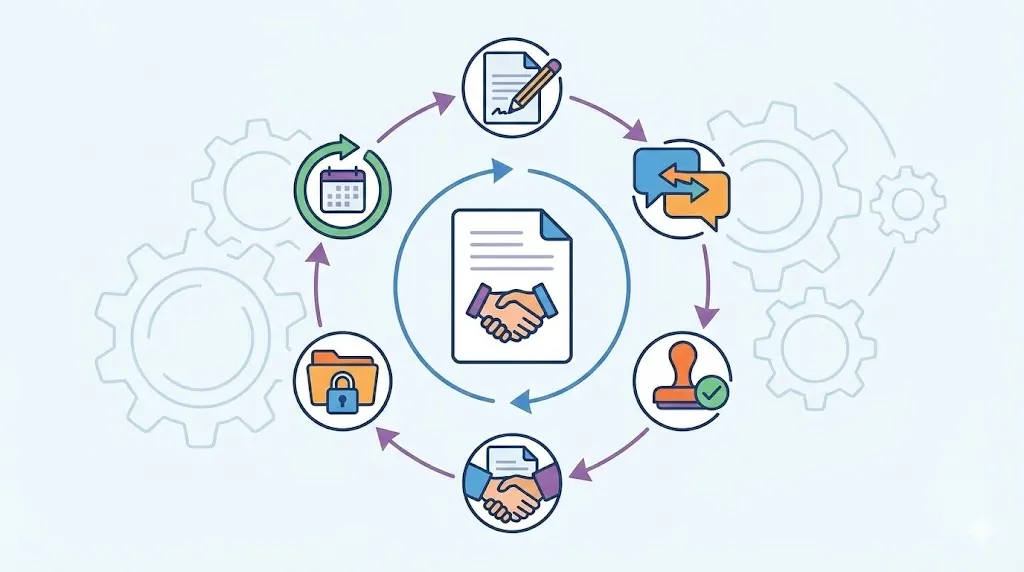
Contract management software helps businesses handle signing and more. Additionally, it also consolidates the entire contract lifecycle—creation, negotiation, signing, and secure storage—into a unified platform.
Accelerating contract turnaround is a key benefit.
By streamlining administrative tasks, it minimizes operational burdens and the likelihood of human error.
Compliance with regulatory frameworks and internal policies becomes more manageable for organizations.
Users gain immediate insight into contract status and potential risks through the platform’s monitoring capabilities.
Using a CLM system turns contract signing from a manual chore into a smooth, controlled process.
Related Article: Precise PDF Contract Editing for Effective Negotiations
How CLM Software Solves This
Contract lifecycle management software helps teams sign PDFs with confidence and ease. Additionally, legally binding electronic signatures are integrated with comprehensive audit trails and identity verification to ensure every signature's security and authenticity.
CLM platforms streamline the process by sending automated reminders and managing approval workflows, accelerating contract progression through your system. Contracts remain accessible as indexed data, enabling precise tracking of key provisions and renewal timelines.
Among its capabilities, Volody incorporates AI-driven contract analysis alongside advanced approval routing and embedded electronic signature tools. This combination reduces manual intervention while promoting closer interaction between legal and business stakeholders.
> Explore how Volody's CLM Software empowers your team to advance contracts with assurance.
FAQ
Can I legally sign a PDF with just an image of my signature?
Additionally, yes, inserting a signature image into a PDF can hold legal weight if both parties consent. However, this method often lacks robust identity verification and detailed audit trails necessary for dispute resolution.
What is the difference between electronic and digital signatures?
Electronic signatures typically consist of scanned images or typed names applied to documents, whereas digital signatures rely on cryptographic techniques to authenticate the signer’s identity and guarantee the document’s integrity.
Are signatures added with MacOS Preview secure?
While convenient, this approach does not offer authentication or audit trail capabilities. When dealing with sensitive contracts, it is critical to adopt authentication methods that provide greater assurance.
Moreover, how can I efficiently sign multiple PDFs?
Most standard applications require signing each PDF individually. Specialized software with batch processing capabilities significantly accelerates this task.
Is it possible to track contract obligations in PDFs?
Not easily. PDFs are static files, so tracking requires manual review or using software that extracts contract data.
Furthermore, what laws govern electronic signatures?
In the United States, the ESIGN Act establishes legal standards, while European regulations fall under eIDAS. Both frameworks recognize electronic signatures that satisfy specific requirements.
Can I use contract management software with my existing tools?
Many CLM platforms offer integrations with CRM, ERP, email, and cloud storage systems to streamline workflows.
What happens if a signed PDF is altered after signing?
Also, without digital signatures, changes to a document may remain undetected. Digital signatures, in contrast, create tamper-evident seals that invalidate the document if altered after signing.
Do I need special hardware to sign PDFs digitally?
Generally, digital signatures require certificates from trusted certificate authorities. Nonetheless, certain software solutions facilitate the signing process without additional hardware.
Is signing a PDF on a mobile device secure?
Mobile apps can be secure if they use encryption and authentication. Always choose trusted apps and networks.
This guide covers practical ways to sign PDFs and explains why basic methods may fall short for businesses. Utilizing advanced contract management technology improves security, operational efficiency, and governance throughout the signing workflow.
About the Company

Volody AI CLM is an Agentic AI-powered Contract Lifecycle Management platform designed to eliminate manual contracting tasks, automate complex workflows, and deliver actionable insights. As a one-stop shop for all contract activities, it covers drafting, collaboration, negotiation, approvals, e-signature, compliance tracking, and renewals. Built with enterprise-grade security and no-code configuration, it meets the needs of the most complex global organizations. Volody AI CLM also includes AI-driven contract review and risk analysis, helping teams detect issues early and optimize terms. Trusted by Fortune 500 companies, high-growth startups, and government entities, it transforms contracts into strategic, data-driven business assets.




" height="216.72211px" id="FYO0bO80Y" transform="translate(3 6.105)" width="206.073px"/><path d="M 108.174 222 C 88.432 222 70.303 217.239 53.785 207.717 C 37.267 198.196 24.173 185.052 14.504 168.285 C 4.835 151.312 0 132.165 0 110.845 C 0 89.731 4.835 70.792 14.504 54.025 C 24.173 37.052 37.267 23.804 53.785 14.282 C 70.303 4.761 88.432 0 108.174 0 C 128.116 0 146.246 4.761 162.562 14.282 C 179.08 23.804 192.073 37.052 201.541 54.025 C 211.21 70.792 216.044 89.731 216.044 110.845 C 216.044 132.165 211.21 151.312 201.541 168.285 C 192.073 185.052 179.08 198.196 162.562 207.717 C 146.044 217.239 127.915 222 108.174 222 Z M 108.174 183.189 C 120.864 183.189 132.044 180.291 141.713 174.495 C 151.382 168.492 158.936 160.006 164.375 149.035 C 169.814 138.064 172.533 125.334 172.533 110.845 C 172.533 96.355 169.814 83.729 164.375 72.965 C 158.936 61.994 151.382 53.611 141.713 47.815 C 132.044 42.02 120.864 39.122 108.174 39.122 C 95.483 39.122 84.202 42.02 74.332 47.815 C 64.663 53.611 57.109 61.994 51.67 72.965 C 46.231 83.729 43.511 96.355 43.511 110.845 C 43.511 125.334 46.231 138.064 51.67 149.035 C 57.109 160.006 64.663 168.492 74.332 174.495 C 84.202 180.291 95.483 183.189 108.174 183.189 Z" fill="rgba(255, 255, 255, 0.12)" height="222px" id="aa1McFcE9" transform="translate(227.183 3)" width="216.04399999999998px"/><path d="M 42.302 182.257 L 111.799 182.257 L 111.799 216.722 L 0 216.722 L 0 0 L 42.302 0 Z" fill="rgba(255, 255, 255, 0.12)" height="216.72211px" id="yRq4AnrsX" transform="translate(477.721 6.105)" width="111.79899999999998px"/><path d="M 108.174 222 C 88.432 222 70.303 217.239 53.785 207.717 C 37.267 198.196 24.173 185.052 14.504 168.285 C 4.835 151.312 0 132.165 0 110.845 C 0 89.731 4.835 70.792 14.504 54.025 C 24.173 37.052 37.267 23.804 53.785 14.282 C 70.303 4.761 88.432 0 108.174 0 C 128.116 0 146.246 4.761 162.562 14.282 C 179.08 23.804 192.073 37.052 201.541 54.025 C 211.21 70.792 216.045 89.731 216.045 110.845 C 216.045 132.165 211.21 151.312 201.541 168.285 C 192.073 185.052 179.08 198.196 162.562 207.717 C 146.044 217.239 127.915 222 108.174 222 Z M 108.174 183.189 C 120.864 183.189 132.044 180.291 141.713 174.495 C 151.382 168.492 158.936 160.006 164.375 149.035 C 169.814 138.064 172.534 125.334 172.534 110.845 C 172.534 96.355 169.814 83.729 164.375 72.965 C 158.936 61.994 151.382 53.611 141.713 47.815 C 132.044 42.02 120.864 39.122 108.174 39.122 C 95.483 39.122 84.202 42.02 74.332 47.815 C 64.663 53.611 57.108 61.994 51.67 72.965 C 46.231 83.729 43.511 96.355 43.511 110.845 C 43.511 125.334 46.231 138.064 51.67 149.035 C 57.108 160.006 64.663 168.492 74.332 174.495 C 84.202 180.291 95.483 183.189 108.174 183.189 Z" fill="rgba(255, 255, 255, 0.12)" height="222px" id="mo8HQspQ0" transform="translate(609.155 3)" width="216.04500000000007px"/><path d="M 73.727 0 C 95.885 0 115.324 4.45 132.044 13.351 C 148.967 22.252 161.957 34.982 171.027 51.541 C 180.287 67.894 184.917 86.937 184.917 108.671 C 184.917 130.405 180.287 149.449 171.027 165.801 C 161.957 181.947 148.967 194.47 132.044 203.371 C 115.324 212.271 95.885 216.722 73.727 216.722 L 0 216.722 L 0 0 Z M 72.216 179.773 C 94.374 179.773 111.497 173.564 123.583 161.144 C 135.669 148.724 141.713 131.233 141.713 108.671 C 141.713 86.109 135.669 68.515 123.583 55.888 C 111.497 43.055 94.374 36.638 72.216 36.638 L 42.302 36.638 L 42.302 179.773 Z" fill="rgba(255, 255, 255, 0.12)" height="216.72211px" id="I3iXX5Hi_" transform="translate(859.693 6.105)" width="184.91699999999992px"/><path d="M 185.22 0 L 113.91 141.273 L 113.91 216.722 L 71.61 216.722 L 71.61 141.273 L 0 0 L 47.74 0 L 93.06 99.046 L 138.08 0 Z" fill="rgba(255, 255, 255, 0.12)" height="216.72211px" id="nzHyWC0_d" transform="translate(1061.78 6.105)" width="185.22000000000003px"/></svg>)