
Contracts define enforceable obligations across revenue, procurement, compliance, and regulatory accountability. At enterprise scale, contracts function as operational infrastructure. Organizations relying on fragmented drafting tools, email approvals, or isolated repositories lack lifecycle continuity, audit traceability, and enforceable governance. This exposes enterprises to regulatory violations, financial leakage, and unmanaged risk accumulation.
This analysis examines Agiloft and Conga across governance architecture, artificial intelligence capability, customization depth, lifecycle automation, integration ecosystems, pricing structure, and enterprise scalability. It also evaluates how Volody approaches lifecycle governance through structured contract intelligence and operational enforcement.
The objective is lifecycle clarity, governance transparency, and architectural differentiation.
Why Enterprise Contract Operations Fail Without Lifecycle Governance
Enterprise contract environments operate across legal, finance, procurement, and commercial departments. Contracts govern revenue recognition schedules, supplier performance obligations, pricing enforcement, and compliance thresholds across jurisdictions.
Without structured lifecycle management, organizations experience predictable governance failures:
Clause inconsistency across regions and business units
Approval routing gaps due to unclear delegation authority
Incomplete audit trails and compliance reporting limitations
Manual metadata correction and unreliable contract classification
Missed renewal windows and untracked contractual obligations
Fragmented repositories limiting portfolio visibility
These failures scale with contract volume. Manual oversight cannot sustain enterprise lifecycle complexity. CLM platforms enforce governance continuity by transforming contracts into structured operational assets.
Contract Lifecycle Management as Enterprise Governance Infrastructure
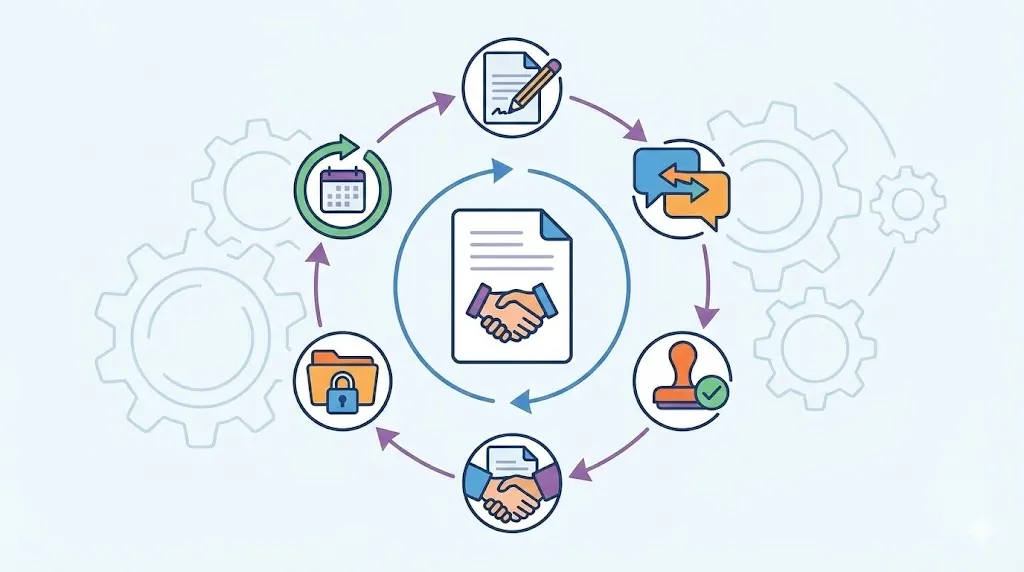
Contract Lifecycle Management platforms govern contracts from intake through execution, monitoring, and renewal. Contracts become structured data entities governed by enforceable workflows and compliance logic.
Core enterprise lifecycle governance layers include:
Structured Intake and Classification
Contracts enter through governed intake workflows capturing jurisdiction, contract type, risk classification, and financial exposure.Template Enforcement and Clause Governance
Clause libraries enforce compliance with internal policy and regulatory requirements. Deviations trigger escalation workflows.Negotiation Auditability and Revision Traceability
All contract modifications remain permanently auditable, preserving compliance defensibility.Execution and Lifecycle Activation
Executed contracts become structured operational records integrated with enterprise systems.Post-Signature Obligation Monitoring
Renewals, milestones, and obligations remain actively monitored within lifecycle governance frameworks.
Artificial intelligence enhances lifecycle governance by extracting metadata, detecting clause risk, and enabling portfolio-level contract intelligence.
Related Article: 10 Tips for Contract Negotiation : Strategies Toward Success
Platform Architecture Overview: Agiloft vs Conga
Agiloft: Configurable No-Code Lifecycle Automation Platform
Agiloft is designed around configurability. Its no-code architecture allows enterprises to model complex workflows, approval logic, and lifecycle automation without traditional software development.
Core architectural capabilities include:
No-code workflow automation and lifecycle configuration
Customizable approval routing aligned with enterprise policy structures
Flexible metadata schemas and contract classification models
Integration with ERP, CRM, and enterprise systems
Configurable dashboards and reporting environments
Agiloft’s architecture prioritizes flexibility. Enterprises can model lifecycle workflows to match operational requirements without software engineering effort.
This makes Agiloft suitable for organizations requiring adaptable lifecycle governance across diverse business environments.
Related Article: Agiloft Pricing Overview: Features, Cost, and Alternatives
Conga: Governance-Centric Enterprise CLM Platform
Conga approaches CLM through structured governance enforcement. Its architecture emphasizes compliance visibility, approval hierarchy enforcement, and lifecycle intelligence aligned with enterprise regulatory requirements.
Core architectural capabilities include:
Structured approval hierarchies aligned with enterprise delegation authority
AI-driven clause intelligence and compliance risk identification
Deep integration with CRM, ERP, and enterprise billing systems
Structured obligation tracking integrated into governance reporting
Enterprise-grade analytics supporting compliance and risk monitoring
Conga’s architecture prioritizes governance depth and compliance control across enterprise contract portfolios.
This positions Conga as a governance-centric CLM platform optimized for regulated enterprise environments.
Enterprise Pricing and Total Cost of Ownership
Cost Component | Agiloft Enterprise Structure | Conga Enterprise Structure |
Annual License Fee | $100,000 – $250,000+ | $150,000 – $300,000+ |
Implementation & Onboarding | $80,000 – $200,000+ | $120,000 – $300,000+ |
Maintenance & Support | 18% – 22% of license cost | 20% – 25% of license cost |
Additional Costs | Advanced AI modules, custom integrations | Advanced analytics, AI functionality |
Pricing Variables | User volume, contract count | User volume, Salesforce/CPQ scope |
Primary Influence on TCO | Configuration scope & governance depth | Integration architecture & module count |
Artificial Intelligence and Contract Intelligence Capability
AI transforms unstructured contract text into structured operational intelligence. Its effectiveness depends on integration into lifecycle governance workflows.
Agiloft provides configurable AI extraction models. Enterprises can customize metadata extraction workflows and classification logic to match operational requirements. AI capability depends heavily on configuration scope and training.
Conga provides enterprise-focused clause intelligence and compliance analytics. Its AI architecture detects clause deviations, identifies contractual risk, and supports compliance visibility across contract portfolios.
Conga’s AI capability is more tightly integrated into governance workflows. Agiloft provides greater configurability but may require enterprise configuration effort to reach equivalent analytical depth.
Lifecycle Execution and Workflow Governance Comparison
Contract Intake and Lifecycle Initiation
Agiloft enables structured intake workflows capturing contract classification, risk attributes, and operational metadata. Rule engines determine drafting logic and approval routing.
Conga embeds intake workflows within enterprise governance frameworks. Contract metadata directly drives compliance validation, risk analysis, and lifecycle enforcement.
Both platforms support structured intake governance, but Conga emphasizes governance enforcement earlier in the lifecycle.
Drafting, Negotiation, and Clause Governance
Agiloft enables template customization using no-code configuration. Enterprises can model clause logic aligned with unique operational workflows.
Conga provides clause intelligence integrated into compliance frameworks. Risk scoring and clause classification enable enterprises to identify non-compliant contract language.
Agiloft emphasizes drafting flexibility. Conga emphasizes compliance discipline and risk visibility.
Approval Routing and Enterprise Delegation Enforcement
Agiloft supports configurable approval workflows adaptable across departments, financial thresholds, and operational requirements.
Conga provides structured hierarchical approval routing aligned with enterprise authority models. Approval workflows reflect governance structures across business units and geographies.
Conga’s architecture aligns more directly with enterprise compliance enforcement requirements.
Execution and Enterprise Integration
Both platforms integrate with electronic signature providers and enterprise systems.
Agiloft emphasizes workflow continuity and integration flexibility.
Conga integrates execution workflows directly into compliance monitoring frameworks, enabling structured governance continuity after contract execution.
Integration architecture determines whether contracts function as operational infrastructure or passive records.
Post-Signature Governance and Obligation Enforcement
Post-signature lifecycle governance determines audit readiness and operational accountability.
Agiloft provides dashboards, renewal alerts, and obligation reminders. Governance capability is configurable and adaptable.
Conga provides structured obligation tracking integrated into enterprise reporting and compliance monitoring frameworks.
Conga’s architecture provides stronger native compliance enforcement and structured governance continuity.
Related Article: How to Manage a Contract Post Execution? Best Practices
Integration Ecosystem and Enterprise Scalability
Enterprise CLM platforms must integrate with operational infrastructure, including ERP, CRM, billing, and compliance systems.
Agiloft integrates broadly with enterprise platforms including SAP, Oracle, Salesforce, and Microsoft environments. Its open architecture supports enterprise customization.
Conga integrates deeply with enterprise CRM platforms, particularly Salesforce, and enterprise billing and analytics systems. Its integration architecture aligns closely with enterprise compliance and financial governance workflows.
Both platforms support enterprise scalability, but integration architecture differs based on operational priorities.
Strengths and Limitations: Agiloft vs Conga
Agiloft Strengths
Highly configurable lifecycle workflows without software development
Flexible metadata schemas supporting enterprise customization
Broad integration capabilities across enterprise systems
Adaptable lifecycle governance models
Agiloft Limitations
AI intelligence depth depends on configuration scope
Governance enforcement requires enterprise configuration effort
Implementation complexity increases with lifecycle customization
Conga Strengths
Strong governance architecture aligned with enterprise compliance requirements
Advanced AI-driven clause intelligence and risk analysis
Deep integration with enterprise CRM, ERP, and billing ecosystems
Structured obligation monitoring supporting audit readiness
Conga Limitations
Longer implementation timelines due to governance configuration
Higher enterprise deployment costs
Greater reliance on structured governance configuration frameworks
Related Article: How to Create contracts in CRM with CLM integration
Volody CLM: Structured Lifecycle Governance and Contract Intelligence Continuity
Volody CLM operates as a lifecycle governance platform designed to embed structured contract intelligence across lifecycle stages.
Core lifecycle governance capabilities include:
AI-assisted metadata extraction integrated into lifecycle workflows
Clause-level intelligence embedded directly within contract drafting templates
Structured obligation tracking aligned with enterprise compliance frameworks
Configurable approval hierarchies aligned with enterprise governance models
Renewal forecasting integrated into lifecycle governance systems
Volody emphasizes lifecycle continuity. Contracts function as structured operational infrastructure integrated into enterprise governance workflows.
Strategic Platform Selection Framework
Platform selection depends on lifecycle governance priorities, operational complexity, and compliance requirements.
Agiloft aligns with organizations requiring:
Highly configurable lifecycle workflows
Flexible contract governance aligned with unique operational processes
Adaptable lifecycle automation without extensive software development
Conga aligns with organizations requiring:
Structured enterprise governance enforcement
AI-driven compliance monitoring and risk analysis
Deep integration with enterprise CRM and compliance systems
Volody aligns with organizations requiring:
Structured lifecycle governance continuity
Integrated contract intelligence aligned with operational enforcement
Automated obligation tracking and renewal governance
Enterprise lifecycle control without excessive configuration complexity
Lifecycle governance architecture determines enterprise contract enforceability, compliance readiness, and operational predictability.
Conclusion
Enterprise contract lifecycle management defines whether contracts operate as enforceable governance infrastructure or remain fragmented records that create compliance, financial, and operational risk. Agiloft provides configurable lifecycle automation suited for organizations requiring flexibility, while Conga emphasizes structured governance enforcement, compliance visibility, and AI-driven risk analysis for regulated enterprise environments. Volody focuses on lifecycle continuity through embedded contract intelligence, structured obligation monitoring, and integrated governance workflows. Platform architecture selection ultimately determines contract enforceability, audit readiness, and enterprise operational control.
About the Company
Volody AI CLM is an Agentic AI-powered Contract Lifecycle Management platform designed to eliminate manual contracting tasks, automate complex workflows, and deliver actionable insights. As a one-stop shop for all contract activities, it covers drafting, collaboration, negotiation, approvals, e-signature, compliance tracking, and renewals. Built with enterprise-grade security and no-code configuration, it meets the needs of the most complex global organizations. Volody AI CLM also includes AI-driven contract review and risk analysis, helping teams detect issues early and optimize terms. Trusted by Fortune 500 companies, high-growth startups, and government entities, it transforms contracts into strategic, data-driven business assets.



" height="216.72211px" id="FYO0bO80Y" transform="translate(3 6.105)" width="206.073px"/><path d="M 108.174 222 C 88.432 222 70.303 217.239 53.785 207.717 C 37.267 198.196 24.173 185.052 14.504 168.285 C 4.835 151.312 0 132.165 0 110.845 C 0 89.731 4.835 70.792 14.504 54.025 C 24.173 37.052 37.267 23.804 53.785 14.282 C 70.303 4.761 88.432 0 108.174 0 C 128.116 0 146.246 4.761 162.562 14.282 C 179.08 23.804 192.073 37.052 201.541 54.025 C 211.21 70.792 216.044 89.731 216.044 110.845 C 216.044 132.165 211.21 151.312 201.541 168.285 C 192.073 185.052 179.08 198.196 162.562 207.717 C 146.044 217.239 127.915 222 108.174 222 Z M 108.174 183.189 C 120.864 183.189 132.044 180.291 141.713 174.495 C 151.382 168.492 158.936 160.006 164.375 149.035 C 169.814 138.064 172.533 125.334 172.533 110.845 C 172.533 96.355 169.814 83.729 164.375 72.965 C 158.936 61.994 151.382 53.611 141.713 47.815 C 132.044 42.02 120.864 39.122 108.174 39.122 C 95.483 39.122 84.202 42.02 74.332 47.815 C 64.663 53.611 57.109 61.994 51.67 72.965 C 46.231 83.729 43.511 96.355 43.511 110.845 C 43.511 125.334 46.231 138.064 51.67 149.035 C 57.109 160.006 64.663 168.492 74.332 174.495 C 84.202 180.291 95.483 183.189 108.174 183.189 Z" fill="rgba(255, 255, 255, 0.12)" height="222px" id="aa1McFcE9" transform="translate(227.183 3)" width="216.04399999999998px"/><path d="M 42.302 182.257 L 111.799 182.257 L 111.799 216.722 L 0 216.722 L 0 0 L 42.302 0 Z" fill="rgba(255, 255, 255, 0.12)" height="216.72211px" id="yRq4AnrsX" transform="translate(477.721 6.105)" width="111.79899999999998px"/><path d="M 108.174 222 C 88.432 222 70.303 217.239 53.785 207.717 C 37.267 198.196 24.173 185.052 14.504 168.285 C 4.835 151.312 0 132.165 0 110.845 C 0 89.731 4.835 70.792 14.504 54.025 C 24.173 37.052 37.267 23.804 53.785 14.282 C 70.303 4.761 88.432 0 108.174 0 C 128.116 0 146.246 4.761 162.562 14.282 C 179.08 23.804 192.073 37.052 201.541 54.025 C 211.21 70.792 216.045 89.731 216.045 110.845 C 216.045 132.165 211.21 151.312 201.541 168.285 C 192.073 185.052 179.08 198.196 162.562 207.717 C 146.044 217.239 127.915 222 108.174 222 Z M 108.174 183.189 C 120.864 183.189 132.044 180.291 141.713 174.495 C 151.382 168.492 158.936 160.006 164.375 149.035 C 169.814 138.064 172.534 125.334 172.534 110.845 C 172.534 96.355 169.814 83.729 164.375 72.965 C 158.936 61.994 151.382 53.611 141.713 47.815 C 132.044 42.02 120.864 39.122 108.174 39.122 C 95.483 39.122 84.202 42.02 74.332 47.815 C 64.663 53.611 57.108 61.994 51.67 72.965 C 46.231 83.729 43.511 96.355 43.511 110.845 C 43.511 125.334 46.231 138.064 51.67 149.035 C 57.108 160.006 64.663 168.492 74.332 174.495 C 84.202 180.291 95.483 183.189 108.174 183.189 Z" fill="rgba(255, 255, 255, 0.12)" height="222px" id="mo8HQspQ0" transform="translate(609.155 3)" width="216.04500000000007px"/><path d="M 73.727 0 C 95.885 0 115.324 4.45 132.044 13.351 C 148.967 22.252 161.957 34.982 171.027 51.541 C 180.287 67.894 184.917 86.937 184.917 108.671 C 184.917 130.405 180.287 149.449 171.027 165.801 C 161.957 181.947 148.967 194.47 132.044 203.371 C 115.324 212.271 95.885 216.722 73.727 216.722 L 0 216.722 L 0 0 Z M 72.216 179.773 C 94.374 179.773 111.497 173.564 123.583 161.144 C 135.669 148.724 141.713 131.233 141.713 108.671 C 141.713 86.109 135.669 68.515 123.583 55.888 C 111.497 43.055 94.374 36.638 72.216 36.638 L 42.302 36.638 L 42.302 179.773 Z" fill="rgba(255, 255, 255, 0.12)" height="216.72211px" id="I3iXX5Hi_" transform="translate(859.693 6.105)" width="184.91699999999992px"/><path d="M 185.22 0 L 113.91 141.273 L 113.91 216.722 L 71.61 216.722 L 71.61 141.273 L 0 0 L 47.74 0 L 93.06 99.046 L 138.08 0 Z" fill="rgba(255, 255, 255, 0.12)" height="216.72211px" id="nzHyWC0_d" transform="translate(1061.78 6.105)" width="185.22000000000003px"/></svg>)