

For legal teams on tight budgets, pricing transparency is crucial. Hidden fees, unexpected add-ons, and drawn-out negotiations can quickly diminish ROI.
This breakdown covers the Summize pricing picture—baseline rates, add-ons, implementation, renewals, and user-reported costs—based on official sources, reviews, and verified insights.
How Summize Typically Prices Its Platform
Tiered Pricing Model
Summize eschews upfront published rate cards in favor of bespoke annual subscriptions. The base rate reported across multiple sources is £99 per user per month, but quotes adjust based on:
Number of legal users vs. business users (e.g., Software Suggest cites a “Legal” tier at $132/user/month vs. “Business” at $65/user/month).
Volume of contracts and stakeholders interacting with the platform.
Required AI-review add-ons, reporting dashboards, and custom templates.
While mid-market packages are advertised as ~12% below the CLM category average, enterprises typically negotiate multi-seat deals that can exceed $60K–$100K per year once scaled across 50–100 users.
Add-Ons & Hidden Costs
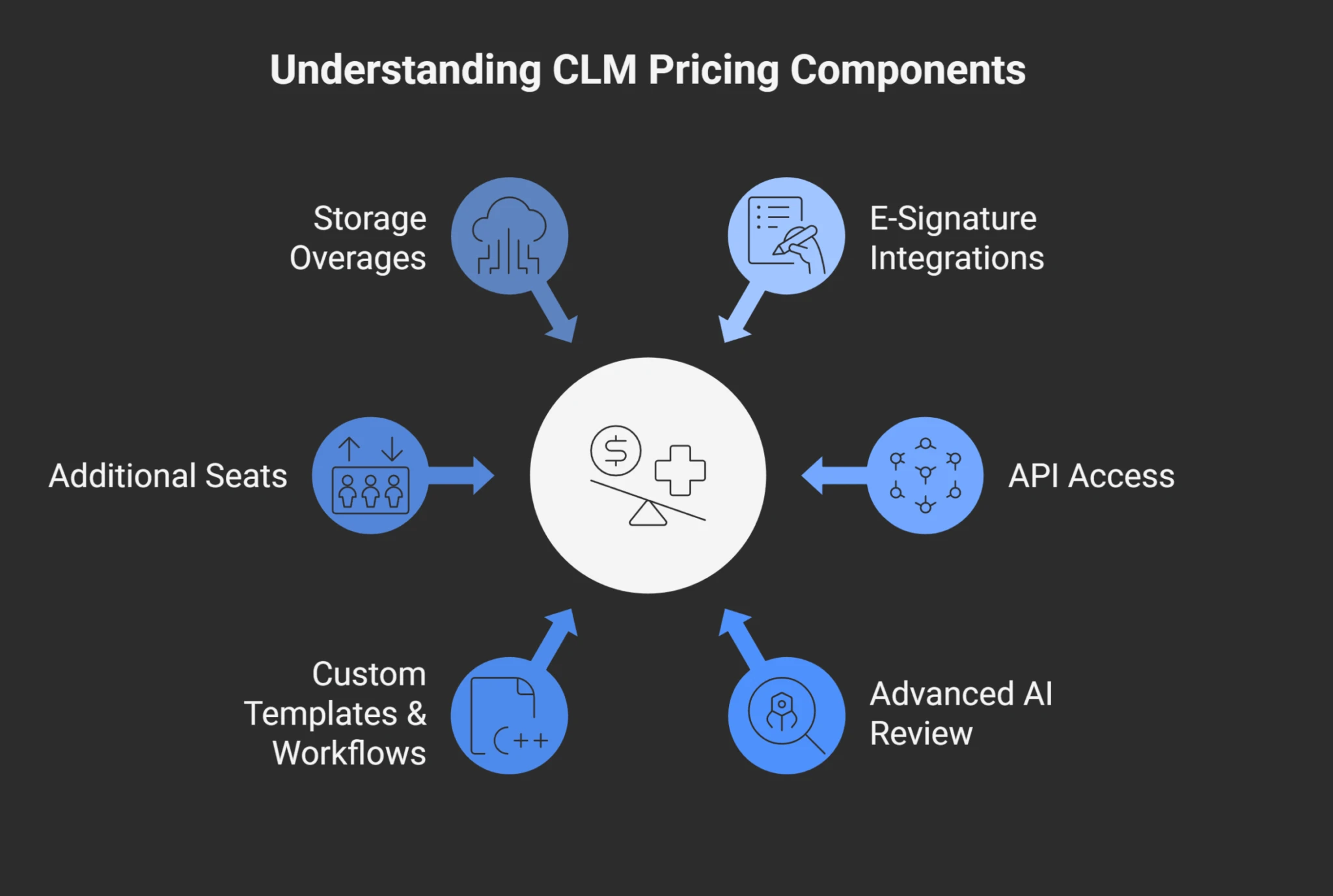
E-signature integrations: While Summize offers native e-signature integrations, any premium or advanced signing features may require additional licensing or usage-based charges, though specifics aren’t publicly listed.
API access and developer support: Deeper integration with CRM, ERP, or third-party platforms often triggers supplemental API access fees and can necessitate extra developer support, especially for highly customized workflows.
Custom workflow templates or extended training sessions: Organizations that require tailored workflow automations, business logic modules, or on-site/virtual training beyond initial onboarding may face one-time customization or day-rate consultant fees.
Additional seats beyond initial licensing bands: User licenses are structured in defined seat blocks (often in increments of 10 or 25); exceeding those bands triggers additional per-seat charges, sometimes at a higher tiered rate.
Support & Implementation Costs
White-glove project management for complex integrations: Summize assigns dedicated project managers for multi-system deployments, but such “white-glove” services are often classified as premium and can significantly increase total setup costs.
Premium support tiers (24/7 SLA vs. standard business-hours): Baseline support may cover weekday hours only; customers needing guaranteed 24/7 rapid-response or multi-channel support must opt for higher-priced support packages.
Optional in-depth training workshops: While basic platform usage training is typically included, in-depth or role-specific training workshops (remote or on-site) are delivered by specialists at additional cost, often billed per session or per day depending on the scope.
Related Article: Contract Compliance: Importance & Best Practices
What Users Have To Say About Summize

Pricing conversations around Summize have been steadily surfacing across legal tech forums, G2 reviews, and legal operations Slack groups.
Here's a snapshot of what real users and evaluators are saying:
"Does not cater for reviewing documents received in an electronic signature files (unless the documents are downloaded from it first)." - Software Advice
"The time taken to build Playbooks is a drawback. Having templated playbooks with input from specialist lawyers would be amazing." - G2 user
"The Repository is very limited in terms of how items are organized and saved. Currently we are limited to on Main folder and you cannot create subfolders within other subfolders." - Capterra
Related Article: Summize Review 2025: Can This CLM Handle Real Legal Work?
Summize Pricing Insights Table
Feature Category | Included in Base Subscription? | May Require Add-on or External Tool? |
|---|---|---|
E-signature | No | Yes (commonly via DocuSign or other integrations) |
AI Redlining | No | Yes (advanced AI review/add-ons typically extra) |
Custom Workflows | Limited (basic template & workflow access) | Yes (advanced/custom workflows require add-on) |
API Access | Limited (some basic API usage) | Yes (full API access and developer support separate) |
Legal Ops Tasks | No | Yes (handled via external legal ops platforms/tools) |
Metadata Reports | Basic reporting included | Yes (complex, customizable analytics require add-on) |
Related Article: Crafting the Perfect Statement of Work (SOW)
Value Analysis: Summize vs. CLM Market
Summize’s core license includes AI-powered clause review, embedded templates, repository access, and basic analytics. However:
High-growth teams may quickly outgrow base seat blocks and trigger tiered overage fees.
AI-review “tokens” or premium analytics add-ons can push total cost beyond initial license estimates.
Annual term lock-ins reduce flexibility for fast-scaling startups.
Feature Comparison with Key CLM Platforms
Platform | AI Features | Support Model | Workflow Flexibility | Metadata Usability |
|---|---|---|---|---|
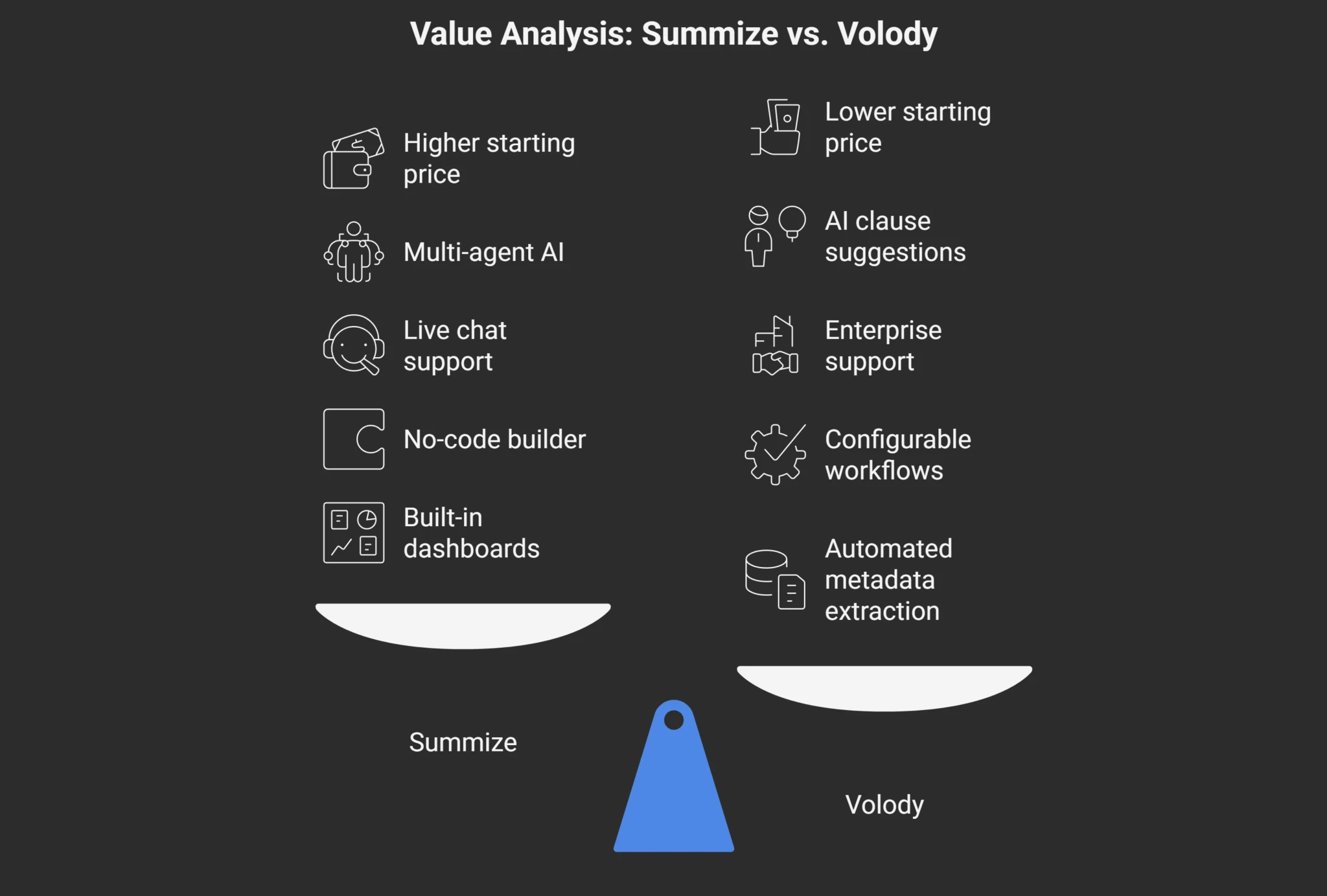
Summize | Multi-agent AI for redlines, summaries, Q&A | Email, phone, chat, knowledge base | No-code builder with integrations | Dashboards; add-on analytics |
Ironclad | None publicly documented | Tiered plans (Bronze/Silver/Gold) | Basic authoring; custom automations | Basic search/cataloguing |
DocuSign CLM | AI summary & clause extraction (Insight add-on) | Enterprise support; optional SLA | Mid-level designer in apps | Base reporting; add-on insights |
LinkSquares | Clause & obligation extraction (Lexi) | Managed support & SLAs | Template-based workflows | Basic dashboards |
Agiloft | Clause risk analysis & playbooks | Enterprise support across tiers | Highly flexible no-code builder | Custom reports & dashboards |
Volody | Clause suggestion, risk analysis, extraction | Contact sales (no published tiers) | Configurable designer | Automated extraction & tracking |
Summize competes well on AI features, but its tiered licensing and add-on fees dilute cost predictability compared to flat-rate models.
Related Article: Contract Review Checklist: An Effective Guide
Assessing Summize Pricing for Legal Teams

Who Should Consider It
Summize’s pricing model is best suited for enterprises with large legal teams, especially those who:
Require deep Microsoft Word integration.
Have predictable contract volumes.
Can negotiate enterprise discounts on multi-year deals.
Where Summize May Fall Short
Mid-size or scaling legal teams may find the pricing less flexible
Tiered, custom pricing with annual commitments can strain tighter budgets
Potential Drawbacks and Cost Triggers
E-signature integrations
Advanced AI analytics
Custom workflows
Limited functionality beyond core contracting (e.g., compliance or litigation support)
May require third-party tools, increasing total cost and complexity
Disclaimer on Pricing Information
It is important to note that Summize CLM does not publicly disclose detailed pricing information on its official website. As a result, all pricing data, feature inclusion assessments, and cost analyses presented in this article are based on a combination of publicly available secondary sources—including third-party review platforms, customer feedback, analyst reports, and industry estimates—and should be treated as indicative rather than definitive.
Where exact pricing figures are absent, we have relied on reported ranges, user anecdotes, and pricing signals from trusted platforms to form a best-effort understanding of Summize’s pricing structure. Actual contract values, discounts, add-on costs, and implementation fees may vary significantly depending on factors such as company size, negotiation terms, regional differences, and specific configuration requirements.
Related Article: Ironclad Pricing 2025: Worth the Investing for Legal Teams?
Final Thoughts
Summize has made a name for itself with its Microsoft-friendly design, intuitive UI, and promise of AI-powered contract acceleration. For well-resourced teams with clear processes and technical support, it can deliver meaningful efficiencies.
At the end of the day, choosing a CLM is about more than sleek integrations—it’s about alignment with your team’s scale, workflows, and evolving needs. Ask hard questions, evaluate real-life use cases, and focus on tools that grow with your operations, not just your contract count.
Why Volody Offers Better Value
A single, all-inclusive rate of $49/user/month—no seat-blocks or hidden AI tokens.
Unlimited contracts, e-sign integrations, and API access baked into the base fee.
White-glove onboarding and 24/7 support as standard.
Flexible monthly or annual plans—scale up or down without penalties.
Related Article: LinkSquares Pricing: Worth the Investment for Legal in 2025
FAQs
How much does Summize cost?
Summize uses a custom-tiered pricing model based on user type and required features. Legal users typically cost around $130/month, while business users are billed at about $65/month. Pricing can rise significantly with add-ons like AI analytics, e-signature integrations, and workflow customization.
What kind of companies benefit most from Summize?
Summize is ideal for mid-to-large companies already working within Microsoft 365 ecosystems. Teams with access to internal IT support and legal operations resources can get the most value from their embedded workflows and AI review tools.
Does anybody provide a better service than Summize?
Volody offers a more scalable and affordable alternative to Summize. With built-in AI, no-code workflow automation, and broader lifecycle coverage, Volody eliminates the need for external tools, delivering more value at a lower total cost.
About the Company

Volody AI CLM is an Agentic AI-powered Contract Lifecycle Management platform designed to eliminate manual contracting tasks, automate complex workflows, and deliver actionable insights. As a one-stop shop for all contract activities, it covers drafting, collaboration, negotiation, approvals, e-signature, compliance tracking, and renewals. Built with enterprise-grade security and no-code configuration, it meets the needs of the most complex global organizations. Volody AI CLM also includes AI-driven contract review and risk analysis, helping teams detect issues early and optimize terms. Trusted by Fortune 500 companies, high-growth startups, and government entities, it transforms contracts into strategic, data-driven business assets.






" height="216.72211px" id="FYO0bO80Y" transform="translate(3 6.105)" width="206.073px"/><path d="M 108.174 222 C 88.432 222 70.303 217.239 53.785 207.717 C 37.267 198.196 24.173 185.052 14.504 168.285 C 4.835 151.312 0 132.165 0 110.845 C 0 89.731 4.835 70.792 14.504 54.025 C 24.173 37.052 37.267 23.804 53.785 14.282 C 70.303 4.761 88.432 0 108.174 0 C 128.116 0 146.246 4.761 162.562 14.282 C 179.08 23.804 192.073 37.052 201.541 54.025 C 211.21 70.792 216.044 89.731 216.044 110.845 C 216.044 132.165 211.21 151.312 201.541 168.285 C 192.073 185.052 179.08 198.196 162.562 207.717 C 146.044 217.239 127.915 222 108.174 222 Z M 108.174 183.189 C 120.864 183.189 132.044 180.291 141.713 174.495 C 151.382 168.492 158.936 160.006 164.375 149.035 C 169.814 138.064 172.533 125.334 172.533 110.845 C 172.533 96.355 169.814 83.729 164.375 72.965 C 158.936 61.994 151.382 53.611 141.713 47.815 C 132.044 42.02 120.864 39.122 108.174 39.122 C 95.483 39.122 84.202 42.02 74.332 47.815 C 64.663 53.611 57.109 61.994 51.67 72.965 C 46.231 83.729 43.511 96.355 43.511 110.845 C 43.511 125.334 46.231 138.064 51.67 149.035 C 57.109 160.006 64.663 168.492 74.332 174.495 C 84.202 180.291 95.483 183.189 108.174 183.189 Z" fill="rgba(255, 255, 255, 0.12)" height="222px" id="aa1McFcE9" transform="translate(227.183 3)" width="216.04399999999998px"/><path d="M 42.302 182.257 L 111.799 182.257 L 111.799 216.722 L 0 216.722 L 0 0 L 42.302 0 Z" fill="rgba(255, 255, 255, 0.12)" height="216.72211px" id="yRq4AnrsX" transform="translate(477.721 6.105)" width="111.79899999999998px"/><path d="M 108.174 222 C 88.432 222 70.303 217.239 53.785 207.717 C 37.267 198.196 24.173 185.052 14.504 168.285 C 4.835 151.312 0 132.165 0 110.845 C 0 89.731 4.835 70.792 14.504 54.025 C 24.173 37.052 37.267 23.804 53.785 14.282 C 70.303 4.761 88.432 0 108.174 0 C 128.116 0 146.246 4.761 162.562 14.282 C 179.08 23.804 192.073 37.052 201.541 54.025 C 211.21 70.792 216.045 89.731 216.045 110.845 C 216.045 132.165 211.21 151.312 201.541 168.285 C 192.073 185.052 179.08 198.196 162.562 207.717 C 146.044 217.239 127.915 222 108.174 222 Z M 108.174 183.189 C 120.864 183.189 132.044 180.291 141.713 174.495 C 151.382 168.492 158.936 160.006 164.375 149.035 C 169.814 138.064 172.534 125.334 172.534 110.845 C 172.534 96.355 169.814 83.729 164.375 72.965 C 158.936 61.994 151.382 53.611 141.713 47.815 C 132.044 42.02 120.864 39.122 108.174 39.122 C 95.483 39.122 84.202 42.02 74.332 47.815 C 64.663 53.611 57.108 61.994 51.67 72.965 C 46.231 83.729 43.511 96.355 43.511 110.845 C 43.511 125.334 46.231 138.064 51.67 149.035 C 57.108 160.006 64.663 168.492 74.332 174.495 C 84.202 180.291 95.483 183.189 108.174 183.189 Z" fill="rgba(255, 255, 255, 0.12)" height="222px" id="mo8HQspQ0" transform="translate(609.155 3)" width="216.04500000000007px"/><path d="M 73.727 0 C 95.885 0 115.324 4.45 132.044 13.351 C 148.967 22.252 161.957 34.982 171.027 51.541 C 180.287 67.894 184.917 86.937 184.917 108.671 C 184.917 130.405 180.287 149.449 171.027 165.801 C 161.957 181.947 148.967 194.47 132.044 203.371 C 115.324 212.271 95.885 216.722 73.727 216.722 L 0 216.722 L 0 0 Z M 72.216 179.773 C 94.374 179.773 111.497 173.564 123.583 161.144 C 135.669 148.724 141.713 131.233 141.713 108.671 C 141.713 86.109 135.669 68.515 123.583 55.888 C 111.497 43.055 94.374 36.638 72.216 36.638 L 42.302 36.638 L 42.302 179.773 Z" fill="rgba(255, 255, 255, 0.12)" height="216.72211px" id="I3iXX5Hi_" transform="translate(859.693 6.105)" width="184.91699999999992px"/><path d="M 185.22 0 L 113.91 141.273 L 113.91 216.722 L 71.61 216.722 L 71.61 141.273 L 0 0 L 47.74 0 L 93.06 99.046 L 138.08 0 Z" fill="rgba(255, 255, 255, 0.12)" height="216.72211px" id="nzHyWC0_d" transform="translate(1061.78 6.105)" width="185.22000000000003px"/></svg>)