
Contract Lifecycle Management (CLM) platforms have evolved from document repositories into operational infrastructure that governs revenue execution, compliance enforcement, and enterprise risk management. Platforms like SpotDraft position themselves as modern CLM systems designed to automate workflows, centralize contract data, and enable faster approvals.
Legal operations leaders evaluating CLM pricing typically fall into three decision stages:
Early Research: Understanding pricing structure, automation capabilities, and AI functionality.
Vendor Shortlist: Comparing cost model, implementation effort, and integration readiness.
Purchase Decision: Evaluating ROI, scalability, and total cost of ownership relative to enterprise alternatives like Volody.
SpotDraft pricing is not published publicly. Instead, it follows a custom quote-based model influenced by several structural variables.
SpotDraft CLM Pricing: Core Cost Drivers
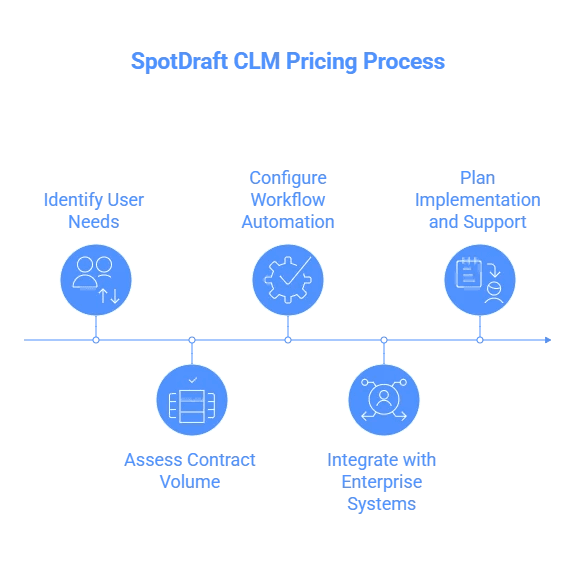
It uses a flexible pricing model based on users, contract volume, workflow complexity, and integration scope rather than fixed subscription tiers.
1. User-Based Licensing
SpotDraft pricing is typically influenced by:
Number of legal, procurement, and business users
Access level requirements (admin, reviewer, read-only users)
Workflow participation across departments
As user count increases, subscription costs scale accordingly. This model can initially appear cost-effective but expands significantly as adoption grows enterprise-wide.
2. Contract Volume and Repository Scale
SpotDraft includes a centralized contract repository with AI extraction capabilities, automatically capturing metadata from contracts for search and analytics.
Cost impact factors include:
Total contract volume stored
Annual contract creation volume
Metadata extraction and analytics scope
Organizations with high contract throughput require more infrastructure, which directly influences pricing tiers.
3. Workflow Automation and Configuration
It provides workflow automation including:
Conditional approval routing
Template-based contract generation
Automated review and signature workflows
However, workflow configuration complexity affects implementation effort and overall deployment cost. Highly customized workflows typically require additional configuration time, increasing onboarding intensity and operational overhead.
4. Integrations with Enterprise Systems
It integrates with enterprise platforms including CRM, storage, and collaboration tools such as Salesforce, Slack, HubSpot, and Google Drive.
Integration scope directly impacts pricing due to:
CRM synchronization complexity
ERP integration requirements
Data migration volume
Workflow automation across systems
SpotDraft’s Salesforce integration enables contract creation, approval tracking, and contract data visibility directly inside CRM workflows. Integration depth often increases both implementation cost and ongoing maintenance requirements.
5. Implementation and Support Costs
SpotDraft includes in-house implementation services covering:
Workflow setup
Contract template configuration
Legacy contract migration
Integration deployment and onboarding
While implementation support is included, deployment timelines and internal adoption effort vary depending on workflow complexity and enterprise requirements. Organizations with complex approval hierarchies, global operations, or regulatory compliance requirements typically require more extensive configuration.
Related Article: The Importance of Centralized Contract Repositories
SpotDraft Pricing by Business Size
SpotDraft pricing alignment varies significantly across organizational maturity.
Small Businesses
Cost Characteristics:
Higher relative cost compared to lightweight CLM tools
Limited need for full enterprise workflow automation
Underutilization of advanced automation capabilities
Operational Impact:
SpotDraft’s architecture is optimized for structured contract governance. Smaller organizations with lower contract volume may not fully utilize advanced automation layers, reducing cost efficiency.
Mid-Market Organizations
Cost Characteristics:
More balanced pricing relative to workflow complexity
Improved ROI due to workflow automation and reduced manual work
Moderate implementation effort
Operational Fit:
Mid-market legal teams benefit from:
Automated contract creation
Structured approval workflows
Centralized repository and audit visibility
SpotDraft cost efficiency improves significantly as contract volume and operational complexity increase.
Large Enterprises
Cost Characteristics:
Higher overall investment due to integration, scale, and workflow requirements
Custom pricing aligned with enterprise governance and compliance needs
Operational Advantages:
Large enterprises benefit from:
Automated contract lifecycle governance
Contract analytics and reporting visibility
CRM-integrated contract management workflows
However, enterprise deployment introduces operational complexity that increases implementation intensity and long-term management overhead.
SpotDraft Features That Influence Cost
SpotDraft provides core CLM capabilities including:
Workflow Automation
SpotDraft automates contract approvals and manages contract progression from creation to signature, reducing reliance on manual email-based workflows.
Impact on ROI:
Faster contract approvals
Reduced legal review workload
Improved compliance consistency
Contract Repository and Metadata Extraction
SpotDraft’s repository automatically extracts contract metadata for structured search and reporting.
Operational value includes:
Faster contract retrieval
Improved audit readiness
Centralized contract visibility
However, reporting depth and customization flexibility may vary depending on configuration scope.
Integrations and Workflow Synchronization
SpotDraft integrates with CRM systems like Salesforce, allowing contract workflows to operate within revenue pipelines.
This improves:
Contract visibility across sales and legal teams
Contract-linked revenue tracking
Workflow continuity across departments
Integration capability is critical for enterprise-level CLM deployment.
Related Article: Digitizing Legacy Contracts: Best Practices
SpotDraft Pricing vs Enterprise CLM Competitors
Pricing architecture not feature count is the primary differentiator between CLM vendors.
Pricing Transparency Comparison
Vendor | Pricing Model | Transparency | Budget Predictability |
SpotDraft | Custom quote | Low | Medium |
Ironclad | Enterprise quote | Low | Medium |
Icertis | Enterprise custom | Low | Low |
Volody | Transparent structured pricing | High | High |
Implication:
Quote-based pricing increases procurement uncertainty and internal approval complexity. Transparent pricing models provide stronger financial planning predictability.
Implementation Cost Intensity Comparison
Vendor | Implementation Effort | Deployment Complexity |
SpotDraft | Moderate | Workflow configuration required |
Ironclad | Moderate | Faster deployment relative to enterprise systems |
Icertis | High | Complex enterprise customization |
Volody | Accelerated | Pre-configured workflows reduce setup effort |
Financial impact:
Longer deployment timelines increase consulting costs and delay ROI realization.
AI and Automation Cost Structure
Vendor | AI Availability | Cost Structure |
SpotDraft | Available | Included but scope varies |
Ironclad | Limited depth | Tier dependent |
Icertis | Advanced | Modular enterprise pricing |
Volody | Advanced enterprise AI | Embedded in core platform |
Implication:
Platforms with embedded AI reduce incremental costs and improve operational efficiency without requiring additional module purchases.
SpotDraft Reviews: Strengths and Limitations
Strengths
Clean and intuitive interface
Structured contract workflow automation
Integration capabilities with CRM and collaboration tools
Centralized contract repository and management
These features improve contract visibility and operational governance.
Limitations Impacting Cost Efficiency
Limited pricing transparency: Requires vendor engagement for cost clarity.
Workflow customization effort: Advanced workflows require configuration effort.
Reporting limitations: Advanced analytics customization may require additional setup.
Scaling cost impact: Pricing expands as user count and contract volume increase.
These factors increase long-term cost unpredictability, particularly for scaling enterprises.
Total Cost of Ownership (TCO): SpotDraft vs Volody
CLM total cost includes multiple operational and technical components:
Platform licensing
Workflow configuration
Implementation and onboarding
Integration consulting
Internal adoption and training
Ongoing support and maintenance
Platforms requiring more customization typically increase total cost of ownership over 3–5 years.
Volody reduces total cost volatility through:
Embedded AI capabilities
Structured pricing architecture
Faster deployment timelines
Pre-configured enterprise workflows
This improves procurement predictability and accelerates ROI realization.
Strategic Interpretation:
SpotDraft is best suited for:
Mid-market legal teams scaling contract operations
Organizations requiring structured workflow automation
Teams needing CRM-integrated contract lifecycle management
However, enterprises prioritizing:
Pricing transparency
Faster deployment timelines
Embedded AI without modular pricing complexity
Predictable total cost of ownership
typically evaluate platforms like Volody more.
Related Article: The Ultimate Guide to Contract Review Tools for 2025
How Legal Teams Should Evaluate SpotDraft Pricing
Legal operations leaders should evaluate CLM pricing across five critical dimensions:
Pricing transparency: Ensure clear cost predictability.
Implementation complexity: Evaluate deployment timelines and internal resource requirements.
AI capability inclusion: Avoid platforms requiring separate AI module purchases.
Integration scope: Validate ERP, CRM, and document management integration readiness.
Long-term scalability: Ensure predictable cost structure as adoption expands.
Platforms that reduce pricing ambiguity and deployment complexity deliver stronger operational and financial outcomes.
Why Volody Is a Strong Alternative
Volody addresses several structural limitations associated with modular or opaque CLM pricing models.
Key advantages:
Embedded AI contract intelligence without additional modules
Transparent, structured pricing model
Faster enterprise deployment timelines
Lower implementation complexity
Predictable long-term total cost
This improves financial planning, accelerates adoption, and reduces operational overhead for enterprise legal teams.
Frequently Asked Questions (FAQs)
1. Does SpotDraft publish fixed pricing tiers?
No. SpotDraft follows a custom quote-based pricing model influenced by users, contract volume, and workflow complexity.
2. What factors influence SpotDraft CLM pricing the most?
User licenses, contract volume, integration scope, implementation effort, and workflow complexity.
3. Is SpotDraft suitable for enterprise legal teams?
Yes, but enterprise deployment increases configuration complexity and overall cost.
4. How does Volody differ from SpotDraft in pricing structure?
Volody provides transparent, structured pricing with embedded AI capabilities, improving budget predictability.
5. What impacts CLM total cost of ownership most?
Implementation complexity, AI module pricing, integration scope, and scalability requirements.
6. Which platform offers better cost predictability?
Platforms with transparent pricing and embedded automation provide stronger cost predictability and faster ROI realization.
About the Company
Volody AI CLM is an Agentic AI-powered Contract Lifecycle Management platform designed to eliminate manual contracting tasks, automate complex workflows, and deliver actionable insights. As a one-stop shop for all contract activities, it covers drafting, collaboration, negotiation, approvals, e-signature, compliance tracking, and renewals. Built with enterprise-grade security and no-code configuration, it meets the needs of the most complex global organizations. Volody AI CLM also includes AI-driven contract review and risk analysis, helping teams detect issues early and optimize terms. Trusted by Fortune 500 companies, high-growth startups, and government entities, it transforms contracts into strategic, data-driven business assets.




" height="216.72211px" id="FYO0bO80Y" transform="translate(3 6.105)" width="206.073px"/><path d="M 108.174 222 C 88.432 222 70.303 217.239 53.785 207.717 C 37.267 198.196 24.173 185.052 14.504 168.285 C 4.835 151.312 0 132.165 0 110.845 C 0 89.731 4.835 70.792 14.504 54.025 C 24.173 37.052 37.267 23.804 53.785 14.282 C 70.303 4.761 88.432 0 108.174 0 C 128.116 0 146.246 4.761 162.562 14.282 C 179.08 23.804 192.073 37.052 201.541 54.025 C 211.21 70.792 216.044 89.731 216.044 110.845 C 216.044 132.165 211.21 151.312 201.541 168.285 C 192.073 185.052 179.08 198.196 162.562 207.717 C 146.044 217.239 127.915 222 108.174 222 Z M 108.174 183.189 C 120.864 183.189 132.044 180.291 141.713 174.495 C 151.382 168.492 158.936 160.006 164.375 149.035 C 169.814 138.064 172.533 125.334 172.533 110.845 C 172.533 96.355 169.814 83.729 164.375 72.965 C 158.936 61.994 151.382 53.611 141.713 47.815 C 132.044 42.02 120.864 39.122 108.174 39.122 C 95.483 39.122 84.202 42.02 74.332 47.815 C 64.663 53.611 57.109 61.994 51.67 72.965 C 46.231 83.729 43.511 96.355 43.511 110.845 C 43.511 125.334 46.231 138.064 51.67 149.035 C 57.109 160.006 64.663 168.492 74.332 174.495 C 84.202 180.291 95.483 183.189 108.174 183.189 Z" fill="rgba(255, 255, 255, 0.12)" height="222px" id="aa1McFcE9" transform="translate(227.183 3)" width="216.04399999999998px"/><path d="M 42.302 182.257 L 111.799 182.257 L 111.799 216.722 L 0 216.722 L 0 0 L 42.302 0 Z" fill="rgba(255, 255, 255, 0.12)" height="216.72211px" id="yRq4AnrsX" transform="translate(477.721 6.105)" width="111.79899999999998px"/><path d="M 108.174 222 C 88.432 222 70.303 217.239 53.785 207.717 C 37.267 198.196 24.173 185.052 14.504 168.285 C 4.835 151.312 0 132.165 0 110.845 C 0 89.731 4.835 70.792 14.504 54.025 C 24.173 37.052 37.267 23.804 53.785 14.282 C 70.303 4.761 88.432 0 108.174 0 C 128.116 0 146.246 4.761 162.562 14.282 C 179.08 23.804 192.073 37.052 201.541 54.025 C 211.21 70.792 216.045 89.731 216.045 110.845 C 216.045 132.165 211.21 151.312 201.541 168.285 C 192.073 185.052 179.08 198.196 162.562 207.717 C 146.044 217.239 127.915 222 108.174 222 Z M 108.174 183.189 C 120.864 183.189 132.044 180.291 141.713 174.495 C 151.382 168.492 158.936 160.006 164.375 149.035 C 169.814 138.064 172.534 125.334 172.534 110.845 C 172.534 96.355 169.814 83.729 164.375 72.965 C 158.936 61.994 151.382 53.611 141.713 47.815 C 132.044 42.02 120.864 39.122 108.174 39.122 C 95.483 39.122 84.202 42.02 74.332 47.815 C 64.663 53.611 57.108 61.994 51.67 72.965 C 46.231 83.729 43.511 96.355 43.511 110.845 C 43.511 125.334 46.231 138.064 51.67 149.035 C 57.108 160.006 64.663 168.492 74.332 174.495 C 84.202 180.291 95.483 183.189 108.174 183.189 Z" fill="rgba(255, 255, 255, 0.12)" height="222px" id="mo8HQspQ0" transform="translate(609.155 3)" width="216.04500000000007px"/><path d="M 73.727 0 C 95.885 0 115.324 4.45 132.044 13.351 C 148.967 22.252 161.957 34.982 171.027 51.541 C 180.287 67.894 184.917 86.937 184.917 108.671 C 184.917 130.405 180.287 149.449 171.027 165.801 C 161.957 181.947 148.967 194.47 132.044 203.371 C 115.324 212.271 95.885 216.722 73.727 216.722 L 0 216.722 L 0 0 Z M 72.216 179.773 C 94.374 179.773 111.497 173.564 123.583 161.144 C 135.669 148.724 141.713 131.233 141.713 108.671 C 141.713 86.109 135.669 68.515 123.583 55.888 C 111.497 43.055 94.374 36.638 72.216 36.638 L 42.302 36.638 L 42.302 179.773 Z" fill="rgba(255, 255, 255, 0.12)" height="216.72211px" id="I3iXX5Hi_" transform="translate(859.693 6.105)" width="184.91699999999992px"/><path d="M 185.22 0 L 113.91 141.273 L 113.91 216.722 L 71.61 216.722 L 71.61 141.273 L 0 0 L 47.74 0 L 93.06 99.046 L 138.08 0 Z" fill="rgba(255, 255, 255, 0.12)" height="216.72211px" id="nzHyWC0_d" transform="translate(1061.78 6.105)" width="185.22000000000003px"/></svg>)