

Contracts rarely stay put in one place. They move through many systems like CRM platforms, email services, cloud storage, and collaboration tools. This movement creates challenges when teams must switch between apps or manually transfer contract data. CLM software integrations archives solve this by connecting contract management with your existing business tools. This article explains how these archives work, why they matter, and how they improve contract workflows across teams.
TL;DR
CLM software integrations archives store and organize all your contract-related connections in one place.
By integrating CRM, email, cloud, and collaboration systems, organizations can significantly reduce manual data entry while minimizing errors.
Connecting contract management with platforms such as Salesforce or Microsoft Teams substantially enhances workflow efficiency.
These archives enable comprehensive tracking of contract statuses and histories across various systems, which improves overall transparency.
Coordination among teams is maintained through automated alerts and synchronized data, removing the need to toggle between multiple applications.
Employing CLM archives reinforces compliance measures, accelerates approval processes, and ensures more rigorous oversight throughout the contract lifecycle.
What Are CLM Software Integrations Archives?
CLM software integrations archives are centralized records or libraries that document and manage all the connections between your contract lifecycle management system and other business tools. These archives keep track of how your CLM software links to customer relationship management (CRM) systems, email platforms, cloud storage, collaboration apps, and more.
Imagine a centralized repository that consolidates every integration your contract software leverages. Within this repository, you can identify which tools interconnect, the pathways data takes between them, and the timing of any synchronization events. Such visibility empowers teams to grasp the comprehensive contract ecosystem and facilitates seamless data interoperability.
Without these archives, companies often struggle to maintain accurate contract data across multiple platforms. Teams may waste time copying information, risking errors or lost updates. Integrations archives eliminate this by providing a clear, organized view of all contract-related connections.
Related articles: How much are you losing without a CLM platform?
Why Do CLM Software Integrations Matter?
Contracts touch many parts of a business. Additionally, sales teams generate deals while legal teams focus on reviewing terms; simultaneously, finance is responsible for budget approvals, and procurement handles supplier agreements. Each group uses different tools. Integrations make sure contract data flows seamlessly between these systems.
Here are key reasons integrations matter:
Reduce Manual Work: Automate data transfer between CRM, email, and contract software. This cuts repetitive tasks and human mistakes.
Speed Up Contract Cycles: Real-time synchronization expedites the entire process from drafting to final signature, preventing delays that arise from outdated information.
Improve Collaboration: Integrations allow teams to work within their native applications while maintaining uninterrupted access to contract statuses and related documents.
Enhance Visibility: By consolidating data, managers gain a comprehensive view of contract progression, which helps identify potential bottlenecks early.
Support Compliance: Consistent data across all platforms is critical for enforcing organizational policies and ensuring thorough audit trails.
Save Costs: Reducing manual data entry and errors lowers administrative expenses and mitigates the risk of legal liabilities.
According to a report by Forrester, companies that integrate contract management with CRM and collaboration tools see up to 30% faster contract turnaround times and 25% fewer errors.
Related Article: Essential Contract Resources Every Sales Team Needs to Win
How Do CLM Software Integrations Work?
Integrations connect your CLM system with other software using APIs (application programming interfaces), connectors, or middleware platforms. These links allow data to flow automatically between systems based on predefined rules.
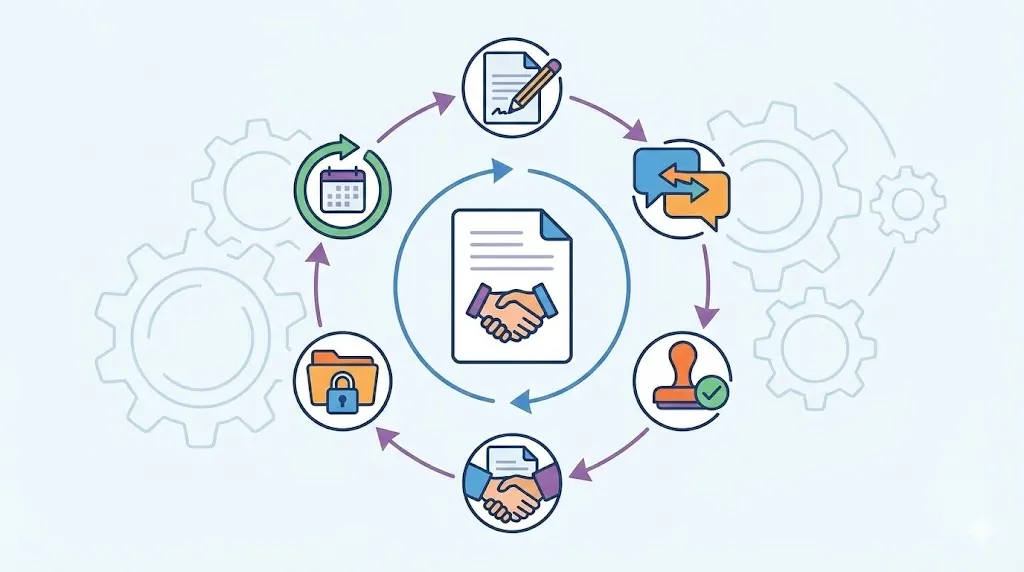
Here is a step-by-step look at how integrations typically function:
Data Mapping: Identify what contract data fields correspond between systems. For example, the customer field in the CLM corresponds to the account field within the CRM.
Trigger Setup: Define events that start data exchange. A new contract draft might trigger an update to the CRM opportunity record.
Data Transfer: When triggered, the integration sends data from one system to another securely and in real time or scheduled batches.
Status Syncing: Contract status updates (draft, review, signed) sync back to connected platforms so all teams see current information.
Error Handling: The integration monitors for failed transfers or conflicts and alerts users to resolve issues.
Audit Logging: Every sync and update is logged for compliance and troubleshooting.
For example, when a sales rep creates a contract within the CLM platform, the integration automatically updates the related deal record in the CRM with contract status and key dates. When the contract is signed, the finance system receives payment terms and renewal alerts.
Related articles: How to Choose the Right CLM Software: A Practical Guide
5 Common CLM Software Integrations and Their Benefits
1. CRM Integrations (Salesforce, HubSpot, Microsoft Dynamics)
CRM systems hold customer and deal data critical to contracts. Connecting a CLM system with CRM platforms enables the following capabilities:
Contract templates can be automatically populated using customer information.
Contracts integrate directly with sales opportunities, enhancing tracking efficiency.
It becomes feasible to observe contract statuses alongside the advancement of deals.
The system can trigger contract creation as deals reach designated stages.
Contract renewal dates are synchronized with CRM-based reminders.
This reduces duplicate data entry and gives sales teams instant contract visibility without leaving their CRM.
2. Email Platforms (Outlook, Gmail)
Email remains a primary communication channel for contract negotiation and approvals. Integrations with email tools enable:
Contracts and their attachments sent via email are captured seamlessly by the CLM platform.
Contract drafts or approval requests may be sent directly through email from the CLM interface.
Responses and approvals received via email are logged in the associated contract files.
Users are alerted to pending email replies and any delays in approval workflows.
This organization ensures contract communications stay properly linked to relevant records.
3. Cloud Storage Services (Google Drive, OneDrive, Dropbox)
Many organizations maintain their contracts and associated documents within cloud storage solutions. Integrating CLM with cloud storage allows:
Contract files become accessible in a unified location via the CLM platform.
Furthermore, version control is synchronized continuously between cloud directories and the CLM software.
Contracts benefit from secure backups coupled with thorough version management.
External partners can access contracts conveniently through shared cloud links.
This prevents file duplication and ensures everyone works on the latest contract version.
4. Collaboration Tools (Slack, Microsoft Teams)
Collaboration apps facilitate real-time communication and teamwork. Integrations with these tools help:
Contract status updates and alerts are posted directly to team channels.
Team members can contribute contract review feedback and approve contracts within chat conversations.
Also, links to contract documents are provided for immediate reference during discussions.
Reminders for contract deadlines and approvals are dispatched automatically.
This consolidates contract discussions and accelerates decision-making.
5. E-Signature Platforms (DocuSign, Adobe Sign)
Electronic signature tools are essential for finalizing contracts. Integrations provide the capability to:
Dispatch contracts for signature without exiting the CLM environment.
Monitor signature workflows in real time to track progress and completion.
Store executed contracts directly in the CLM repository without manual intervention.
Launch subsequent processes such as obligation management immediately after signing.
These features reduce delays and minimize manual follow-up after contract signing.
Related articles: Benefits of using CLM Software for Transportation Industry
How CLM Software Integrations Archives Improve Contract Management
Integrations archives organize and document all your CLM connections in one place. This brings several advantages:
Clear Overview: Teams see what tools connect to the CLM and how data flows. This helps identify gaps or redundant links.
Simplified Troubleshooting: Archives serve as a diagnostic resource, enabling precise identification of the problematic integration or data field when synchronization issues occur.
Faster Onboarding: By consulting the archive, new team members or IT personnel can rapidly familiarize themselves with the contract ecosystem and the specifics of the integration architecture.
Better Change Management: The archive maintains a comprehensive record of integration updates and modifications, facilitating transparent communication among all stakeholders.
Compliance Support: Maintaining an audit trail of integrations helps meet regulatory requirements and internal policies.
Scalability: As your business grows, archives make it easier to add or modify integrations without disrupting workflows.
For example, a legal operations manager can use the integrations archive to review all active connections before upgrading the CLM software. This prevents unexpected downtime or data loss.
Related articles: Leading CLM Solutions for the Energy Sector in 2026
4 Challenges in Maintaining CLM Software Integrations Archives
Maintaining these archives requires ongoing attention. Common challenges include:
Keeping Documentation Current
Integrations evolve as business needs change. Without regular updates, archives become outdated and unreliable. Teams must schedule periodic reviews to refresh documentation.
Managing Multiple Integration Types
Because different tools utilize a range of connection methods—such as APIs, middleware, and custom scripts—the complexity of consolidating these into a single archive is significant and demands specialized technical knowledge.
Ensuring Data Consistency
Variations in data formats and field mappings across systems necessitate comprehensive documentation within the archive to prevent synchronization errors and discrepancies.
Handling Security and Access Controls
Given the sensitivity of contract data involved in integrations, it is critical that archives document specific security measures, including detailed access controls and encryption protocols.
Effectively addressing these challenges requires close collaboration among legal, IT, and operations teams, each contributing their expertise to maintain integrity and security.
Establishing well-defined roles and responsibilities lays the foundation for reliable and secure management of integration archives.
Further reading: How to Choose the Right CLM Software: A Practical Guide
Best Practices for Building and Using CLM Software Integrations Archives
Follow these steps to create and maintain effective integration archives:
Inventory All Integrations
List every connection between your CLM and other systems. Additionally, be sure to record tool names, integration types, synchronized data fields, and the business rationale behind each integration.
Document Data Flows and Mappings
Describe what data moves between systems and how fields correspond. Use diagrams or flowcharts for clarity.
Define Ownership and Responsibilities
Clearly designate team members who will oversee each integration. This approach ensures that documentation remains current and that accountability is well established.
Set Change Management Procedures
Implement a structured review and approval workflow for modifications to integrations, which helps prevent operational disruptions.
Use Centralized Documentation Tools
Maintain all integration archives within a single platform that facilitates easy access for stakeholders from legal, IT, and operations.
Monitor Integration Performance
Track sync success rates, errors, and delays. Use this data to improve reliability.
Train Teams on Archive Use
Ensure everyone understands how to access and interpret integration archives for troubleshooting or onboarding.
By following these practices, your organization can keep contract workflows smooth and data accurate.
Related articles: Benefits of using CLM Software for Transportation Industry
How CLM Software Solves This
Contract lifecycle management software connects your contracts seamlessly with the existing tools your teams rely on daily. Additionally, it facilitates the seamless exchange of data among CRM, email, cloud storage, and collaboration platforms. This process minimizes manual handoffs and preserves the accuracy of contract information across all integrated systems.
Modern CLM solutions offer features including AI-assisted contract drafting, optimized approval workflows, and real-time collaborative editing. They centralize contract storage with advanced search and version control. Connecting with widely used business applications guarantees your contract data remains synchronized and readily available.
Volody’s platform for managing contract lifecycles integrates these capabilities alongside AI-driven contract review, obligation tracking, and secure e-signature functionalities. Moreover, it also accommodates workflows across multiple teams and includes dashboards that provide actionable insights derived from contract data. This functionality supports collaboration among legal, sales, procurement, and finance teams.
> Need a more streamlined approach to contract management? Explore Volody's CLM Software.
FAQ
What types of systems typically integrate with CLM software?
CLM software usually integrates with CRM platforms, email services, cloud storage, collaboration tools, and e-signature providers. Furthermore, these linkages automate contract data flow and enhance transparency across teams.
How do integrations contribute to reducing contract cycle times?
By automating data synchronization and status updates across platforms, integrations remove the need for manual data entry and reduce delays during drafting, approval, and execution phases.
Can CLM integrations work with custom or legacy systems?
Yes, many CLM platforms support API connections or middleware that link to custom or older systems. Setting these up may demand technical expertise and ongoing support.
Also, what security risks do CLM integrations pose?
Also, integrations involve data exchange that must be encrypted and access-controlled. Poorly managed integrations can expose sensitive contract information or allow unauthorized changes.
How often should integration archives be updated?
Integration archives should be reviewed and updated at least quarterly or whenever new integrations are added or existing ones change.
What is the role of AI in CLM integrations?
Therefore, AI can assist by automatically extracting contract data, flagging risks, suggesting clauses, and summarizing contract terms. This enhances integration value by improving data quality and speed.
Therefore, how do integrations support compliance requirements?
They maintain consistency and completeness of contract data across systems, preserve detailed audit trails for all changes, and automate notifications for critical deadlines and obligations.
Are integrations difficult to set up?
Basic connections to commonly used tools often include prebuilt connectors. More advanced or custom integration scenarios typically require specialized technical resources and thorough planning.
What happens if an integration fails?
Consequently, most systems log errors and notify administrators. Teams should have processes to quickly identify and fix integration issues to avoid data gaps.
Can integrations improve collaboration between legal and business teams?
Yes, integrations allow contract data and status to be shared in tools each team uses, enabling faster reviews, approvals, and communication.
This article explains how CLM software integrations archives organize and optimize contract workflows by connecting contract management with essential business tools. Properly maintained archives reduce risk, speed processes, and enhance collaboration across departments. Using a modern CLM solution with strong integration support is key to managing contracts efficiently in complex enterprise environments.
About the Company

Volody AI CLM is an Agentic AI-powered Contract Lifecycle Management platform designed to eliminate manual contracting tasks, automate complex workflows, and deliver actionable insights. As a one-stop shop for all contract activities, it covers drafting, collaboration, negotiation, approvals, e-signature, compliance tracking, and renewals. Built with enterprise-grade security and no-code configuration, it meets the needs of the most complex global organizations. Volody AI CLM also includes AI-driven contract review and risk analysis, helping teams detect issues early and optimize terms. Trusted by Fortune 500 companies, high-growth startups, and government entities, it transforms contracts into strategic, data-driven business assets.




" height="216.72211px" id="FYO0bO80Y" transform="translate(3 6.105)" width="206.073px"/><path d="M 108.174 222 C 88.432 222 70.303 217.239 53.785 207.717 C 37.267 198.196 24.173 185.052 14.504 168.285 C 4.835 151.312 0 132.165 0 110.845 C 0 89.731 4.835 70.792 14.504 54.025 C 24.173 37.052 37.267 23.804 53.785 14.282 C 70.303 4.761 88.432 0 108.174 0 C 128.116 0 146.246 4.761 162.562 14.282 C 179.08 23.804 192.073 37.052 201.541 54.025 C 211.21 70.792 216.044 89.731 216.044 110.845 C 216.044 132.165 211.21 151.312 201.541 168.285 C 192.073 185.052 179.08 198.196 162.562 207.717 C 146.044 217.239 127.915 222 108.174 222 Z M 108.174 183.189 C 120.864 183.189 132.044 180.291 141.713 174.495 C 151.382 168.492 158.936 160.006 164.375 149.035 C 169.814 138.064 172.533 125.334 172.533 110.845 C 172.533 96.355 169.814 83.729 164.375 72.965 C 158.936 61.994 151.382 53.611 141.713 47.815 C 132.044 42.02 120.864 39.122 108.174 39.122 C 95.483 39.122 84.202 42.02 74.332 47.815 C 64.663 53.611 57.109 61.994 51.67 72.965 C 46.231 83.729 43.511 96.355 43.511 110.845 C 43.511 125.334 46.231 138.064 51.67 149.035 C 57.109 160.006 64.663 168.492 74.332 174.495 C 84.202 180.291 95.483 183.189 108.174 183.189 Z" fill="rgba(255, 255, 255, 0.12)" height="222px" id="aa1McFcE9" transform="translate(227.183 3)" width="216.04399999999998px"/><path d="M 42.302 182.257 L 111.799 182.257 L 111.799 216.722 L 0 216.722 L 0 0 L 42.302 0 Z" fill="rgba(255, 255, 255, 0.12)" height="216.72211px" id="yRq4AnrsX" transform="translate(477.721 6.105)" width="111.79899999999998px"/><path d="M 108.174 222 C 88.432 222 70.303 217.239 53.785 207.717 C 37.267 198.196 24.173 185.052 14.504 168.285 C 4.835 151.312 0 132.165 0 110.845 C 0 89.731 4.835 70.792 14.504 54.025 C 24.173 37.052 37.267 23.804 53.785 14.282 C 70.303 4.761 88.432 0 108.174 0 C 128.116 0 146.246 4.761 162.562 14.282 C 179.08 23.804 192.073 37.052 201.541 54.025 C 211.21 70.792 216.045 89.731 216.045 110.845 C 216.045 132.165 211.21 151.312 201.541 168.285 C 192.073 185.052 179.08 198.196 162.562 207.717 C 146.044 217.239 127.915 222 108.174 222 Z M 108.174 183.189 C 120.864 183.189 132.044 180.291 141.713 174.495 C 151.382 168.492 158.936 160.006 164.375 149.035 C 169.814 138.064 172.534 125.334 172.534 110.845 C 172.534 96.355 169.814 83.729 164.375 72.965 C 158.936 61.994 151.382 53.611 141.713 47.815 C 132.044 42.02 120.864 39.122 108.174 39.122 C 95.483 39.122 84.202 42.02 74.332 47.815 C 64.663 53.611 57.108 61.994 51.67 72.965 C 46.231 83.729 43.511 96.355 43.511 110.845 C 43.511 125.334 46.231 138.064 51.67 149.035 C 57.108 160.006 64.663 168.492 74.332 174.495 C 84.202 180.291 95.483 183.189 108.174 183.189 Z" fill="rgba(255, 255, 255, 0.12)" height="222px" id="mo8HQspQ0" transform="translate(609.155 3)" width="216.04500000000007px"/><path d="M 73.727 0 C 95.885 0 115.324 4.45 132.044 13.351 C 148.967 22.252 161.957 34.982 171.027 51.541 C 180.287 67.894 184.917 86.937 184.917 108.671 C 184.917 130.405 180.287 149.449 171.027 165.801 C 161.957 181.947 148.967 194.47 132.044 203.371 C 115.324 212.271 95.885 216.722 73.727 216.722 L 0 216.722 L 0 0 Z M 72.216 179.773 C 94.374 179.773 111.497 173.564 123.583 161.144 C 135.669 148.724 141.713 131.233 141.713 108.671 C 141.713 86.109 135.669 68.515 123.583 55.888 C 111.497 43.055 94.374 36.638 72.216 36.638 L 42.302 36.638 L 42.302 179.773 Z" fill="rgba(255, 255, 255, 0.12)" height="216.72211px" id="I3iXX5Hi_" transform="translate(859.693 6.105)" width="184.91699999999992px"/><path d="M 185.22 0 L 113.91 141.273 L 113.91 216.722 L 71.61 216.722 L 71.61 141.273 L 0 0 L 47.74 0 L 93.06 99.046 L 138.08 0 Z" fill="rgba(255, 255, 255, 0.12)" height="216.72211px" id="nzHyWC0_d" transform="translate(1061.78 6.105)" width="185.22000000000003px"/></svg>)