

Key Highlights
Contract terms are the specific provisions in legal agreements that outline the rights and duties of each party.
Understanding different types of terms, like conditions and warranties, is vital for effective contract management.
Key terms in a contract include express terms, which are explicitly stated, and implied terms, which are assumed by law or custom.
A contract clause is a specific section that details a particular obligation, such as confidentiality or payment.
Poorly drafted terms can lead to disputes, making clarity and precision essential for all business agreements.
Effective management of contract terms helps to limit risk and ensure all parties meet their obligations.
Introduction
Every business contract you sign is built on a foundation of specific contract terms. These provisions are the heart of your agreements, defining everything from payment schedules to performance expectations. A strong grasp of contract law and the terms within your agreements is not just a legal formality; it is a critical part of protecting your business, managing relationships, and avoiding costly disputes. Understanding these fundamentals helps you navigate the contracting process with confidence and secure better outcomes.
What Are Contract Terms?

Contract terms are the legally binding provisions that make up a contract. They detail the rights, responsibilities, and obligations of the parties involved in legal agreements. Essentially, these terms are the rules of the engagement that everyone agrees to follow.
When you enter the contracting process, each term serves a purpose, from defining the price to outlining what happens if a party fails to comply. Well-defined contract terms provide a clear framework, reduce ambiguity, and are fundamental to the enforceability of any agreement.
Definition and Role of Contract Terms
Contract terms are the specific details within an agreement that establish each party's contractual obligation. Think of them as the building blocks of a contract, defining exactly what each side must do, provide, or refrain from doing. The terms of a contract can cover anything from delivery dates and quality standards to payment schedules and confidentiality rules.
Their primary role is to create a clear and enforceable set of expectations. By setting out these provisions, you remove doubt and provide a roadmap for the business relationship. Each term gives the parties specific rights and imposes corresponding duties.
If a party does not adhere to one of these terms, it can lead to a breach of contract. Therefore, these provisions are crucial for ensuring that the intentions of all parties are accurately recorded and legally protected throughout the agreement's lifecycle.
Why Contract Terms Matter in Legal Agreements
The importance of contract terms in legal agreements cannot be overstated. They are your primary tool for mitigating risk and preventing misunderstandings that can escalate into serious contract disputes. Clear, well-drafted terms ensure that all parties have a shared understanding of their commitments, which fosters stronger business relationships.
Without precise terms, agreements are left open to interpretation, which can cause significant problems down the line. Ambiguity is a common source of conflict, potentially leading to damaged partnerships and expensive legal action. Properly defined terms protect your interests and provide a solid foundation for your transactions.
Ultimately, effective contract management relies on the clarity and strength of your contract terms. They provide the legal framework to enforce promises and offer remedies if things go wrong, making them essential for any business seeking to operate securely and efficiently.
Essential Elements of Valid Contract Terms

For the terms of a contract to be legally enforceable, the contract itself must contain several key elements. According to contract law, these essential components validate the agreement and ensure that the commitments within it can be upheld in court.
Understanding these fundamentals is crucial, as a missing element can render an entire agreement void. The main pillars that support valid contract terms include a clear offer and acceptance, consideration, and an intention to create legal relations. We will explore each of these below.
Offer and Acceptance
The first step in forming a legally binding contract is a clear offer made by one party to another. The offer is a definite promise to be bound by specific terms, such as selling a product for a set price. It must be communicated clearly, leaving no room for misunderstanding.
For a contract to be formed, the other party must provide an unconditional acceptance of that offer. This means agreeing to all the proposed terms without any changes. If the party tries to vary the terms, it is considered a counter-offer, not an acceptance, and the original offer is voided.
Once a valid offer is met with a clear acceptance, an agreement is created. This moment is a critical stage in the contract lifecycle, as it establishes the mutual consent needed to move forward with a binding arrangement.
Consideration
Consideration is a fundamental concept in contract law, representing the value that each party exchanges. It is often described as "something for something." This value does not have to be money; it can be a promise to perform a service, deliver goods, or even refrain from doing something.
Without consideration from both sides, a contract is generally not enforceable. For example, if one party promises to give another a gift, it is not a contract because the receiving party has not provided anything of value in return. This element ensures that the agreement is a two-way street, where each side has a stake in the outcome.
Consideration is what distinguishes a contractual obligation from a gratuitous promise. It underpins the financial obligations and other commitments within the agreement, confirming that both parties are giving up something to create a legally binding deal.
Intention to Create Legal Relations
For a contract to be valid, all parties must intend for their agreement to have legal consequences. This means they understand and accept that if they fail to uphold their promises, they could face legal action. This principle helps distinguish serious business agreements from casual or social arrangements.
In commercial dealings, there is a strong presumption that the parties intend to create legal relations. This assumption is based on the understanding that businesses operate in good faith and expect their agreements to be binding. The contract terms are not just suggestions but carry a weight of legal responsibility.
This intention is a cornerstone of the entire agreement, ensuring that all parties take their commitments seriously. Effective contract lifecycle management depends on this shared understanding, as it confirms that the agreement is meant to be enforceable from the outset.
Main Types of Contract Terms in Business Contracts

In business agreements, contract terms can be categorised in several ways. The most common distinction is between express terms and implied terms. Understanding this difference is essential for interpreting your obligations and rights correctly.
Furthermore, terms are also classified by their importance, such as conditions, warranties, and innominate terms. This classification determines the remedies available if a term is breached. Using contract management software can help you track these different types of terms and manage your business agreements more effectively.
Express Terms
Express terms are the provisions that have been specifically stated and agreed upon by the parties, either in writing or orally. These are the terms that are explicitly laid out in the contract document, leaving little room for doubt about what is expected.
When drafting a contract, express terms are used to define the core obligations, such as the scope of work, payment amounts, and delivery schedules. Their clarity is crucial for achieving the purpose of the contract, as they directly articulate the mutual understanding between the parties.
Because they are clearly documented and negotiated, express terms are the most straightforward provisions to enforce. The terms of a contract should always be written as unambiguously as possible to ensure that these explicit promises are easy to understand and follow.
Implied Terms
An implied term is a provision that is not explicitly stated in a contract but is considered part of the agreement anyway. These terms are introduced into contracts by law or through custom and practice. They are assumed to be included because they are obvious or necessary for the contract to function properly.
Terms can be implied by statute, such as those found in consumer protection laws that guarantee goods are of satisfactory quality. This ensures a baseline level of protection for buyers even if the contract does not mention it. Other terms are implied for business efficacy, meaning they are necessary to make the contract workable.
Courts are generally cautious about implying terms into a contract, doing so only when it is essential. The idea is not to rewrite the agreement but to fill in gaps with terms that the parties would have logically included had they thought about it.
Conditions, Warranties, and Innominate Terms
Contract terms are also classified based on their importance, which dictates the legal remedies available if a breach occurs. This classification is a key aspect of risk management and ensuring contract compliance.
The three main categories are conditions, warranties, and innominate terms. Understanding their differences is vital because a breach of each type has very different consequences for the terms of the contract.
Conditions: These are fundamental terms that go to the very heart of the contract. A breach of a condition is so serious that it allows the innocent party to terminate the contract and claim damages.
Warranties: These are less critical, secondary terms. A breach of a warranty only entitles the injured party to claim damages for any loss suffered; they cannot terminate the contract.
Innominate Terms: These terms are not clearly defined as either conditions or warranties. The remedy for a breach depends on its severity. If the breach is serious, it is treated like a breach of a condition. If it is minor, it is treated like a breach of a warranty.
Difference Between Contract Terms and Contract Clauses
While the phrases "contract terms" and "contract clauses" are often used interchangeably, there is a subtle but important distinction between them in legal agreements. Understanding this difference can help you draft and interpret contracts with greater precision.
In short, a contract clause is a specific section or provision within the contract document. Contract terms, on the other hand, represent the broader substance of the agreement, which is expressed through these clauses. Let’s explore this relationship more closely.
Understanding Terms vs. Clauses
In contract terminology, "terms" refer to the obligations and conditions that form the agreement as a whole. They are the conceptual promises and stipulations, like the "term of payment." A "clause" is the specific wording in the contract that articulates these terms. So, a payment clause sets out the specific terms of how and when payment is to be made.
Essentially, clauses are the building blocks used to construct the terms of the agreement. A single contract clause can contain multiple specific terms or details related to one aspect of the deal.
This table highlights the key differences:
Feature | Contract Terms | Contract Clauses |
|---|---|---|
Definition | The broader concepts, obligations, and conditions of the agreement. | The specific numbered paragraphs or sections in a contract document. |
Scope | A general concept covering the substance of the promises. | A detailed provision that articulates a specific part of the agreement. |
Example | The agreement has a term of confidentiality. | The "Confidentiality Clause" (e.g., Clause 7) details what is confidential and for how long. |
Usage in Commercial Contract Drafting
During the commercial contract drafting process, legal teams focus on crafting precise clauses to accurately reflect the agreed-upon terms. Each clause is carefully constructed to address a specific aspect of the transaction, such as liability, payment, or termination. The goal is to leave no ambiguity.
For example, when negotiating a commercial contract, parties will discuss the terms of payment. The legal team then translates this discussion into a detailed "Payment Clause," specifying the exact amounts, due dates, and penalties for late payment. This clause makes the abstract term of payment concrete and enforceable.
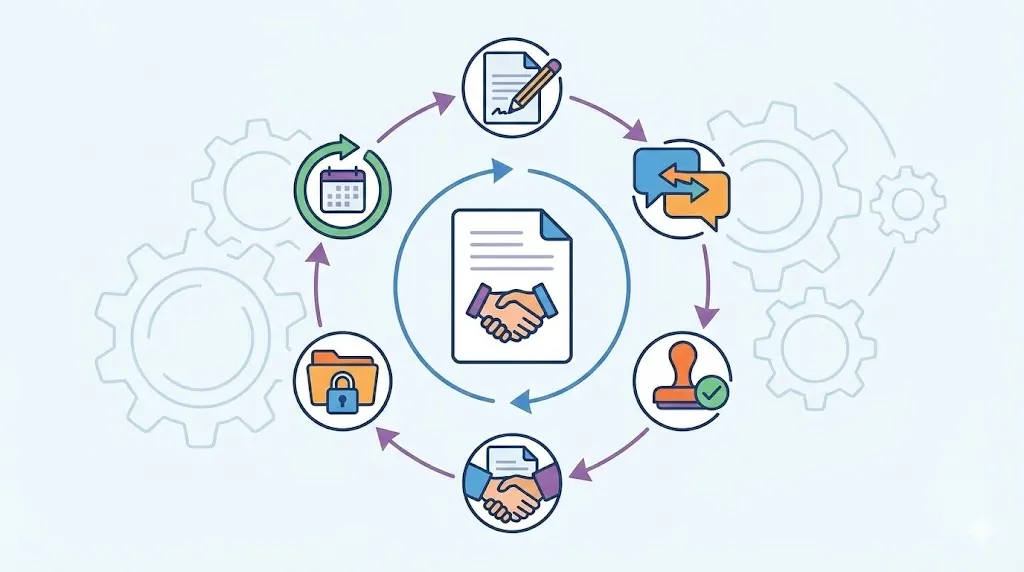
Throughout the contract lifecycle, from creation to renewal, the clarity of these clauses is paramount. Well-drafted clauses ensure that all parties understand their rights and obligations, which helps streamline the contracting process and prevents disputes later on.
Related Article: Mastering Contract Clauses: Risk & Performance
Common Examples of Contract Terms

Every contract is unique, but most business agreements include a set of common contract terms. These standard provisions address predictable issues and are essential for good contract management. They help clarify each party's contractual obligation and manage expectations throughout the contract lifecycle.
Familiarising yourself with these common terms will help you review contracts more effectively and ensure your agreements are comprehensive. Below, we look at some of the most frequently encountered examples in commercial contracts.
Confidentiality Obligations
A confidentiality clause is one of the most common and critical terms in business agreements. Its purpose is to protect sensitive information shared between parties during a business relationship. This provision legally requires one or both parties to keep certain information private and not disclose it to third parties.
The clause defines what constitutes confidential information, which can include a wide range of data. Properly defining this is key to protecting valuable business assets like trade secrets and intellectual property.
A confidentiality clause typically applies to:
Financial data and business strategies.
Customer lists and supplier details.
Proprietary software, formulas, or designs.
Any information marked or identified as "confidential."
Payment Terms and Deadlines
Clearly defined payment terms are essential for any business contract involving the exchange of money. These terms outline the specific financial obligations of the buyer, ensuring that the seller gets paid correctly and on time. Vague payment terms are a common cause of disputes and can negatively impact your cash flow.
A strong payment clause will specify all the necessary details to avoid confusion. This includes not just the amount due but also the method and timing of payments. Being precise helps manage financial expectations and maintains a healthy business relationship.
A comprehensive payment term in a business contract should detail:
The exact price and currency of the transaction.
The due date for each payment (e.g., within 30 days of invoice receipt).
Any penalties for late payments, such as interest charges.
Delivery and Performance Requirements
Delivery and performance requirements are contract obligations that specify how, when, and to what standard goods or services must be provided. These terms are crucial for setting clear expectations and ensuring that you receive exactly what you paid for.
Without clear performance requirements, it becomes difficult to hold a party accountable if their work is substandard or late. These terms serve as a benchmark against which performance can be measured throughout the contract's duration, making them a vital part of contract lifecycle management.
Key aspects to define in these terms include:
Specific deadlines for delivery or project milestones.
Quality standards or specifications that the goods or services must meet.
The location and method of delivery.
Related Article: Mastering Contract Terms: Your Comprehensive Guide
Important Legal Terminology Related to Contract Terms
Legal agreements are often filled with contract terminology that can be confusing if you are not a legal professional. This legal jargon, however, serves a specific purpose in defining the rights and obligations of the parties with precision.
Understanding some of the most important legal terms will empower you to review contracts more effectively and grasp the full extent of your commitments. Let's break down a few key examples that frequently appear in business contracts.
Force Majeure
A force majeure clause is a provision that frees parties from liability if they are unable to fulfil their contractual obligations due to unforeseen events beyond their control. The term "force majeure" is French for "superior force."
These events typically include natural disasters like floods or earthquakes, as well as other major disruptions such as wars, pandemics, or government actions. The clause lists the specific types of events that will trigger its protections. If such an event occurs, performance of the contract may be suspended or, in some cases, lead to contract termination.
This clause is designed to protect parties from being in breach of contract for circumstances they could not have reasonably anticipated or prevented. Without it, a party could be held responsible for non-performance even if it was impossible for them to act.
Indemnity and Liability
An indemnity clause is a contractual promise by one party (the indemnifying party) to compensate another party (the indemnified party) for specific losses or damages they might suffer. This term effectively shifts the financial risk for certain events from one party to another.
For example, a supplier might agree to indemnify a retailer against any losses arising from lawsuits related to intellectual property infringement by the supplier's product. If a lawsuit occurs, the supplier (the breaching party in this context) would cover the retailer's legal costs and any damages awarded.
Liability refers to legal responsibility. Indemnity clauses are a way to manage and allocate liability between the parties. They are heavily negotiated because they directly impact the financial exposure of the aggrieved party and the party at fault.
Governing Law and Jurisdiction
A governing law and jurisdiction clause specifies which legal system will be used to interpret the contract and which courts will have the authority to settle any disputes. This is one of the most important clauses in any agreement, especially those involving parties from different countries or states.
The choice of law determines which country's or state's laws will apply to the contract. This is crucial because laws can vary significantly, affecting how the contract is enforced. The jurisdiction clause names the specific location (e.g., "the courts of England and Wales") where any court proceedings must take place.
By agreeing to these terms upfront, parties create certainty and avoid costly preliminary legal battles over where to resolve a dispute. This clause ensures a clear path for legal resolution if disagreements arise.
Contract Terms Every Business Should Know
While all contract terms are important, some carry more weight and have a greater impact on your business agreements. As part of your contract management process, you should pay special attention to a handful of critical provisions before signing any document.
These key contract terms govern how the relationship ends, how disputes are handled, and what happens when things go wrong. Understanding them is essential for protecting your interests and managing risk effectively.
Termination Provisions
Termination clauses are vital because they define how and when a contract can be brought to an end. Business circumstances can change, and these provisions provide a clear exit strategy, reducing the risk of being locked into an unfavourable agreement.
These clauses outline the specific grounds for contract termination, ensuring that if one party needs to end the relationship, they can do so without facing a lawsuit for breach of contract, provided they follow the agreed-upon procedure. Having these clauses clearly documented in your contract repository is crucial.
Common grounds for termination include:
Termination for Cause: Allows a party to terminate if the other party breaches a material term of the contract.
Termination for Convenience: Allows a party to end the contract for any reason, usually with a specified notice period and potentially a fee.
Termination upon a specific event: Such as the insolvency or bankruptcy of one party.
Dispute Resolution Mechanisms
A dispute resolution clause specifies the process that parties must follow if a disagreement arises. This term is incredibly important because it can help you avoid lengthy and expensive court proceedings. By agreeing on a mechanism in advance, you can handle conflicts more efficiently.
Many contracts now favour alternative dispute resolution (ADR) methods, which are often faster and less confrontational than traditional legal action. This clause provides a structured path to resolving issues while potentially preserving the business relationship.
Common dispute resolution mechanisms include:
Negotiation: A requirement for parties to first attempt to resolve the dispute in good faith among themselves.
Mediation: Involving a neutral third-party mediator to help facilitate a mutually acceptable solution.
Arbitration: A more formal process where a neutral arbitrator hears both sides and makes a binding decision.
Best Practices for Drafting Clear Contract Terms

Drafting clear and effective contract terms is a foundational element of good contract management. The quality of your contract language directly impacts its enforceability and your ability to ensure contract compliance. Ambiguous terms can lead to conflicts and undermine the entire agreement.
By following a few best practices, you can create contracts that are easy to understand, align with your goals, and legally robust. The following guidelines will help you improve your drafting process and minimise risks.
Using Plain Language
One of the most effective best practices is to use plain language whenever possible. While some legal jargon is unavoidable, overly complex or archaic language can create confusion and hide the true meaning of a clause. The goal is to set clear expectations that all parties can understand without needing a lawyer to translate.
Clarity reduces the risk of misinterpretation and future disputes. If everyone involved knows exactly what is expected of them, they are more likely to comply with the terms. Plain language makes your contracts more accessible and transparent.
When drafting, try to:
Use short, simple sentences.
Define any technical or industry-specific terms.
Avoid vague words like "reasonable" without defining what they mean in context.
Aligning with Business Goals
Every contract you sign should serve a strategic purpose. Before drafting, it is essential to identify your key business goals for the agreement. Are you trying to secure a long-term supply, reduce costs, or enter a new market? The terms of the contract should be crafted to help you achieve these objectives.
Each contracting party will have its own priorities. A successful negotiation involves finding a balance where the contract terms support the business relationships and offer mutual benefits. The agreement should be a tool that helps both sides succeed, not just a list of restrictive rules.
Modern contract management software can help with this alignment by providing templates and clause libraries designed to support common business goals. This ensures consistency and helps you create agreements that actively contribute to your company's success.
Reviewing Terms with Legal Experts
Even with the best drafting practices, it is always wise to have contracts reviewed by legal experts. Your legal teams have the training to spot potential risks, ambiguities, or unenforceable clauses that you might miss. This review is a critical step in risk management.
A legal professional can ensure your contract is not only clear but also legally sound and provides adequate protection for your business. They can advise on the latest regulations and help you achieve contract compliance, saving you from costly legal issues in the future.
When working with legal experts, be sure to:
Clearly explain your business goals for the contract.
Highlight any terms you are particularly concerned about.
Ask for clarification on any legal language you do not understand.
Related Article: How to Manage Contracts Efficiently: Best Practices
Conclusion
In conclusion, understanding contract terms is crucial for anyone entering into legal agreements, whether in business or personal matters. A comprehensive grasp of key elements such as offer and acceptance, consideration, and the distinctions between express and implied terms can safeguard your interests and promote transparency. By adhering to best practices, such as using plain language and consulting legal experts, you can ensure that your contracts are clear and enforceable. Ultimately, being well-informed about contract terms not only protects your rights but also enhances your ability to navigate complex agreements confidently. If you're looking for personalised guidance in reviewing or drafting your contracts, don’t hesitate to reach out for a free consultation.
Frequently Asked Questions
What is the difference between express and implied contract terms?
Express terms are provisions that are explicitly stated and agreed upon by the parties, either in writing or orally. An implied term, in contrast, is not written in the contract but is assumed to be part of the agreement by contract law or custom, such as the expectation of business efficacy.
Which contract terms should be reviewed before signing a business contract?
Before signing a business contract, always review the termination clauses, payment terms, liability and indemnity provisions, and dispute resolution mechanisms. These terms carry significant financial and legal risk, so ensuring they align with your interests is crucial for contract compliance and effective contract management.
Are there any checklists for reviewing contract terms?
Yes, many legal teams and contract lifecycle management systems use a contract checklist to ensure consistency and contract compliance. These checklists guide reviewers through critical terms, helping to identify risks, confirm alignment with business goals, and apply best practices before a contract is finalised and signed.
About the Company

Volody AI CLM is an Agentic AI-powered Contract Lifecycle Management platform designed to eliminate manual contracting tasks, automate complex workflows, and deliver actionable insights. As a one-stop shop for all contract activities, it covers drafting, collaboration, negotiation, approvals, e-signature, compliance tracking, and renewals. Built with enterprise-grade security and no-code configuration, it meets the needs of the most complex global organizations. Volody AI CLM also includes AI-driven contract review and risk analysis, helping teams detect issues early and optimize terms. Trusted by Fortune 500 companies, high-growth startups, and government entities, it transforms contracts into strategic, data-driven business assets.




" height="216.72211px" id="FYO0bO80Y" transform="translate(3 6.105)" width="206.073px"/><path d="M 108.174 222 C 88.432 222 70.303 217.239 53.785 207.717 C 37.267 198.196 24.173 185.052 14.504 168.285 C 4.835 151.312 0 132.165 0 110.845 C 0 89.731 4.835 70.792 14.504 54.025 C 24.173 37.052 37.267 23.804 53.785 14.282 C 70.303 4.761 88.432 0 108.174 0 C 128.116 0 146.246 4.761 162.562 14.282 C 179.08 23.804 192.073 37.052 201.541 54.025 C 211.21 70.792 216.044 89.731 216.044 110.845 C 216.044 132.165 211.21 151.312 201.541 168.285 C 192.073 185.052 179.08 198.196 162.562 207.717 C 146.044 217.239 127.915 222 108.174 222 Z M 108.174 183.189 C 120.864 183.189 132.044 180.291 141.713 174.495 C 151.382 168.492 158.936 160.006 164.375 149.035 C 169.814 138.064 172.533 125.334 172.533 110.845 C 172.533 96.355 169.814 83.729 164.375 72.965 C 158.936 61.994 151.382 53.611 141.713 47.815 C 132.044 42.02 120.864 39.122 108.174 39.122 C 95.483 39.122 84.202 42.02 74.332 47.815 C 64.663 53.611 57.109 61.994 51.67 72.965 C 46.231 83.729 43.511 96.355 43.511 110.845 C 43.511 125.334 46.231 138.064 51.67 149.035 C 57.109 160.006 64.663 168.492 74.332 174.495 C 84.202 180.291 95.483 183.189 108.174 183.189 Z" fill="rgba(255, 255, 255, 0.12)" height="222px" id="aa1McFcE9" transform="translate(227.183 3)" width="216.04399999999998px"/><path d="M 42.302 182.257 L 111.799 182.257 L 111.799 216.722 L 0 216.722 L 0 0 L 42.302 0 Z" fill="rgba(255, 255, 255, 0.12)" height="216.72211px" id="yRq4AnrsX" transform="translate(477.721 6.105)" width="111.79899999999998px"/><path d="M 108.174 222 C 88.432 222 70.303 217.239 53.785 207.717 C 37.267 198.196 24.173 185.052 14.504 168.285 C 4.835 151.312 0 132.165 0 110.845 C 0 89.731 4.835 70.792 14.504 54.025 C 24.173 37.052 37.267 23.804 53.785 14.282 C 70.303 4.761 88.432 0 108.174 0 C 128.116 0 146.246 4.761 162.562 14.282 C 179.08 23.804 192.073 37.052 201.541 54.025 C 211.21 70.792 216.045 89.731 216.045 110.845 C 216.045 132.165 211.21 151.312 201.541 168.285 C 192.073 185.052 179.08 198.196 162.562 207.717 C 146.044 217.239 127.915 222 108.174 222 Z M 108.174 183.189 C 120.864 183.189 132.044 180.291 141.713 174.495 C 151.382 168.492 158.936 160.006 164.375 149.035 C 169.814 138.064 172.534 125.334 172.534 110.845 C 172.534 96.355 169.814 83.729 164.375 72.965 C 158.936 61.994 151.382 53.611 141.713 47.815 C 132.044 42.02 120.864 39.122 108.174 39.122 C 95.483 39.122 84.202 42.02 74.332 47.815 C 64.663 53.611 57.108 61.994 51.67 72.965 C 46.231 83.729 43.511 96.355 43.511 110.845 C 43.511 125.334 46.231 138.064 51.67 149.035 C 57.108 160.006 64.663 168.492 74.332 174.495 C 84.202 180.291 95.483 183.189 108.174 183.189 Z" fill="rgba(255, 255, 255, 0.12)" height="222px" id="mo8HQspQ0" transform="translate(609.155 3)" width="216.04500000000007px"/><path d="M 73.727 0 C 95.885 0 115.324 4.45 132.044 13.351 C 148.967 22.252 161.957 34.982 171.027 51.541 C 180.287 67.894 184.917 86.937 184.917 108.671 C 184.917 130.405 180.287 149.449 171.027 165.801 C 161.957 181.947 148.967 194.47 132.044 203.371 C 115.324 212.271 95.885 216.722 73.727 216.722 L 0 216.722 L 0 0 Z M 72.216 179.773 C 94.374 179.773 111.497 173.564 123.583 161.144 C 135.669 148.724 141.713 131.233 141.713 108.671 C 141.713 86.109 135.669 68.515 123.583 55.888 C 111.497 43.055 94.374 36.638 72.216 36.638 L 42.302 36.638 L 42.302 179.773 Z" fill="rgba(255, 255, 255, 0.12)" height="216.72211px" id="I3iXX5Hi_" transform="translate(859.693 6.105)" width="184.91699999999992px"/><path d="M 185.22 0 L 113.91 141.273 L 113.91 216.722 L 71.61 216.722 L 71.61 141.273 L 0 0 L 47.74 0 L 93.06 99.046 L 138.08 0 Z" fill="rgba(255, 255, 255, 0.12)" height="216.72211px" id="nzHyWC0_d" transform="translate(1061.78 6.105)" width="185.22000000000003px"/></svg>)